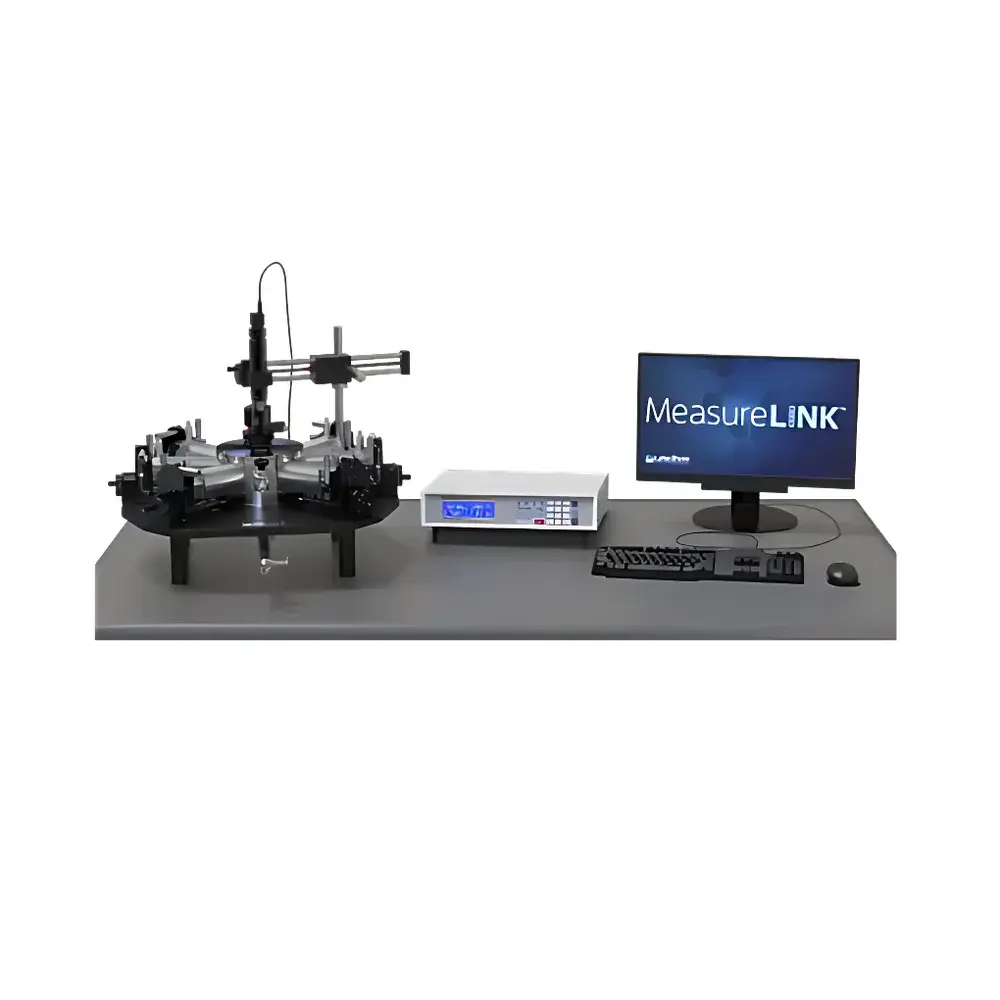
Lake Shore TTPX Desktop Cryogenic Probe Station
| Brand | Lake Shore |
|---|---|
| Origin | USA |
| Manufacturer Status | Authorized Distributor |
| Product Origin | Imported |
| Model | TTPX |
| Pricing | Upon Request |
Overview
The Lake Shore TTPX Desktop Cryogenic Probe Station is a compact, high-performance cryogenic measurement platform engineered for low-temperature electrical, optical, and microwave characterization of semiconductor devices, thin-film materials, and nanostructures. Utilizing a continuous-flow cryogenic system compatible with liquid helium (LHe) and liquid nitrogen (LN₂), the TTPX achieves stable operation across a broad thermal range—from 3.2 K (with optional PS-LT stage) to 675 K (with PS-HTSTAGE)—enabling precise thermally controlled experiments under ultra-high vacuum (UHV) conditions. Its modular architecture integrates seamlessly with standard laboratory infrastructure while maintaining sub-30 nm mechanical stability (with PS-PVIS vibration isolation option), making it suitable for sensitive DC/RF I-V, C-V, Hall effect, photoluminescence, and millimeter-wave measurements. Designed specifically for academic labs, R&D centers, and process development teams, the TTPX balances scientific rigor with operational accessibility—offering full compatibility with industry-standard probe cards, coaxial cables, and optical fiber feedthroughs.
Key Features
- Continuous-flow cryogenic operation: 4.3 K base temperature (standard), extendable to 3.2 K (PS-LT) or 675 K (PS-HTSTAGE)
- Ultra-stable thermal control: ±15 mK stability at <10 K (LHe mode); ±50 mK up to 675 K (HT mode)
- High-vacuum performance: Base pressure <1 × 10⁻⁵ Torr at 4.3 K; <5 × 10⁻⁴ Torr at room temperature using TPS-FRG turbomolecular pump package
- Compact desktop footprint: Fits within standard lab bench space without dedicated floor mounting
- 2-inch (51 mm) sample capacity: Accommodates full wafers, diced dies, and custom substrates with optional backside optical access (5 mm clear aperture)
- Modular probe configuration: Supports up to six independently adjustable probe arms with integrated temperature monitoring and thermal anchoring
- Low-noise electrical interface: >100 GΩ DC insulation for ultra-low leakage current measurements
- RF/microwave readiness: DC–67 GHz capability with calibrated microwave probes and shielded RF feedthroughs
- Vibration mitigation: Standard <300 nm sample-stage RMS motion; optional PS-PVIS active/passive isolation reduces displacement to <30 nm RMS
Sample Compatibility & Compliance
The TTPX accommodates rigid and semi-rigid samples up to 51 mm in diameter—including Si, GaAs, InP, sapphire, quartz, and flexible polymer substrates—without requiring clamping-induced strain. Backside optical access enables transmission-mode spectroscopy (e.g., FTIR, ellipsometry) and photoluminescence excitation through the chuck. All vacuum and thermal interfaces conform to ISO-KF and CF-35 standards. The system supports GLP-compliant experimental logging when integrated with Lake Shore’s BlueBox™ software suite and meets mechanical and electrical safety requirements per UL 61010-1 and IEC 61000-6-3. Vacuum integrity and thermal calibration protocols align with ASTM E2847 (cryogenic thermometer calibration) and ISO/IEC 17025 traceability frameworks for metrology-grade instrumentation.
Software & Data Management
Control and data acquisition are managed via Lake Shore’s BlueBox™ software platform—a Windows-based application supporting synchronized temperature ramping, multi-channel voltage/current sourcing (via integrated or external SMUs), real-time parameter logging, and script-driven automation. BlueBox™ provides native export to CSV, HDF5, and MATLAB-compatible formats, with optional integration into LabVIEW, Python (PyVISA), and Keysight PathWave environments. Audit trails, user-level access control, and electronic signatures comply with FDA 21 CFR Part 11 requirements for regulated environments. Calibration data—including sensor coefficients, thermal time constants, and vacuum gauge linearity corrections—are stored in encrypted, tamper-evident metadata fields.
Applications
- Low-temperature transport characterization of 2D materials (graphene, TMDCs), topological insulators, and superconducting heterostructures
- Gate-controlled capacitance-voltage profiling of MOSCAPs and FinFET test structures
- Millimeter-wave S-parameter extraction for on-wafer RF device modeling (pHEMTs, HBTs, metamaterials)
- Electro-optic response mapping of photodetectors and modulators under variable thermal bias
- Thermoelectric property evaluation (Seebeck coefficient, thermal conductivity) via dual-heater differential techniques
- Fundamental defect spectroscopy using deep-level transient spectroscopy (DLTS) and admittance spectroscopy
- Reliability stress testing (HTGB, TDDB) under cryogenic and elevated temperature conditions
FAQ
What cooling media are supported by the TTPX?
Liquid helium (LHe) and liquid nitrogen (LN₂) are fully supported via standardized continuous-flow dewar interfaces. Optional closed-cycle refrigerator (CCR) integration is available through third-party OEM partnerships.
Can the TTPX be upgraded for magnetic field measurements?
Yes—optional annular superconducting magnets (up to 0.19 T) integrate directly with the cold stage and maintain field homogeneity over the 25.4 mm probe landing zone.
Is optical access limited to the sample backside?
Standard configuration includes a 5 mm diameter backside viewport. Frontside optical access is available via optional top-mounted lens tubes or collimated fiber bundles aligned to the probe plane.
How is thermal crosstalk between probe arms minimized?
Each probe arm features independent thermal anchoring to either the cold stage or radiation shield, with low-thermal-conductivity titanium flexures and guarded heater/sensor wiring to suppress conductive and radiative coupling.
Does the TTPX support automated wafer mapping?
While the base system lacks motorized X-Y-Z stages, it is fully compatible with third-party wafer probers (e.g., Cascade Microtech, MPI) via IEEE-488 (GPIB) and TCP/IP command sets for coordinated stage control and data correlation.