
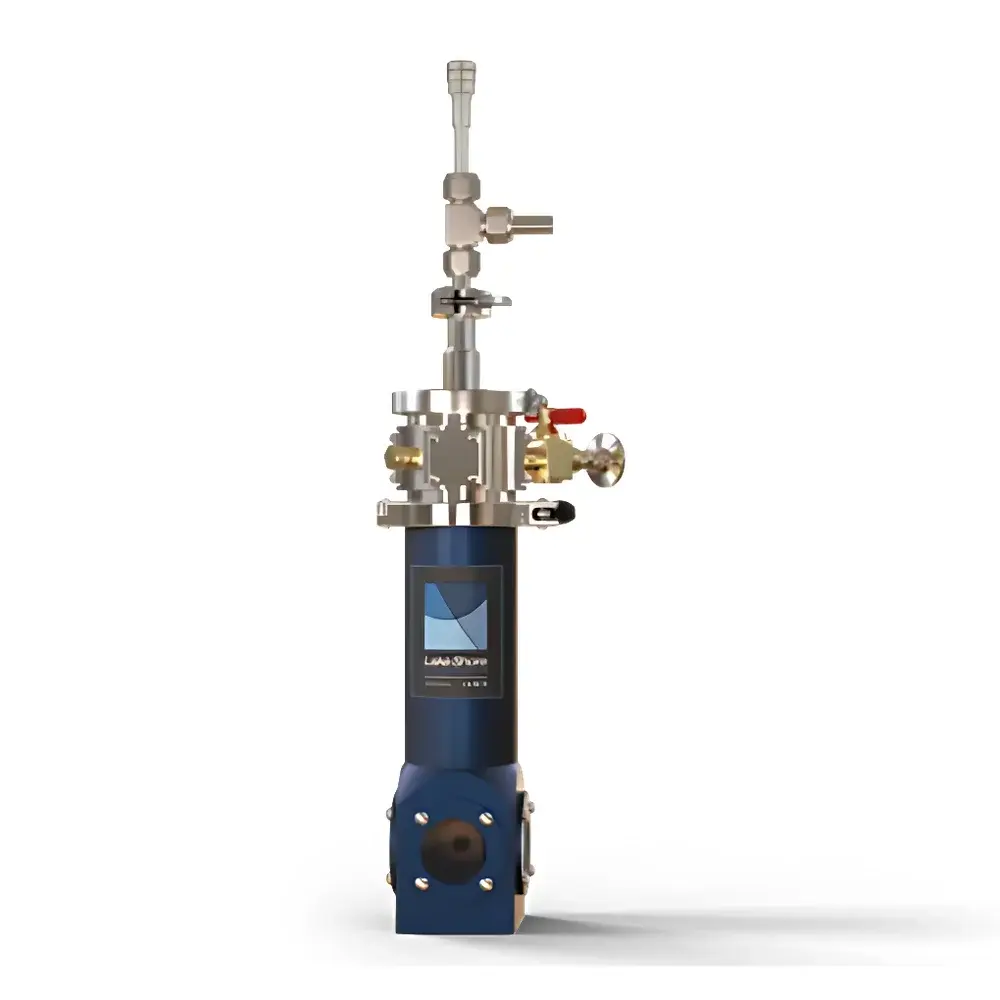
Lake Shore VPF-100 Optical Cryogenic Thermostat
| Brand | Lake Shore |
|---|---|
| Origin | USA |
| Manufacturer Status | Authorized Distributor |
| Origin Category | Imported |
| Model | VPF-100 |
| Quotation | Upon Request |
| Cooling Method | Liquid Nitrogen (LN₂) Fill |
| Temperature Range | 65 K to 500 K (VPF-100), 65 K to 800 K (VPF-100-H) |
| Typical Temperature Stability | ±50 mK |
| Sample Environment | High Vacuum (~10⁻⁴ Torr) |
| Sample Types | Conductive, Solid |
| Cool-down Time to 77 K | 15 min |
| LN₂ Hold Time at 77 K | 8 h (VPF-100), 5 h (VPF-100-H) |
| LN₂ Hold Time at 100 K | 4.5 h |
| LN₂ Hold Time at 200 K | 2.5 h |
| Optical Window | Standard |
| Height (approx.) | 583 mm |
| Sample Chamber Inner Diameter | 76.2 mm (VPF-100), 63.5 mm (VPF-100-H) |
| Sample Mounting Diameter | 31.75 mm |
| Net Weight (approx.) | 3.3 kg |
| Shipping Weight (approx.) | 9.1 kg |
| Shipping Dimensions (approx.) | 610 × 406 × 305 mm |
Overview
The Lake Shore VPF-100 Optical Cryogenic Thermostat is a vacuum-compatible, liquid nitrogen–cooled cryostat engineered for precision optical and electro-optical characterization of solid-state materials across a broad thermal range. Operating on the principle of direct-conduction cooling via a thermally anchored cold finger immersed in a refillable LN₂ reservoir, the VPF-100 achieves stable, controllable temperatures from 65 K up to 500 K (standard configuration) or 800 K (VPF-100-H high-temperature variant). Its all-metal, UHV-compatible construction ensures minimal outgassing and long-term vacuum integrity—critical for minimizing background interference in sensitive optical measurements such as photoluminescence (PL), Raman spectroscopy, Fourier-transform infrared (FTIR) absorption, and terahertz time-domain spectroscopy (THz-TDS). The sample chamber resides under high vacuum (~10⁻⁴ Torr), eliminating convective heat transfer and enabling high signal-to-noise ratio detection. Unlike closed-cycle cryocoolers, the VPF-100’s LN₂ fill architecture delivers rapid cooldown (≤15 minutes to 77 K), excellent thermal homogeneity, and predictable hold times—key advantages for labs requiring reproducible, non-vibrating thermal environments without compressor-generated mechanical noise or electromagnetic interference.
Key Features
- Vacuum-sealed optical dewar design with integrated LN₂ reservoir and automated fill port for safe, tool-free refilling without temperature perturbation
- Two standard configurations: VPF-100 (65–500 K) and VPF-100-H (65–800 K), both offering ±50 mK temperature stability over extended dwell periods
- Optimized optical access: configurable multi-wavelength window options spanning X-ray through THz (e.g., CaF₂, Si, Ge, ZnSe, polyethylene)
- Modular electrical feedthrough compatibility: supports DC, BNC, SMA, and triaxial connectors for low-noise transport measurements, including four-probe resistivity and Hall effect setups
- Interchangeable sample stages: optical mount, standard conductive mount, four-point probe mount, and plug-and-play mount—each designed for thermal uniformity and mechanical stability
- Compact footprint (610 × 406 × 305 mm shipping dimensions) and lightweight construction (3.3 kg net) facilitate integration into optical tables, confocal microscopes, and FTIR spectrometers
Sample Compatibility & Compliance
The VPF-100 accommodates conductive solid samples up to 31.75 mm in diameter, mounted directly onto thermally anchored stages that ensure efficient heat transfer and minimal thermal lag. Its vacuum environment eliminates oxidation and moisture contamination—essential for air-sensitive semiconductors, 2D materials (e.g., MoS₂, graphene), quantum dots, and superconducting thin films. All internal components comply with ASTM E1502 (Standard Guide for Use of Vacuum Desiccators) and ISO 20483 (Vacuum technology — Vocabulary), while vacuum integrity meets requirements for GLP-compliant material characterization workflows. Optional CryoComplete™ integration enables full system validation per IEC 61000-4-3 (EMC immunity) and NIST-traceable temperature calibration protocols.
Software & Data Management
When paired with Lake Shore’s CryoSoft™ control suite (v5.0+), the VPF-100 supports automated temperature ramping, PID parameter optimization, and real-time logging of sensor data (Cernox™ or RuO₂) with timestamped metadata export in CSV and HDF5 formats. The software architecture conforms to FDA 21 CFR Part 11 requirements when deployed with electronic signature modules and audit trail logging—enabling compliance in regulated QC/QA environments. Remote operation via Ethernet or USB-C allows integration into LabVIEW™, Python (PyVISA), or MATLAB® automation frameworks, supporting synchronized acquisition with spectrometers, lock-in amplifiers, and CCD detectors.
Applications
- Temperature-dependent photoluminescence mapping of perovskite solar cell absorbers
- In-situ Raman spectroscopy of strain-engineered van der Waals heterostructures
- FTIR transmission analysis of phonon modes in topological insulators (e.g., Bi₂Se₃)
- THz conductivity measurements of correlated electron systems under variable thermal bias
- Calibration of infrared detector responsivity across 77–300 K
- Low-temperature ellipsometry of dielectric function evolution in transition metal oxides
FAQ
What vacuum level is required before initiating cooling?
A base pressure of ≤10⁻⁴ Torr is recommended prior to filling LN₂ to minimize condensable gas accumulation and ensure thermal stability.
Can the VPF-100 be used with magnetic fields?
Yes—the non-magnetic stainless-steel construction and absence of ferromagnetic components make it compatible with external electromagnets and superconducting magnets up to 9 T (with appropriate field alignment).
Is the system compatible with ultra-high vacuum (UHV) systems?
While not UHV-rated by default, the VPF-100 can be upgraded with bakeable seals and all-metal gaskets to achieve ≤10⁻⁸ Torr base pressure upon integration with turbomolecular pumping stations.
How is temperature calibrated and traceable?
Each unit ships with factory-calibrated Cernox™ sensors; optional NIST-traceable calibration certificates are available for ISO/IEC 17025-accredited laboratories.
What support is provided for custom window or feedthrough configurations?
Lake Shore offers engineering consultation and custom machining services—including threaded optical mounts, differential pumping ports, and hermetic fiber feedthroughs—for application-specific integration.
Related Products



