
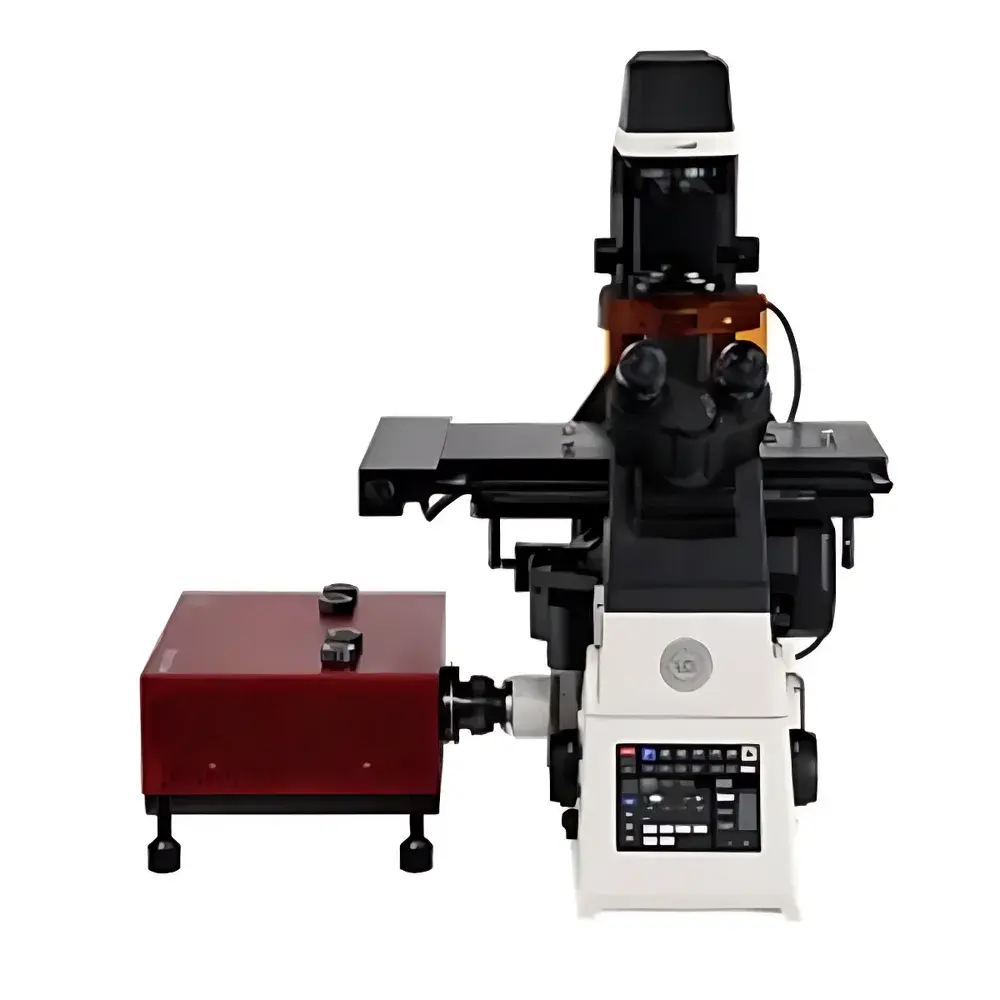
LCI QUADSCAN Confocal Microscopy System
| Brand | LCI / Live Cell Instrument |
|---|---|
| Origin | South Korea |
| Manufacturer Type | Authorized Distributor |
| Origin Category | Imported |
| Model | QUADSCAN |
| Pricing | Available Upon Request |
Overview
The LCI QUADSCAN Confocal Microscopy System is a high-performance, integrated platform engineered for quantitative live-cell imaging and multi-dimensional fluorescence analysis. Built upon classical point-scanning confocal optics—featuring a pinhole-based optical sectioning architecture—the system delivers intrinsic z-resolution without reliance on post-acquisition deconvolution. Its core optical design ensures that only in-focus fluorescence photons emitted from the objective’s focal plane pass through the confocal pinhole to reach the detector; out-of-focus light is physically rejected, yielding high-contrast, quantitatively reproducible optical sections. This principle underpins reliable 3D reconstruction, volumetric time-lapse (4D) acquisition, and precise subcellular signal quantification across diverse biological specimens—from fixed tissue sections to long-term (>72 h) cultured mammalian cells under physiological conditions.
Key Features
- Quad-channel simultaneous excitation & detection: Four independently optimized optical subunits support concurrent illumination and collection at 405 nm, 488 nm, 561 nm, and 638 nm—each with dedicated dichroic mirrors, emission filters, and PMT detectors—eliminating spectral crosstalk via physical optical isolation rather than software compensation.
- High-speed MEMS scanning: A resonant micro-electromechanical systems (MEMS) mirror operating at 29 kHz enables up to 76 frames per second (fps) at full FOV (25 mm), facilitating real-time observation of rapid dynamic processes such as Ca2+ transients, vesicle trafficking, and membrane remodeling.
- Low phototoxicity & photobleaching architecture: Short dwell time per pixel, combined with high quantum-efficiency PMTs and proprietary analog signal processing, minimizes cumulative light exposure—critical for maintaining cell viability during extended timelapse experiments.
- FOV-25 mm optical pathway: Large-diameter tube lens and high-fill-factor CMOS sensor support wide-field brightfield and fluorescence imaging at 25 mm field of view, compatible with specialized flat-field-corrected objectives delivering diffraction-limited resolution across the entire image plane.
- Adaptive Focus System (AFS): Real-time hardware-based focus stabilization compensates for thermal drift and mechanical vibration, enabling stable imaging over hours or days—even with high-NA oil-immersion objectives and demanding modalities including TIRF, super-resolution, and confocal.
- Integrated 5.6-inch touchscreen interface: Front-panel capacitive touchscreen provides intuitive control of acquisition parameters, environmental sensors, and workflow presets; physical knobs and buttons remain accessible for tactile operation in low-light environments.
Sample Compatibility & Compliance
The QUADSCAN accommodates standard glass-bottom dishes (e.g., MatTek, ibidi), multi-well plates (6–96-well), and custom chambered slides. It supports ambient, heated (up to 40 °C), and CO2-controlled incubation environments via optional stage-top or enclosure-based live-cell modules. All optical components comply with ISO 10110 standards for surface quality and wavefront error. The system meets IEC 61000-6-3 (EMC emissions) and IEC 61000-6-2 (immunity) requirements. Data acquisition and storage workflows are compatible with GLP/GMP-aligned documentation practices, and QuadVue software supports audit-trail logging per FDA 21 CFR Part 11 when deployed with validated IT infrastructure.
Software & Data Management
QuadVue is a modular, open-architecture software suite comprising four tightly integrated components: Acquisition, Visualization, Restoration, and Quantitation. QuadVue Acquisition offers drag-and-drop protocol building for 2D–4D experiments—including multi-position, multi-timepoint, multi-channel, and multi-z acquisitions—with hardware abstraction layers supporting third-party cameras, stages, and environmental controllers. QuadVue Visualization employs GPU-accelerated ray-tracing and interactive isosurface rendering for publication-ready 3D/4D visualization. QuadVue Restoration implements Wiener-filter and constrained iterative deconvolution algorithms validated against NIST-traceable fluorescent bead standards. QuadVue Quantitation provides ISO/IEC 17025-aligned measurement tools for intensity profiling, co-localization (Pearson’s r, Mander’s coefficients), FRAP/FRET kinetics, particle tracking (with sub-pixel centroiding), and morphometric analysis—all exportable to CSV, HDF5, or OME-TIFF formats compliant with the Open Microscopy Environment (OME) data model.
Applications
The QUADSCAN serves as a primary imaging platform for academic and industrial life science laboratories engaged in cell biology, neurobiology, developmental biology, and drug discovery. Specific use cases include: longitudinal monitoring of organelle dynamics in CRISPR-edited iPSC-derived neurons; quantitative assessment of receptor internalization using pH-sensitive fluorophores; spatial mapping of protein-protein interactions via FRET-FLIM; volumetric quantification of tumor spheroid invasion in 3D collagen matrices; and high-content screening of mitochondrial membrane potential changes across compound libraries. Its robustness, repeatability, and compliance-ready software stack make it suitable for preclinical assay development requiring regulatory submission.
FAQ
What laser lines are supported natively by the QUADSCAN?
The system integrates four solid-state lasers at 405 nm, 488 nm, 561 nm, and 638 nm. Additional wavelengths may be added via OEM-compatible fiber-coupled laser modules.
Can the QUADSCAN perform spectral unmixing?
No—spectral detection is not implemented. Crosstalk suppression is achieved optically via isolated subunit architecture, not computational unmixing.
Is the AFS compatible with oil-immersion objectives?
Yes. The Adaptive Focus System operates independently of immersion medium and maintains stability with NA ≥ 1.4 oil, water, or glycerol objectives.
Does QuadVue support third-party camera integration?
Yes. Through its Hardware Abstraction Layer (HAL), QuadVue supports GenICam-compliant sCMOS and EMCCD cameras from Andor, Hamamatsu, and Photometrics.
What file formats does QuadVue export for downstream analysis?
OME-TIFF (with complete metadata), HDF5, and native .QVD format. All support multi-dimensional indexing (c, z, t, position) and channel-specific calibration data.




