
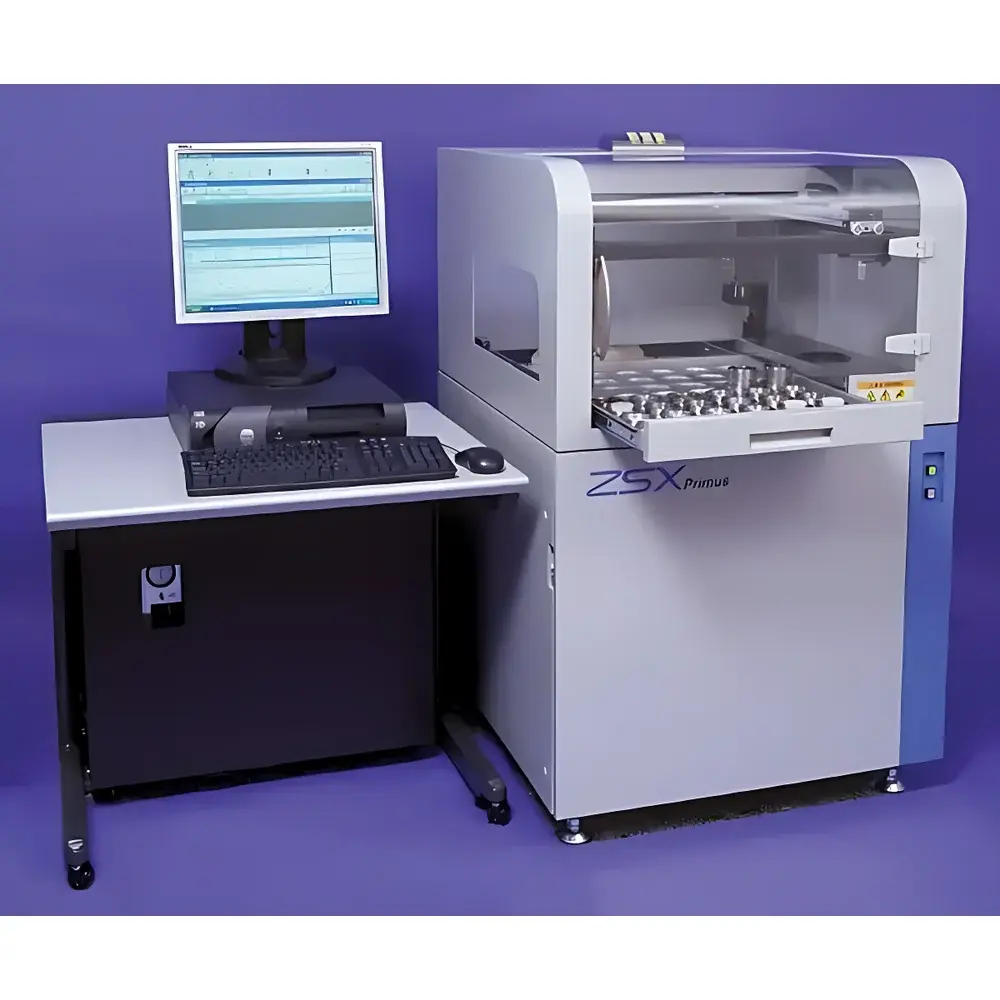
Rigaku ZSX Primus Wavelength Dispersive X-Ray Fluorescence Spectrometer
| Brand | Rigaku |
|---|---|
| Origin | Japan |
| Model | ZSX Primus |
| Instrument Type | Floor-standing |
| X-ray Tube Power | 4 kW |
| Elemental Range | Be–U |
| Scan Speed | 2400°/min |
| Beryllium Window Thickness | 30 µm |
| Goniometer Angular Reproducibility | ±0.0001° |
Overview
The Rigaku ZSX Primus is a high-performance, floor-standing wavelength dispersive X-ray fluorescence (WDXRF) spectrometer engineered for precision elemental quantification across the full periodic range from beryllium (Be, Z=4) to uranium (U, Z=92). Utilizing Bragg diffraction from precisely aligned analyzing crystals, the instrument separates characteristic X-ray emissions by wavelength—enabling superior spectral resolution, minimal peak overlap, and exceptional detection limits for light elements. Its robust architecture integrates a 4 kW high-power X-ray tube with a proprietary 30 µm ultra-thin beryllium exit window, optimized for enhanced transmission of low-energy photons emitted by elements such as C, N, O, F, and Na. The system operates in a continuously evacuated optical path—maintained via helium-purged sample chamber sealing—to preserve detector sensitivity and crystal integrity over extended analytical campaigns. Designed for routine QC, R&D, and regulatory-compliant testing, the ZSX Primus delivers trace-level accuracy, long-term stability, and reproducibility required in metallurgical, geological, cement, polymer, and electronic materials laboratories.
Key Features
- Full-element coverage from Be to U with optimized light-element sensitivity enabled by 30 µm Be window and vacuum-optimized optics
- Floor-standing configuration with compact footprint—designed for space-constrained laboratories without compromising accessibility or serviceability
- High-precision goniometer with angular reproducibility of ±0.0001°, ensuring consistent peak positioning and long-term calibration stability
- 2400°/min maximum scan speed for rapid qualitative survey scans and high-throughput quantitative analysis
- Downward-illumination geometry optimized for liquid samples, loose powders, and irregular solids—minimizing surface effects and enhancing homogeneity representation
- Micro-spot analysis capability down to 500 µm diameter for localized composition assessment and inclusion characterization
- Integrated elemental mapping functionality for spatially resolved distribution analysis (elemental terrain imaging)
Sample Compatibility & Compliance
The ZSX Primus accommodates a broad spectrum of solid, powdered, and liquid specimens—including pressed pellets, fused beads, thin films, alloys, ceramics, soils, catalysts, and polymer composites. Its downward-illumination design supports direct analysis of non-flat or fragile samples without extensive preparation. Helium-purged chamber operation ensures stable vacuum conditions during measurement, critical for reliable light-element quantification and minimizing atmospheric absorption artifacts. The system complies with ISO 20053:2017 (XRF—general requirements), ASTM E1621 (standard guide for WDXRF elemental analysis), and supports GLP/GMP workflows through audit-trail-enabled software logging. Optional configurations meet IEC 61000-4 electromagnetic compatibility standards and are suitable for installation in ISO/IEC 17025-accredited laboratories.
Software & Data Management
Operation is fully integrated with Rigaku’s EZ-scan software suite, enabling intuitive method setup, real-time spectrum visualization, and automated qualitative identification. The embedded SQX fundamental parameters (FP) algorithm performs comprehensive matrix correction—including interelement effects (e.g., line overlaps), secondary fluorescence, absorption enhancement, variable sample thickness, and atmosphere-dependent attenuation (air vs. He purge). Calibration-free analysis of unknowns is supported via library-matched scanning protocols and empirical standardless quantification validated against certified reference materials. All acquisition parameters, processing steps, user actions, and timestamped results are recorded in a secure, searchable database compliant with FDA 21 CFR Part 11 requirements when configured with electronic signature modules. Data export supports ASTM E1346, CSV, and SPC-compatible formats for LIMS integration.
Applications
The ZSX Primus serves mission-critical roles in raw material verification (e.g., ore grade control, slag composition), alloy certification (stainless steel, superalloys, aluminum grades), RoHS/WEEE compliance screening (Pb, Cd, Hg, Cr⁶⁺, Br), catalyst formulation analysis (Pt, Pd, Ni loading), thin-film thickness and stoichiometry validation, and geological exploration (major/minor/trace element profiling in silicates and carbonates). Its micro-analysis and mapping capabilities support failure analysis in electronics (intermetallic layer composition, solder joint contamination), forensic material attribution, and advanced battery cathode/anode homogeneity studies.
FAQ
What is the minimum detectable limit for sodium (Na) under optimal conditions?
Detection limits for Na are typically <5 ppm in fused-glass bead matrices using optimized crystals (e.g., PET) and extended counting times; actual performance depends on sample matrix and measurement protocol.
Can the ZSX Primus analyze coated or layered samples?
Yes—the downward geometry and variable take-off angle support depth-profiling of thin films and multilayer structures when combined with appropriate standards and FP modeling.
Is vacuum pumping required for every analysis?
No—the helium-sealed chamber maintains optical path vacuum continuously; only the sample chamber requires evacuation or purging based on element range and matrix.
How does the 30 µm Be window improve light-element analysis compared to conventional 75 µm windows?
It increases photon transmission below 1 keV by ~40%, significantly improving signal-to-noise ratio for Be, B, C, N, O, and F—particularly critical for organic fillers, oxides, and nitrides.
Does the system support automated multi-point analysis for heterogeneous materials?
Yes—programmable stage movement enables up to 999 discrete analysis points per sample, with statistical reporting of mean, standard deviation, and spatial trends.




