
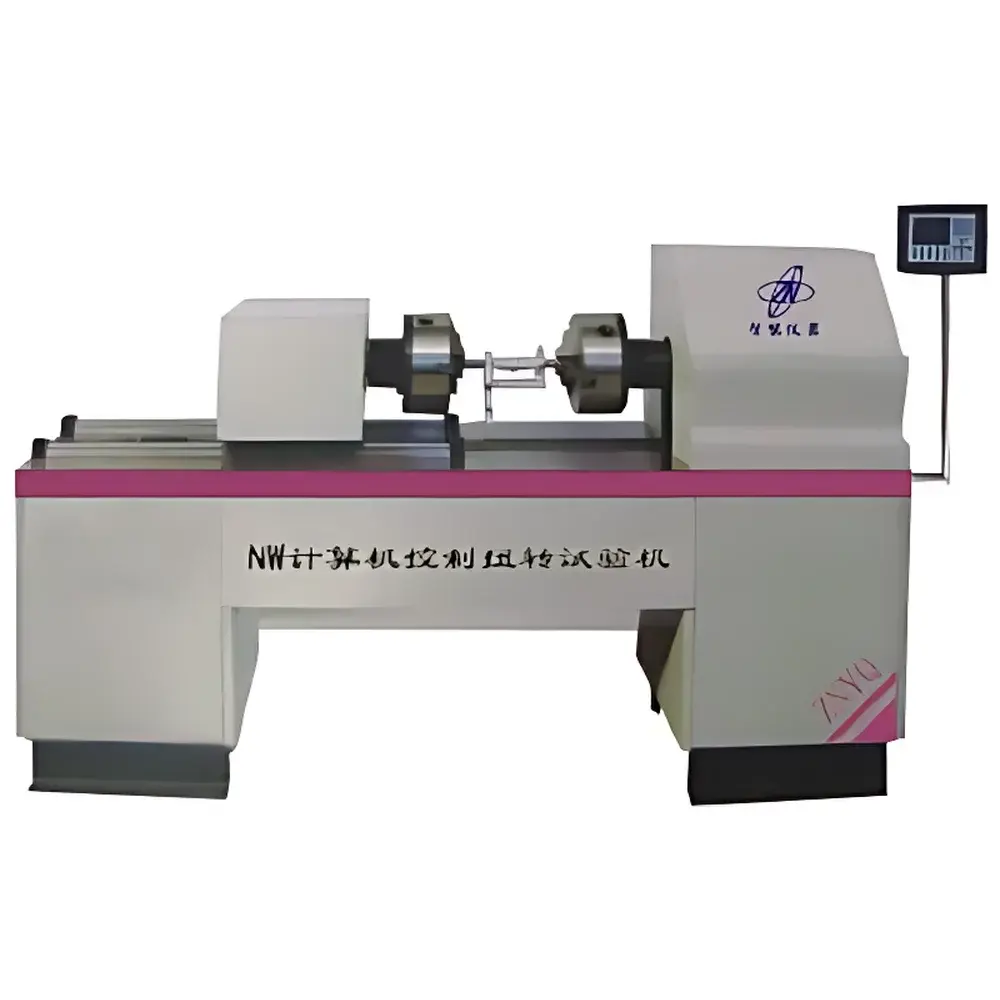
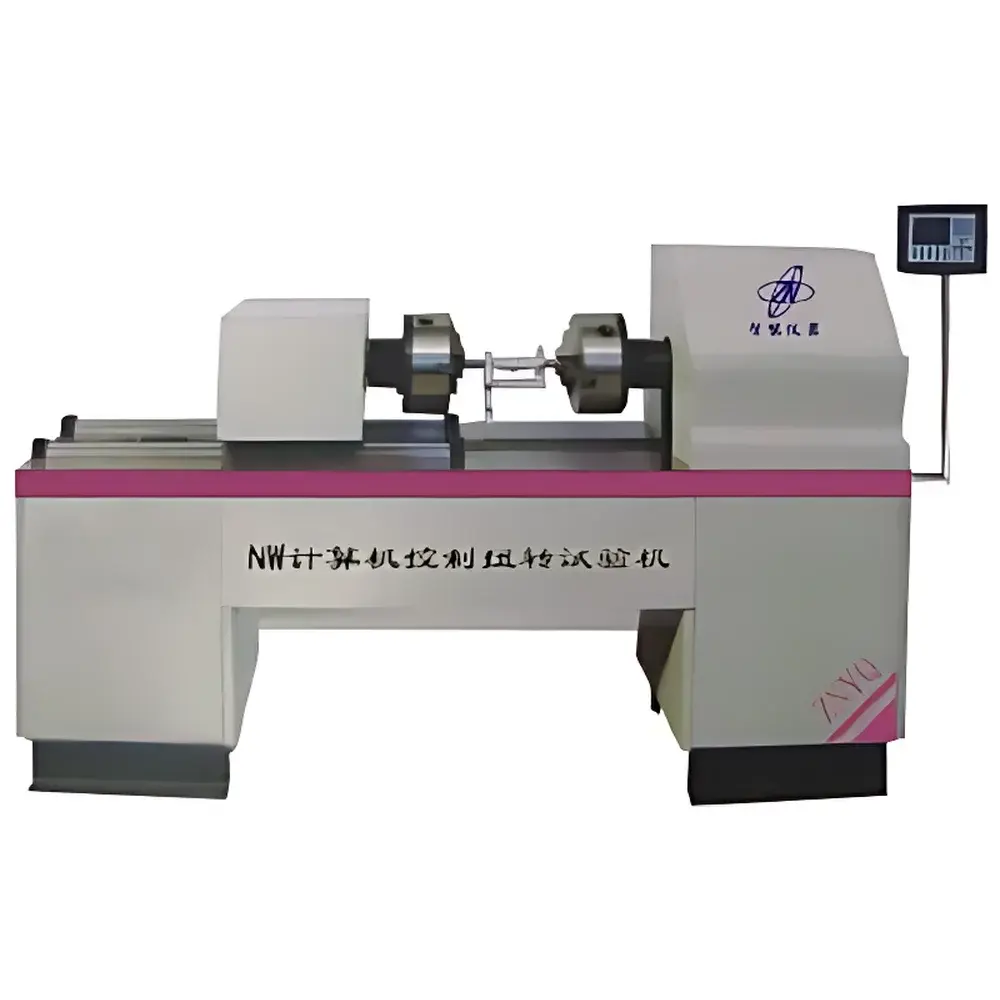
NW-1000 Torsion Testing Machine for Automotive Half-Shafts and Structural Components
| Key | Origin: Jilin, China |
|---|---|
| Manufacturer Type | Authorized Distributor |
| Country of Origin | China |
| Model | NW-1000 |
| Quotation | Available Upon Request |
| Torque Range | 0–1000 N·m |
| Torque Accuracy | ±1% of reading |
| Angular Displacement Range | n × 360° (n ≤ integer limit) |
| Twist Angle Accuracy | ±0.1° |
Overview
The NW-1000 Torsion Testing Machine is a precision-engineered mechanical testing system designed for static and dynamic torsional characterization of metallic and non-metallic materials, critical automotive components—including drive shafts, half-shafts, CV joints, and suspension linkages—as well as structural assemblies and fasteners. Operating on the principle of controlled angular displacement under applied torque, the system complies with ISO 7800:2015 (Metallic materials — Determination of torsional yield strength and torsional strength) and GB/T 10128–2022 (Metallic materials — Torsion testing at ambient temperature), ensuring traceable, repeatable, and standards-aligned mechanical property evaluation. Its robust dual-sensor architecture enables simultaneous high-fidelity acquisition of torque and angular displacement, supporting both quasi-static torsion strength determination and low-cycle torsional fatigue protocols.
Key Features
- Full-range torque measurement capability from 0 to 1000 N·m with load cell calibration traceable to national metrological standards;
- High-resolution angular encoder delivering twist angle resolution of ±0.1° across multi-revolution ranges (n × 360°, where n is configurable per test sequence);
- Real-time torque-rate and angular-velocity monitoring with programmable ramp control for precise loading profile execution;
- Integrated safety subsystem including phase-loss protection, overcurrent cutoff, hydraulic filter clogging detection, emergency stop circuitry, and upper/lower torque-angle limit enforcement;
- Onboard peak-hold function for maximum torque and corresponding twist angle retention during transient loading events;
- Automated test sequencing with pre-defined test templates for standardized compliance testing (e.g., GB/T 10128 Annex B for round bar specimens);
- Acoustic and visual alarm activation upon violation of user-defined operational thresholds or safety interlock breach.
Sample Compatibility & Compliance
The NW-1000 accommodates cylindrical, tubular, and prismatic specimens up to Ø45 mm diameter and 300 mm gauge length, with customizable fixturing for automotive half-shafts (including flanged and splined interfaces). It supports both free-end and fixed-end torsion configurations per ASTM E143–22 (Standard Test Method for Shear Modulus at Room Temperature) and ISO 14577–3 (Instrumented indentation testing — Part 3: Calibration of reference blocks). All firmware and mechanical calibrations adhere to GLP-compliant documentation practices, and audit trails—including operator ID, timestamp, calibration certificate expiry, and environmental conditions (ambient temperature/humidity logging)—are retained in accordance with ISO/IEC 17025:2017 requirements.
Software & Data Management
Control and analysis are performed via dedicated Windows-based software compliant with FDA 21 CFR Part 11 for electronic records and signatures. The platform provides real-time graphical display of torque vs. twist angle curves, automatic yield point identification using the offset method (0.2% shear strain), and calculation of shear modulus (G), torsional yield strength (τy), ultimate torsional strength (τu), and ductility (% twist at fracture). Raw data export is supported in CSV, XML, and PDF formats; report generation includes mandatory fields per GB/T 10128—specimen ID, material grade, test date, testing standard reference, measured torque values, angular displacement, and pass/fail status against acceptance criteria. Audit logs record all user actions, parameter modifications, and calibration events with immutable timestamps.
Applications
- Verification of torsional stiffness and failure modes in OEM and Tier-1 automotive driveline components;
- Quality assurance testing of forged and machined axles, steering columns, and torsion bars prior to assembly;
- R&D validation of new alloy formulations (e.g., high-strength steels, aluminum-magnesium composites) under combined torsional and axial loading;
- Periodic in-service inspection of critical rotating parts in rail and aerospace maintenance programs;
- Accredited third-party testing for certification bodies requiring ISO/IEC 17025 scope coverage in mechanical testing;
- Educational use in university materials science laboratories for hands-on torsion mechanics instruction.
FAQ
Does the NW-1000 support torsional fatigue testing?
Yes—it is configured for low-cycle fatigue (LCF) testing with programmable sinusoidal, trapezoidal, or block-loading waveforms, frequency range up to 5 Hz, and cycle counting with automatic termination on specimen fracture or torque decay threshold.
Is calibration documentation provided with the system?
Each unit ships with a factory calibration certificate covering torque transducer and angular encoder, valid for 12 months; optional accredited calibration by CNAS-certified labs is available upon request.
Can test reports be exported in formats compatible with LIMS integration?
Yes—CSV and XML exports include structured metadata fields (e.g., test_id, operator_id, instrument_sn, timestamp_utc, result_units) enabling direct ingestion into laboratory information management systems.
What safety certifications does the NW-1000 hold?
The system meets CE marking requirements under Machinery Directive 2006/42/EC and conforms to IEC 61000-6-2 (EMC immunity) and IEC 61000-6-4 (EMC emissions) standards.
Is remote diagnostics supported?
Yes—the embedded controller supports secure SSH access and VNC-based remote troubleshooting with prior authorization and role-based access control.
Related Products



