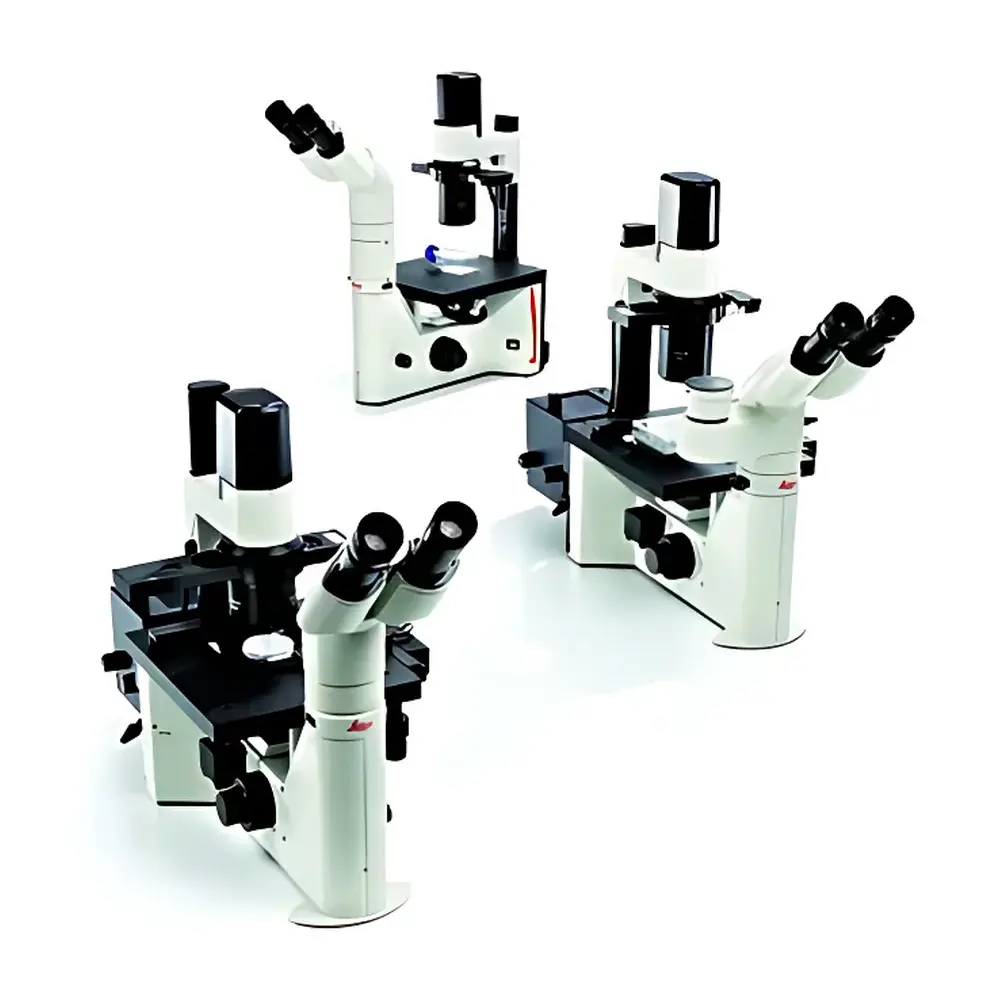
Leica DMIL LED Inverted Microscope
| Brand | Leica |
|---|---|
| Origin | Germany |
| Model | DMIL LED |
| Illumination | Long-life white LED (50,000 h) |
| Optical Design | Infinity-corrected optical system |
| Objective Type | Plan achromatic to plan semi-apochromatic long-working-distance objectives |
| Maximum Working Space | 120 mm |
| Fine Focus Step Size | 1 µm |
| Condenser | Height-adjustable condenser (40 mm, NA = 0.45 |
| Eyepiece Field Number | 18–25 |
| Imaging Modes | Brightfield, Darkfield, Phase Contrast, Hoffman Modulation Contrast, Fluorescence (up to 100 W mercury or metal-halide lamp compatible), Digital Imaging Ready |
| Expandability | Compatible with live-cell incubation chambers, micromanipulation systems (e.g., ICSI), multi-user viewing heads (dual/triple) |
Overview
The Leica DMIL LED is a robust, research-grade inverted microscope engineered for demanding life science applications requiring high optical fidelity, ergonomic usability, and modular adaptability. Designed around an infinity-corrected optical architecture, the system ensures minimal chromatic and spherical aberration across the entire field of view—critical for quantitative imaging and long-term time-lapse experiments. Its inverted configuration places the objective lenses beneath the specimen stage, enabling direct access to culture vessels (e.g., Petri dishes, flasks, and chambered coverslips) without mechanical interference. This geometry is fundamental for live-cell observation, microinjection, patch-clamp electrophysiology, and co-culture assays where sterility, environmental control, and operator accessibility are paramount. The integrated high-efficiency white LED illumination delivers stable, flicker-free, color-accurate illumination with a rated lifetime of 50,000 hours—eliminating thermal drift, mercury lamp hazards, and frequent replacement cycles common in traditional arc-lamp systems.
Key Features
- Infinity-corrected optical pathway optimized for high-resolution contrast imaging and compatibility with advanced contrast techniques including phase contrast, darkfield, and Hoffman modulation contrast.
- Long-working-distance (LWD) plan achromatic and plan semi-apochromatic objectives—designed to accommodate thick culture vessels and maintain sharp focus through glass-bottom dishes up to 1.5 mm in thickness.
- 120 mm maximum vertical working space between stage and objective nosepiece—enabling unobstructed integration of micromanipulators, perfusion systems, and environmental chambers.
- Precision fine-focus mechanism with 1 µm minimum step resolution—essential for Z-stack acquisition, confocal correlation, and precise focal plane positioning during dynamic cellular events.
- Dual-height adjustable condenser (40 mm / 80 mm) with numerical apertures up to 0.45—supporting both high-NA phase contrast and low-magnification overview imaging under uniform Köhler illumination.
- Ergonomic viewing head options including binocular, trinocular, and tilting configurations with field numbers ranging from 18 to 25—ensuring user comfort during extended observation sessions and seamless coupling to digital cameras.
Sample Compatibility & Compliance
The Leica DMIL LED supports standard and custom cell culture formats—including 35 mm, 60 mm, and 100 mm Petri dishes; T25–T225 flasks; multi-well plates (6–96-well); and specialized chambered coverslips (e.g., Lab-Tek, Ibidi). Its open-stage architecture accommodates auxiliary hardware such as CO₂ incubation enclosures, temperature-controlled stage adapters, and motorized XY stages—all compliant with ISO 13485 and GLP-aligned laboratory infrastructure requirements. While the base system itself does not carry FDA 510(k) clearance as a medical device, its configuration and documentation support audit readiness for GMP-regulated bioprocessing environments and preclinical research workflows governed by ISO/IEC 17025.
Software & Data Management
The microscope integrates natively with Leica Application Suite X (LAS X) software—a platform validated for regulated environments and supporting 21 CFR Part 11-compliant electronic records, user role-based access control, and full audit trail logging. LAS X enables automated acquisition protocols (time-lapse, multi-position, Z-series), real-time image processing (background subtraction, deconvolution, channel alignment), and metadata embedding per frame (objective ID, exposure time, illumination intensity, stage coordinates). Export formats include TIFF (16-bit), OME-TIFF, and HDF5—ensuring compatibility with downstream analysis tools such as ImageJ/Fiji, MATLAB, Python-based scikit-image pipelines, and commercial AI training frameworks.
Applications
- Live-cell imaging of adherent and suspension cultures under physiological conditions (temperature, CO₂, humidity).
- Cell migration and wound-healing assays using time-lapse phase contrast or fluorescence labeling.
- Micromanipulation procedures including intracytoplasmic sperm injection (ICSI), nuclear transfer, and single-cell isolation.
- Quality control in stem cell banking and therapeutic cell manufacturing—monitoring morphology, confluence, and contamination status.
- Teaching laboratories requiring durable, intuitive instrumentation for undergraduate and graduate instruction in cell biology, histology, and developmental biology.
- Preclinical toxicology screening where morphological endpoints (e.g., cytoskeletal disruption, vacuolization, detachment) are quantified over time.
FAQ
Is the DMIL LED suitable for fluorescence imaging with modern fluorophores?
Yes—the system accepts standard Leica filter cubes and is compatible with high-intensity LED fluorescence modules or external 100 W metal-halide sources. Its optical path preserves excitation/emission efficiency for common dyes including DAPI, FITC, TRITC, and Alexa Fluor series.
Can the DMIL LED be upgraded to support motorized Z-focus or automated stage control?
Yes—Leica offers optional motorized focus drives and encoded XY stages that integrate seamlessly with LAS X for repeatable, script-driven acquisition workflows.
Does the microscope meet ISO or CE safety standards for laboratory use?
Yes—the DMIL LED carries CE marking per Directive 2014/30/EU (EMC) and 2014/35/EU (LVD), and complies with IEC 61000-6-2/6-3 for electromagnetic immunity and emissions.
What level of service and calibration support is available outside Germany?
Leica Microsystems maintains a global network of certified service centers offering on-site preventive maintenance, optical alignment verification, and traceable calibration reports aligned with ISO/IEC 17025 requirements.