
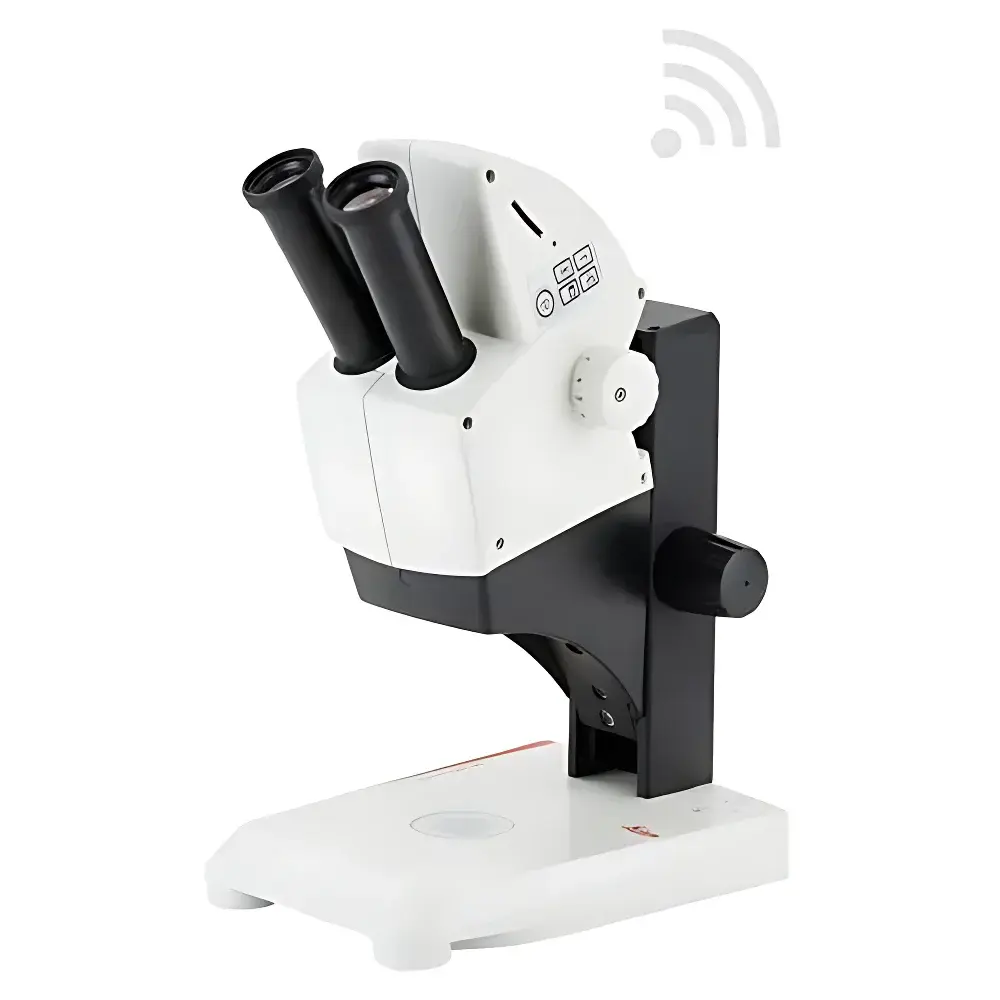
Leica EZ4 W Stereo Microscope for Educational Laboratories
| Brand | Leica |
|---|---|
| Origin | Germany |
| Model | EZ4 W |
| Camera Resolution | 5 MP CMOS |
| Zoom Ratio | 4.4:1 (8×–35×) |
| Illumination | 7-Position LED (incident, oblique, transmitted) |
| Connectivity | Built-in Wi-Fi, HDMI, USB, SD card slot |
| Software | Leica Application Suite (LAS) for Windows, Leica Acquire for macOS, Leica AirLab App (iOS/Android) |
| Compliance | CE, RoHS, ISO 9001 certified manufacturing |
| Power | Integrated power supply (no external camera adapter required) |
Overview
The Leica EZ4 W is a purpose-engineered stereo microscope designed specifically for undergraduate and secondary-level science education laboratories. It operates on the principle of Greenough optical design—providing true stereoscopic vision with independent objective paths—to deliver natural depth perception, accurate spatial interpretation, and minimal parallax error. Unlike compound microscopes optimized for high-magnification cellular analysis, the EZ4 W prioritizes ergonomic usability, rapid image sharing, and pedagogical flexibility across biology, materials science, entomology, and forensic introductory courses. Its integrated 5-megapixel CMOS imaging system captures high-fidelity, color-accurate images under native illumination conditions, eliminating reliance on external cameras or complex cabling. The instrument is manufactured in Germany under strict ISO 9001 quality management protocols and conforms to CE and RoHS directives—ensuring compliance with EU safety, electromagnetic compatibility, and environmental standards relevant to academic instrumentation procurement.
Key Features
- Integrated 5 MP CMOS Imaging System: Delivers native-resolution digital output (2592 × 1944 pixels) with automatic white balance and exposure control—enabling consistent documentation without post-acquisition correction.
- 4.4:1 Continuous Zoom Optics (8×–35×): Provides stable magnification scaling across the entire range; combined with high NA PlanApo objectives, ensures edge-to-edge sharpness and minimal chromatic aberration at all settings.
- 7-Position LED Illumination Module: Offers selectable incident (top), oblique (45°), and transmitted (bottom) lighting configurations—each independently adjustable in intensity—to optimize contrast for opaque, translucent, or reflective specimens.
- Built-in Dual-Mode Connectivity: Supports both Wi-Fi direct (ad-hoc) and infrastructure-mode network integration; enables simultaneous streaming to up to 16 mobile devices or PCs within a standard classroom LAN environment.
- CapSense™ Touch Interface: Sealed capacitive control panel resists dust, moisture, and mechanical wear—designed for high-frequency student interaction in shared lab environments over multi-year service life.
- Unified Power Architecture: All subsystems—including camera, LEDs, and Wi-Fi module—are powered directly from the main unit’s internal regulated supply; eliminates need for separate adapters or battery packs.
Sample Compatibility & Compliance
The EZ4 W accommodates specimens ranging from intact insects and plant tissues to circuit boards, mineral samples, and polymer fragments—without requiring sectioning or staining. Its working distance (up to 110 mm at lowest magnification) supports manipulation with forceps, pipettes, or dissection tools beneath the objective. The system meets EN 61000-6-3 (EMC emission limits) and EN 61000-6-2 (immunity to electrostatic discharge and RF fields), making it suitable for deployment in mixed-signal teaching labs adjacent to electrophysiology or spectroscopy workstations. While not intended for GLP-regulated research, its traceable calibration workflow (via LAS software audit logs) supports basic QA documentation requirements aligned with ISO/IEC 17025 Annex A.2 for educational institution accreditation frameworks.
Software & Data Management
Image acquisition and annotation are managed through three interoperable platforms: Leica AirLab (free iOS/Android app) for real-time touch-based capture, markup, and export in JPEG/PNG; Leica Application Suite (LAS) v4.x for Windows-based batch processing, measurement overlays, and TIFF export with embedded EXIF metadata; and Leica Acquire for macOS users requiring native Metal-accelerated rendering and iCloud-synced project libraries. All software modules enforce role-based user permissions and support timestamped, encrypted export to network drives or local SD cards (microSDHC up to 128 GB). Raw image files retain full sensor data for retrospective reprocessing—critical for student-led experimental reproducibility exercises.
Applications
- Botanical morphology studies—leaf venation mapping, pollen grain identification, and fungal hyphae observation.
- Entomological specimen examination—external anatomy, wing venation, and setae distribution analysis.
- Materials characterization—surface defect inspection on solder joints, composite laminates, or 3D-printed prototypes.
- Introductory forensic science—fiber comparison, toolmark replication, and handwriting document analysis.
- Developmental biology—live embryo staging in zebrafish or Drosophila using low-light transmitted illumination.
- STEM outreach demonstrations—real-time wireless projection to large-format displays during open-house events or museum exhibits.
FAQ
Does the EZ4 W require a dedicated IT infrastructure to operate wirelessly?
No. The built-in Wi-Fi module functions as an autonomous access point—students connect directly via SSID “Leica-EZ4W-XXXX” without needing campus network credentials or router configuration.
Can image metadata be exported in CSV format for laboratory report generation?
Yes. LAS software includes configurable metadata templates (user ID, date/time, magnification, illumination mode) that auto-populate Excel-compatible CSV exports alongside each acquired image.
Is the SD card slot compatible with Class 10 UHS-I cards?
Yes. The microSDHC interface supports UHS-I speed class ratings, enabling sustained write throughput >30 MB/s—sufficient for burst-mode acquisition of time-lapse sequences.
What is the maximum supported resolution when outputting via HDMI?
The HDMI port delivers native 1080p60 video output with full-color fidelity and zero frame dropping—verified per HDMI 1.4a specification compliance testing.
How is firmware updated, and is version history publicly documented?
Firmware updates are distributed through Leica’s official support portal (leica-microsystems.com/support) and applied via USB drive or network download; complete revision notes—including bug fixes and regulatory alignment updates—are published with each release.



