
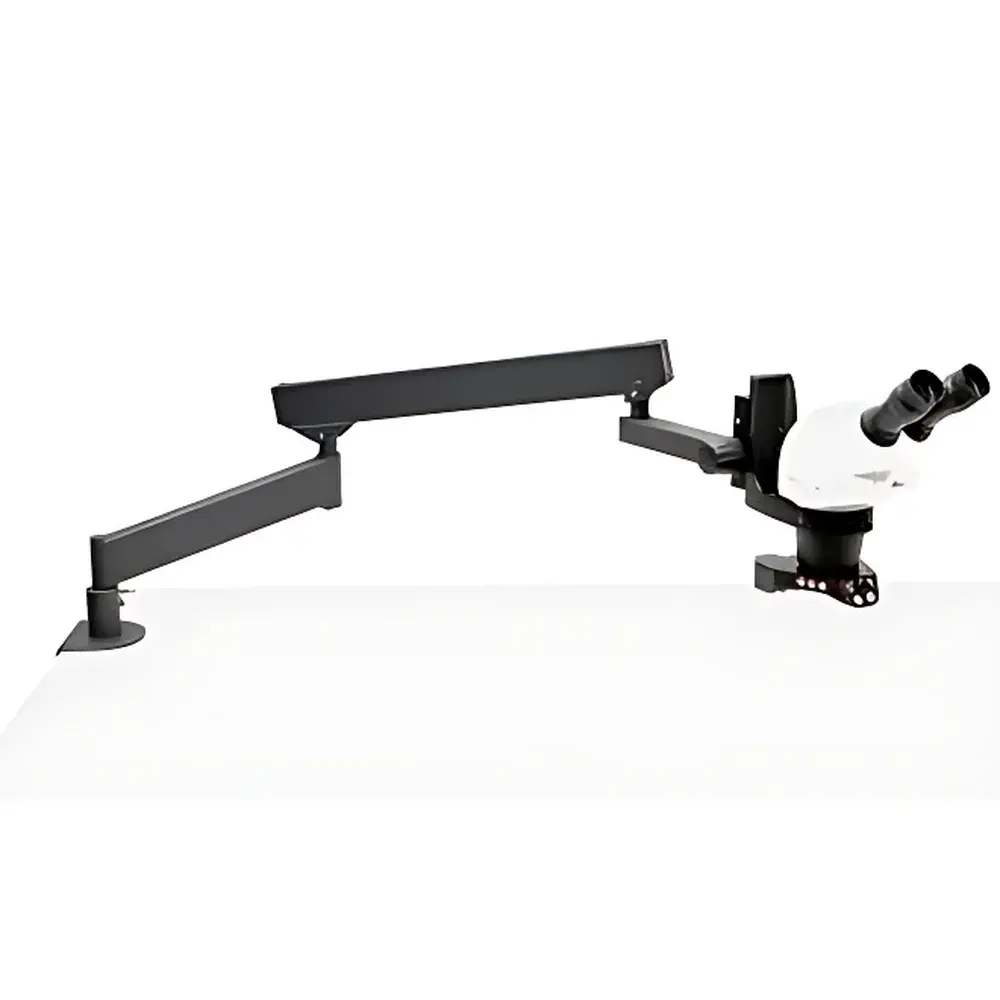
Leica Flexarm Stand for Stereo Microscopes
| Brand | Leica |
|---|---|
| Origin | Germany |
| Model | Flexarm Stand |
| Type | Articulating Boom Stand |
| Arm Reach | 1000 mm (1 m) |
| Rotation | 360° continuous horizontal rotation |
| Base Footprint | ~100 mm × 100 mm |
| Counterbalance | Tool-free, weight-compensated height adjustment |
| Compliance | Designed for integration with Leica M-series and Z-series stereo microscopes |
Overview
The Leica Flexarm Stand is a precision-engineered articulating boom stand specifically designed for stereo microscopy applications requiring high positional flexibility without compromising optical stability. Built on the foundational principles of kinematic linkage and passive counterbalance mechanics, the Flexarm Stand enables full 360° horizontal rotation and smooth, tool-free vertical positioning across a 1-meter radial working envelope. Its rigid yet compliant mechanical architecture eliminates parasitic vibrations and drift during extended observation or manual manipulation—critical for tasks demanding consistent focus plane maintenance under dynamic repositioning. Unlike fixed-column or cantilever stands, the Flexarm’s dual-segment articulated arm decouples lateral reach from vertical height constraints, allowing operators to position microscope objectives precisely over large, immobile, or heat-sensitive samples—including printed circuit boards, dental prostheses, industrial castings, and biological specimens in custom holders—without relocating the sample itself.
Key Features
- Full 360° Continuous Horizontal Rotation: Precision-machined azimuth bearing ensures zero-backlash, repeatable orientation across the entire horizontal plane—enabling rapid repositioning between multiple inspection zones on oversized workpieces.
- 1-Meter Radial Reach with Dual-Stage Articulation: Two independently adjustable arm segments (upper and lower) provide fine-grained control over working distance and viewing angle while maintaining constant center-of-gravity alignment relative to the base.
- Tool-Free Weight-Compensated Height Adjustment: Integrated spring-balanced counterweight system automatically adapts to the mass of attached stereo microscope bodies (e.g., Leica M125, M205 A, Z16 APO), permitting instantaneous vertical repositioning with one hand and eliminating manual tension calibration.
- Minimalist Benchtop Footprint: Compact 100 mm × 100 mm base design maximizes usable lab space; arm folds flat against the base when not in use—ideal for shared microscopy stations or cleanroom environments with strict spatial protocols.
- Modular Mounting Interface: Standardized M6 threaded receptacle at the distal end accepts Leica C-mount adapters, camera brackets, coaxial illumination modules, and third-party accessories conforming to DIN 45208 mechanical interface specifications.
Sample Compatibility & Compliance
The Flexarm Stand supports non-invasive examination of samples that cannot be relocated due to size, fragility, thermal sensitivity, or regulatory handling restrictions—including assembled electronics subassemblies, dental molds mounted on articulators, forensic evidence trays, and metallurgical test coupons. Its vibration-damped base and low-resonance arm geometry meet ISO 10816-1 requirements for permissible vibration levels in optical metrology setups. When used with Leica stereo microscopes configured for GLP/GMP workflows, the stand contributes to documented instrument positioning repeatability—a prerequisite for audit-ready quality control records under ISO/IEC 17025 and FDA 21 CFR Part 11-compliant digital documentation systems.
Software & Data Management
While the Flexarm Stand itself is a purely mechanical positioning platform, its seamless integration with Leica Application Suite (LAS X) enables synchronized metadata capture: motorized Z-focus position, illumination intensity, and stage coordinates (when paired with compatible motorized stages) are logged alongside image files. The stand’s repeatable positioning capability allows users to define and recall up to 16 preset arm configurations via LAS X macro scripting—supporting standardized inspection routines across shifts or operators. All position logs are exportable as CSV or XML for traceability in LIMS or QMS platforms.
Applications
- Electronics manufacturing: In-line solder joint inspection, component placement verification, and PCB trace continuity assessment without disassembly.
- Dental laboratory QA: Dimensional validation of crowns, bridges, and implant abutments directly on articulator-mounted casts.
- Forensic documentation: High-magnification surface feature capture (e.g., tool marks, fracture patterns) on bulky evidence items such as firearms or vehicle components.
- Materials science: Real-time monitoring of thermal expansion or creep behavior in unmounted alloy samples under controlled environmental chambers.
- Educational microscopy labs: Facilitating collaborative observation sessions where multiple students adjust viewing angles without disturbing sample placement.
FAQ
Is the Flexarm Stand compatible with non-Leica stereo microscopes?
Yes—provided the microscope features a standard C-mount or M6 accessory thread and falls within the supported weight range (0.8–3.2 kg); mechanical compatibility must be verified against Leica’s published mounting interface specifications.
Does the stand include vibration isolation?
The base incorporates elastomeric damping elements optimized for tabletop resonance suppression; for ultra-low-vibration environments (e.g., nanoscale metrology), supplemental active or passive isolation tables are recommended.
Can the arm be locked in position during imaging?
All rotational and angular joints feature independent friction-locking knobs calibrated to retain position under typical operational loads without slippage or creep.
What maintenance is required?
Annual inspection of spring-tension integrity and bearing lubrication is advised; no scheduled recalibration is necessary due to the purely mechanical, non-servo design.
Is CE marking applicable?
Yes—the Flexarm Stand complies with EU Machinery Directive 2006/42/EC and carries the CE mark, confirming conformity with essential health and safety requirements for laboratory equipment.





