
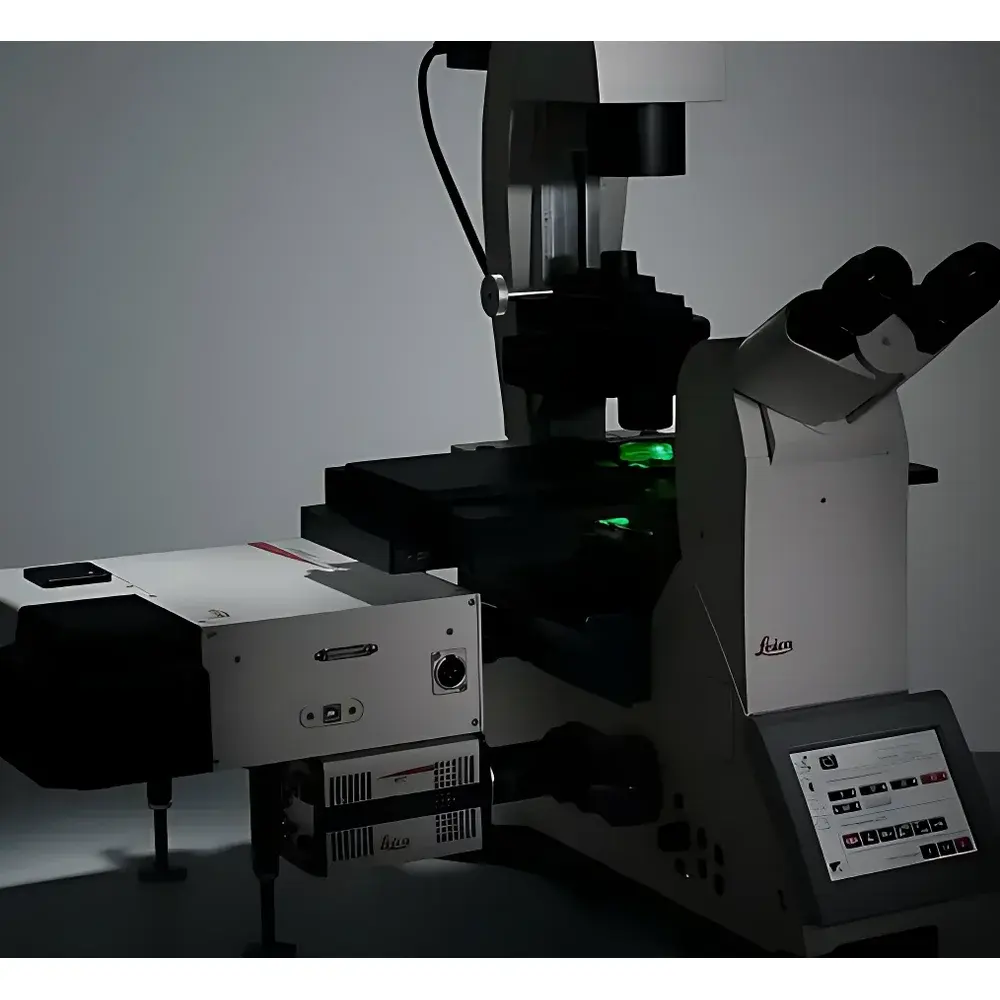
Leica Infinity Multispectral Light Manipulation Module for DMi8 S Inverted Microscopy Platform
| Brand | Leica |
|---|---|
| Origin | Germany |
| Model | Infinity |
| Microscope Type | Inverted |
| Compatible Platform | DMi8 S |
| Laser Pathways | Dual infinity-corrected optical paths with chromatic aberration correction |
| Beam Shaping | Adjustable beam waveform (vector scanning) |
| Control Interface | LAS X software integration |
| Application Modes | FRAP, FLIP, optogenetics, photoactivation, photobleaching, photocutting, uncaging, photostimulation |
| Imaging Compatibility | Simultaneous or sequential operation with TIRF, widefield, and time-lapse acquisition |
| Hardware Integration | Fully motorized DMi8 system with AFC, WSU laser combiner, DFC9000 GT sCMOS camera, high-speed fiber-coupled laser switching (3 ms actuation) |
Overview
The Leica Infinity Multispectral Light Manipulation Module is a precision-engineered optical add-on designed exclusively for the DMi8 S inverted microscopy platform. It enables spatially and spectrally resolved light-based interventions—such as photoactivation, photobleaching, photocutting, optogenetic stimulation, and caged compound uncaging—within live-cell and tissue imaging experiments. Built upon dual infinity-corrected optical pathways, the module delivers diffraction-limited beam delivery across multiple excitation wavelengths while maintaining rigorous chromatic aberration correction. Its vector-scanning architecture supports sub-millisecond positioning accuracy and programmable beam waveforms, allowing precise spatiotemporal control of photonic stimuli synchronized with high-speed sCMOS acquisition (e.g., DFC9000 GT). The system operates under full hardware-software co-registration via Leica’s LAS X platform, ensuring deterministic timing between illumination events and image capture—critical for quantitative dynamic assays in developmental biology, neurophysiology, and cell signaling research.
Key Features
- Dual independent infinity-corrected optical paths enabling simultaneous multi-wavelength light manipulation without spectral crosstalk
- High-fidelity chromatic correction across 405–785 nm, supporting up to four laser lines with minimal focus drift during wavelength switching
- Vector-scanning galvanometric mirrors with <1 µm positional repeatability and <3 ms fiber-optic laser switching latency
- Fully integrated motorized control via LAS X software: unified workflow for defining ROIs, drawing arbitrary photomanipulation patterns, and scheduling multi-step protocols
- Native compatibility with Adaptive Focus Control (AFC) and Widefield Scanning Unit (WSU) for long-term drift-compensated experiments
- Modular expansion support: seamless interoperability with Infinity TIRF, resonant scanning, and environmental chamber modules on the DMi8 S platform
Sample Compatibility & Compliance
The Infinity module is validated for use with standard glass-bottom dishes (e.g., MatTek, Ibidi), silicone- or collagen-coated substrates, and cleared tissue sections up to 500 µm thick. It supports aqueous immersion objectives (40×/63×/100× oil, glycerol, and water immersion) and maintains optical performance under physiological conditions (37°C, 5% CO₂). All optical components comply with ISO 10110-7 (laser safety), EN 60825-1 (Class 4 laser product classification), and IEC 61000-6-3 (EMC emissions). Experimental workflows—including FRAP recovery quantification and optogenetic pulse trains—are traceable and audit-ready per GLP/GMP requirements when configured with LAS X’s electronic lab notebook (ELN) and 21 CFR Part 11-compliant user access controls.
Software & Data Management
LAS X software provides a unified interface for experiment design, execution, and analysis. The “Light Pattern Designer” enables graphical ROI definition, temporal sequencing of photomanipulation events, and real-time preview of beam placement relative to acquired images. All illumination parameters—including laser power, dwell time, scan speed, and pulse duration—are logged with timestamped metadata embedded in TIFF/OME-TIFF files. Raw data export supports HDF5 and N5 formats for downstream analysis in Python (e.g., napari, scikit-image) or MATLAB. Version-controlled protocol templates ensure inter-experiment reproducibility; audit trails record operator ID, parameter changes, and hardware state transitions—fully compliant with FDA 21 CFR Part 11 for regulated environments.
Applications
- Quantitative FRAP/FLIP kinetics in membrane protein trafficking and nucleoplasmic diffusion studies
- Spatiotemporally resolved optogenetic interrogation of neuronal circuits in acute brain slices
- Precision subcellular photodisruption for mitotic spindle ablation or organelle isolation
- Multiplexed photoactivation of orthogonal caged fluorophores (e.g., PA-GFP + Dronpa) in single cells
- Correlative light-manipulation and TIRF imaging to resolve exocytosis dynamics at plasma membrane microdomains
- Long-term z-stack time-lapse with periodic photostimulation to assess cellular stress responses
FAQ
Can the Infinity module be used with non-Leica microscope platforms?
No—the Infinity module is mechanically and optically engineered exclusively for the DMi8 S inverted platform and requires native integration with its motorized nosepiece, stage, and LAS X firmware.
Does the system support pulsed laser sources?
Yes—via the WSU laser combiner and fiber-switching architecture, it accommodates picosecond and nanosecond pulsed lasers (e.g., OPO systems) with TTL-triggered synchronization.
Is chromatic correction applied automatically during multi-color experiments?
Yes—each optical path includes dedicated relay optics and adjustable collimation elements calibrated per wavelength to maintain focal plane alignment across 405–785 nm.
How is phototoxicity minimized during extended manipulations?
Through adaptive power modulation: LAS X dynamically adjusts laser intensity based on real-time camera feedback and predefined photodamage thresholds defined in protocol templates.
Can custom Python scripts interface with the Infinity module?
Yes—LAS X exposes a COM-based API and RESTful endpoints for external control, enabling integration into automated screening pipelines or machine-learning-driven closed-loop experiments.



