
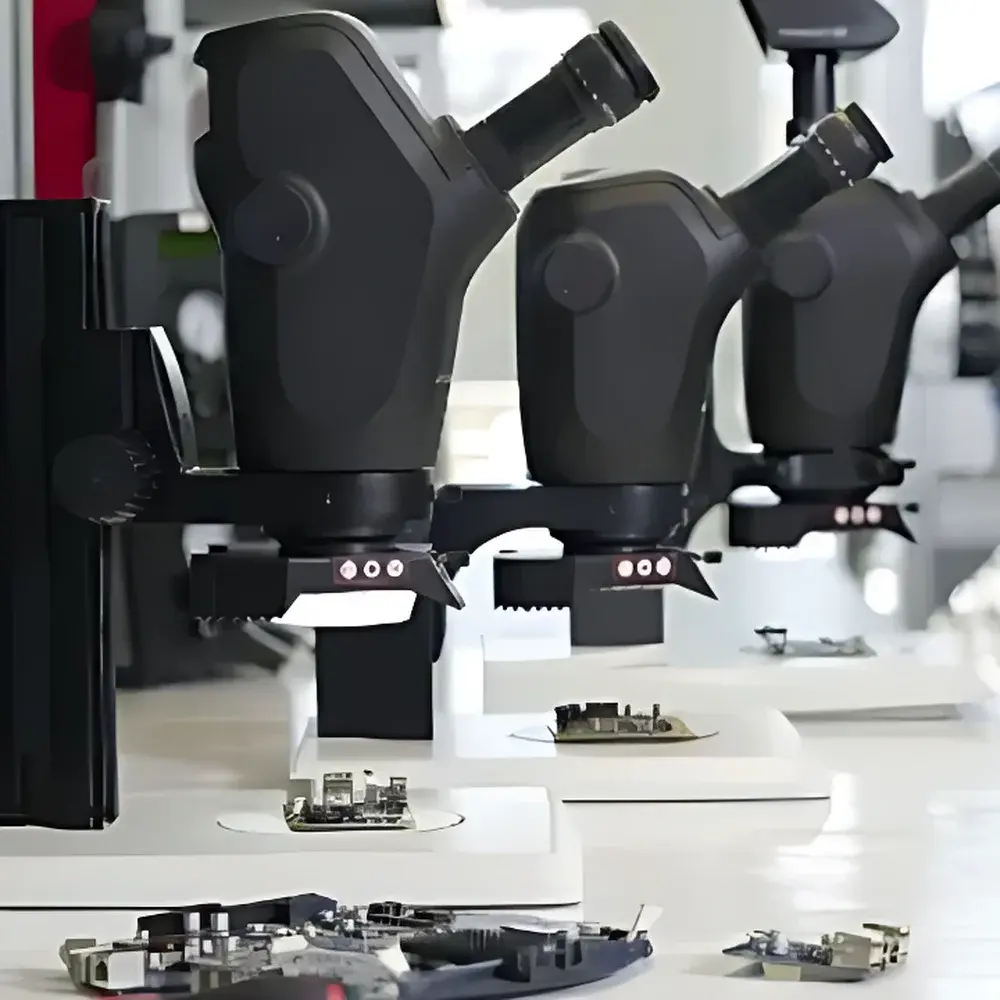
Leica Ivesta 3 Series Stereo Microscope
| Brand | Leica |
|---|---|
| Origin | Germany |
| Model | Ivesta 3 Series |
| Total Magnification | 55× |
| Zoom Ratio | 9:1 |
| Working Distance | 135 mm |
| Objective Type | Achromatic Apochromatic Plan-Corrected |
| Illumination | LED |
Overview
The Leica Ivesta 3 Series Stereo Microscope is an entry-level, high-performance stereo imaging platform engineered for routine inspection, quality control, and educational applications in industrial laboratories, electronics manufacturing, and academic teaching environments. Built upon Leica Microsystems’ legacy of precision optical engineering, the Ivesta 3 leverages FusionOptics technology — a proprietary optical design that simultaneously optimizes resolution and depth of field within a single optical path. Unlike conventional stereo microscopes relying on dual-path optics with fixed trade-offs between sharpness and depth, FusionOptics employs asymmetric beam splitting and differential magnification pathways to deliver up to three times greater effective depth of field while maintaining high lateral resolution across the entire zoom range. This enables operators to visualize complex, topographically varied specimens — such as printed circuit boards (PCBs), solder joints, biological tissue sections, or mechanical assemblies — without frequent refocusing. The system operates on a Greenough-style optical architecture enhanced with plan-corrected achromat-apochromat hybrid objectives, ensuring minimal chromatic and spherical aberration across the full 55× magnification range.
Key Features
- FusionOptics technology: Delivers extended depth of field (up to 3× greater than standard stereo optics) without compromising resolution or contrast.
- 9:1 continuous zoom ratio: Enables seamless transition from macro overview (e.g., full PCB board inspection) to fine-detail examination (e.g., individual solder pad morphology) with a single rotation.
- 135 mm working distance: Provides ample clearance for manipulation tools, probe stations, or sample-handling fixtures — critical for electronics rework, micro-assembly, and non-contact measurement workflows.
- LED illumination system: Integrated cold-white LED provides uniform, flicker-free, energy-efficient illumination with >50,000-hour lifetime and stable color temperature (6,000 K), minimizing thermal drift during prolonged observation.
- Modular configuration options: Available in three variants — base model (Ivesta 3), integrated digital camera version (Ivesta 3 with built-in 5 MP CMOS sensor), and C-mount adapter version (Ivesta 3 with standardized 1″ C-mount port) — supporting flexible integration into documentation, teaching, or automated inspection pipelines.
- Ergonomic design: Adjustable interpupillary distance, inclined binocular tube (45°), and low-positioned focus controls reduce operator fatigue during extended use sessions.
Sample Compatibility & Compliance
The Ivesta 3 accommodates a broad spectrum of opaque and semi-transparent specimens without requiring specialized preparation. Common applications include visual inspection of surface-mounted devices (SMDs), wire bonding integrity, metallurgical grain structure assessment, botanical dissection, entomological specimen analysis, and polymer component evaluation. Its optical performance meets ISO 10934-1 (Microscopes — Nomenclature of components and features) and complies with EN 61000-6-3 (EMC emission standards) and EN 61000-6-2 (EMC immunity). While not certified for GMP/GLP-regulated production environments out-of-the-box, the system supports audit-ready documentation when paired with Leica Application Suite (LAS) X software and configured with 21 CFR Part 11-compliant user access controls and electronic signature modules.
Software & Data Management
When equipped with the optional built-in camera or C-mount interface, the Ivesta 3 integrates natively with Leica Application Suite (LAS) X — a modular, platform-independent software framework designed for image acquisition, annotation, measurement, and report generation. LAS X supports DICOM, TIFF, JPEG2000, and proprietary .lei file formats, enabling long-term archival compatibility and cross-platform data exchange. Measurement tools include calibrated linear, angular, area, and particle-counting functions traceable to NIST-traceable calibration standards. For regulated environments, optional software modules provide full audit trail logging, role-based user permissions, electronic signatures, and secure data export — aligning with FDA 21 CFR Part 11 requirements for electronic records and signatures.
Applications
- Electronics manufacturing: Visual verification of solder paste deposition, reflow quality, component placement accuracy, and post-reflow defect identification (bridging, tombstoning, voiding).
- Academic instruction: Teaching comparative morphology, dissection techniques, and optical principles in undergraduate life science and materials engineering labs.
- Quality assurance labs: Routine incoming inspection of machined parts, plastic injection-molded components, and coated surfaces for dimensional consistency and finish defects.
- Maintenance & repair: In-field troubleshooting of electromechanical systems, connector integrity checks, and fiber optic end-face inspection (when used with optional fiber alignment accessories).
- Forensic documentation: High-fidelity imaging of tool marks, bullet striations, and trace evidence under consistent illumination and geometric scaling.
FAQ
Does the Ivesta 3 support third-party camera integration?
Yes — the C-mount variant accepts standard 1″ format cameras from major industrial imaging vendors (e.g., Basler, FLIR, IDS), provided mechanical back-focus alignment and sensor size compatibility are verified.
Is FusionOptics compatible with all eyepiece configurations?
FusionOptics performance is optimized for Leica’s factory-calibrated widefield 10×/22 mm eyepieces; use of non-OEM eyepieces may degrade depth-of-field enhancement and resolution balance.
Can the LED illumination intensity be adjusted manually or programmatically?
Intensity is controlled via a rotary dial on the microscope base; no software-controlled dimming is available in the base model, though LAS X can modulate exposure time for digital capture.
What is the maximum recommended payload for the optional mechanical stage?
The standard XY mechanical stage supports up to 1.5 kg uniformly distributed load; heavier samples require custom mounting solutions or vibration-isolated platforms.
Is service calibration traceable to national metrology institutes?
Leica-certified service centers provide calibration reports traceable to PTB (Physikalisch-Technische Bundesanstalt) standards for magnification accuracy, working distance, and field-of-view linearity.






