
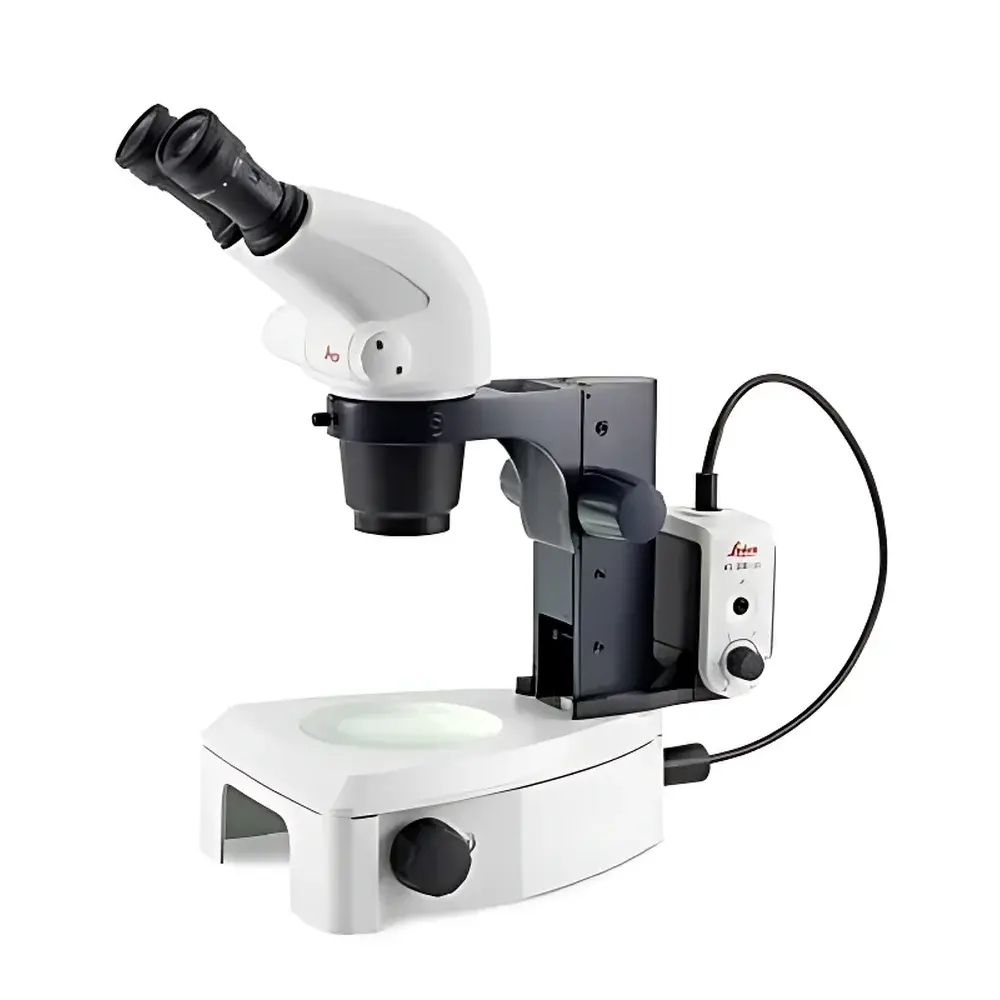
Leica KL300 LED Cold Light Source
| Brand | Leica |
|---|---|
| Origin | Germany |
| Model | KL300 LED |
| Light Source Type | High-Efficiency White LED |
| Equivalent Luminous Output | 50 W Halogen |
| Rated Lifetime | ≥50,000 hours |
| Power Consumption | <12 W |
| Cooling | Fanless Passive Thermal Management |
| Housing | ESD-Safe Compact Aluminum Chassis |
| Compatibility | Universal Fiber-Optic Coupling (FOC) for Leica S-Series, M-Series, and Standard Stereo Microscopes |
| Dimensions (W × H × D) | 110 × 65 × 140 mm |
| Weight | 0.85 kg |
| Regulatory Compliance | CE, RoHS, IEC 61000-6-3, IEC 61000-6-2 |
Overview
The Leica KL300 LED is a precision-engineered cold light source designed specifically for demanding illumination requirements in stereo microscopy across industrial quality control, life science research, and educational laboratory environments. Unlike traditional halogen or metal-halide illuminators, the KL300 LED employs high-color-rendering-index (CRI >90) white LEDs coupled with advanced thermal management architecture to deliver stable, flicker-free, and spectrally consistent output without infrared (IR) or ultraviolet (UV) radiation. Its photometric performance—equivalent to a 50 W halogen lamp—is achieved at less than 25% of the power draw, eliminating heat-induced sample drying, stage warping, or operator discomfort during prolonged observation sessions. The device operates on constant-current LED driver circuitry, ensuring intensity stability over time and temperature, and is fully compatible with Leica’s modular fiber-optic light guide ecosystem—including bifurcated, ring, gooseneck, and coaxial guides—enabling precise spatial control of incident illumination geometry.
Key Features
- Fanless passive cooling system ensures silent operation (<22 dB[A]), critical for noise-sensitive applications such as electrophysiology or microsurgery training.
- ESD-safe anodized aluminum housing complies with IEC 61340-5-1 standards, preventing electrostatic discharge damage to sensitive electronic components or semiconductor wafers during inspection.
- Compact form factor (110 × 65 × 140 mm) allows direct mounting onto Leica S-series microscope stands or independent benchtop deployment via integrated rubber feet and rear cable management slots.
- LED lifetime rated at ≥50,000 hours at full output—translating to over 12 years of continuous 12-hour/day usage—eliminates lamp replacement cycles, service downtime, and associated calibration drift.
- Integrated analog dimming interface (0–10 V) enables seamless integration with Leica’s DM750 or IC80 HD imaging platforms for synchronized illumination control within automated workflows.
Sample Compatibility & Compliance
The KL300 LED supports a broad spectrum of sample types—from reflective metallic surfaces and PCB assemblies to translucent biological specimens (e.g., zebrafish embryos, plant tissue sections, and live-cell cultures)—without inducing thermal artifacts or phototoxicity. Its narrow spectral emission profile (400–700 nm, peak at 560 nm) avoids excitation of common fluorophores unless intentionally paired with optional bandpass filters. The unit conforms to key international safety and electromagnetic compatibility standards including CE marking under the EU Machinery Directive 2006/42/EC, RoHS 2011/65/EU, and IEC 61000-6-2 (immunity) / IEC 61000-6-3 (emissions). It is validated for use in GLP-compliant laboratories and satisfies the environmental operating conditions specified in ISO/IEC 17025:2017 Annex A.2.8 for optical measurement instrumentation.
Software & Data Management
While the KL300 LED operates as a standalone analog-controlled illuminator, its 0–10 V input interface permits bidirectional integration with Leica Application Suite (LAS X) v3.7+ via optional DAQ modules. This enables audit-trail-capable illumination logging synchronized with image acquisition timestamps, supporting FDA 21 CFR Part 11 compliance when deployed in regulated QC/QA environments. Illumination intensity settings can be saved as part of LAS X experiment protocols, ensuring inter-operator reproducibility and traceability across shifts or sites. No proprietary firmware updates or cloud connectivity are required—configuration remains local and deterministic, minimizing cybersecurity exposure vectors.
Applications
- Industrial metrology: High-contrast edge detection for solder joint inspection, wire bonding verification, and surface defect mapping on silicon wafers.
- Life science education: Long-duration classroom dissection and morphological analysis where thermal load must be minimized.
- Forensic documentation: Polarized and oblique illumination modes enabled via compatible fiber guides for latent print enhancement and toolmark analysis.
- Pharmaceutical manufacturing: Visual inspection of tablet coatings, capsule integrity, and lyophilized product morphology under controlled, non-drying illumination.
- Museum conservation: Non-invasive examination of pigment layers, varnish degradation, and parchment micro-cracking without IR-induced dehydration.
FAQ
Is the KL300 LED compatible with non-Leica stereo microscopes?
Yes—it features a universal 7.5 mm diameter fiber-optic port compliant with DIN 45200 and ISO 8578 standards, enabling mechanical and optical interoperability with Olympus SZX, Nikon SMZ, and Zeiss Stemi series via standard adapter sleeves.
Does it support intensity modulation during time-lapse imaging?
Yes—when connected to a programmable 0–10 V signal generator or LAS X-controlled DAQ, intensity can be ramped, pulsed, or held at discrete levels synchronized to camera exposure timing.
What maintenance is required over its operational lifetime?
None beyond periodic cleaning of the fiber-optic coupling port and air inlet vents using lint-free swabs and isopropyl alcohol; no recalibration or consumable replacement is specified by Leica.
Can it be used in Class 100 cleanroom environments?
Yes—the sealed aluminum housing and absence of moving parts meet ISO 14644-1 Class 5 particulate limits when installed with static-dissipative cabling and mounted on vibration-isolated optical tables.






