
Leica LAS X ID Modules for Metallography and Materials Analysis
| Brand | Leica |
|---|---|
| Origin | Germany |
| Manufacturer Type | Authorized Distributor |
| Origin Category | Imported |
| Model | LAS X ID Modules |
| Price Range | USD 13,500 – 27,000 |
Overview
Leica LAS X ID Modules are a suite of purpose-built, standards-compliant software extensions for the Leica Application Suite X (LAS X) platform—engineered to transform routine optical microscopy into a rigorous, quantitative materials characterization workflow. Designed specifically for metallography, metallurgical research, and industrial quality control laboratories, these modules implement traceable, algorithm-driven image analysis grounded in stereological principles and international standard methodologies. Unlike generic image analysis tools, LAS X ID Modules integrate directly with Leica DM-series upright and inverted metallurgical microscopes and digital cameras, enabling real-time acquisition, calibration, and analysis within a single validated environment. The core architecture adheres to ISO/IEC 17025-aligned data integrity practices, supporting audit-ready metadata logging—including instrument configuration, user identity, timestamped calibration events, and version-controlled analysis parameters. Each module operates on high-bit-depth (12–16 bit) or HDR-acquired images, ensuring quantifiable fidelity across intensity gradients critical for phase contrast, polarized light, and differential interference contrast (DIC) imaging.
Key Features
- Modular, license-based deployment: Users select only the modules required for their specific analytical scope—e.g., grain size, phase fraction, graphite morphology, decarburization depth—minimizing licensing overhead and maximizing ROI.
- Standards-embedded algorithms: All measurement routines are preconfigured to comply with ASTM, ISO, DIN, JIS, and GOST standards—including ASTM E112 (grain size), ASTM A247 (graphite classification), ASTM E1077 (decarburization), ISO 945-2 (cast iron), and ISO 643 (steel grain size).
- Automated stereology engine: Replaces manual point-counting and line-intercept methods with reproducible, operator-independent 2D area-based grain sizing (Heyn linear intercept, Jeffries planimetric, Abrams three-circle), delivering <±1.5% repeatability under GLP conditions.
- Digital reticle overlay system: Over 50 calibrated digital graticules—including ASTM E1245-compliant non-metallic inclusion templates—are dynamically projected onto live or stored images without optical realignment or mechanical eyepiece changes.
- Multi-channel logical classification: Supports Boolean logic (AND/OR/XOR) across up to 8 spectral or intensity channels, enabling simultaneous segmentation of complex microstructures—e.g., distinguishing ferrite, pearlite, cementite, and graphite in ductile iron using combined brightfield + polarized + HDR inputs.
- Fully scriptable classifier framework: Allows users to define custom morphometric parameters (aspect ratio, convexity, Feret diameter, circularity) and export classification rules as reusable .lasxclass files for cross-laboratory method transfer.
Sample Compatibility & Compliance
LAS X ID Modules support analysis of polished and etched metallic samples—including carbon steels, stainless alloys, aluminum castings, titanium grades, and sintered powders—as well as mineral thin sections and ceramic composites. Sample preparation artifacts (scratches, relief, etchant over-etching) are mitigated via adaptive preprocessing filters (anisotropic diffusion, top-hat morphological enhancement, local histogram equalization). All modules generate reports compliant with FDA 21 CFR Part 11 requirements when deployed with LAS X’s optional Electronic Signature and Audit Trail add-on. Validation documentation—including IQ/OQ protocols, standard operating procedures (SOPs), and uncertainty budgets per EURACHEM/CITAC Guide—can be supplied upon request for GMP-regulated environments.
Software & Data Management
Data handling follows FAIR principles (Findable, Accessible, Interoperable, Reusable): all measurements are stored with embedded EXIF-like metadata (objective magnification, camera gain, exposure time, stage coordinates, calibration scale bar). LAS X supports direct export to CSV, XML, and HDF5 formats for integration with LIMS (e.g., LabWare, Thermo Fisher SampleManager) and statistical platforms (JMP, Minitab, Python pandas). Version-controlled project files (.lasxproj) preserve full analysis lineage—from raw TIFF acquisition through intermediate masks to final statistics—enabling retrospective reprocessing without loss of provenance. Software updates are delivered via Leica’s secure update portal with SHA-256 checksum verification and rollback capability.
Applications
- Quantitative grain size assessment per ASTM E112 and ISO 643 in heat-treated steels and aerospace superalloys.
- Graphite nodule classification (shape, count, distribution) in ductile and compacted graphite iron per ASTM A247 and ISO 945-2.
- Phase fraction analysis (ferrite/pearlite/bainite/martensite) in multiphase steels using multi-threshold segmentation and intensity-weighted area calculation.
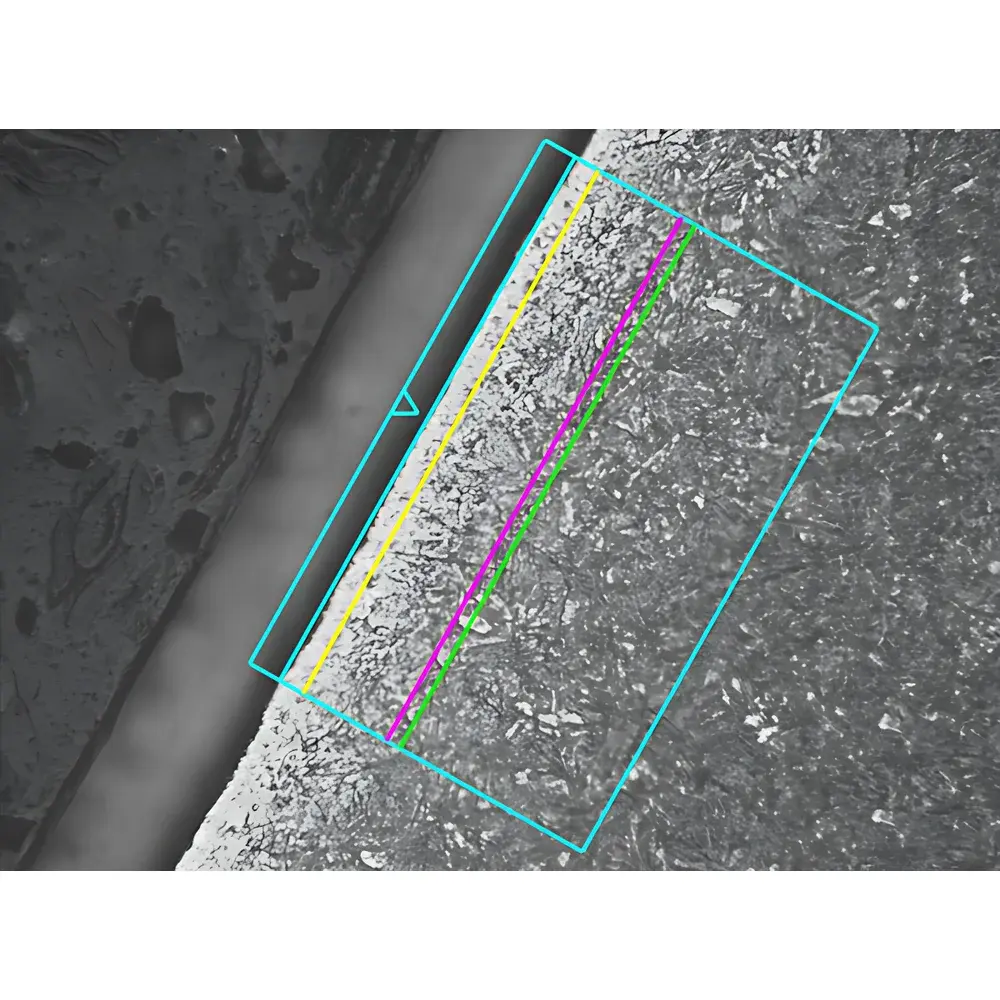
- Decarburization depth profiling in case-hardened components per ASTM E1077 and ISO 3887, including functional depth determination based on hardness-correlated carbon gradient modeling.
- Non-metallic inclusion rating per ASTM E45 and ISO 4967 using automated shape-filtered particle detection and ASTM Class A–D template matching.
- Coating thickness and interfacial porosity quantification in thermal spray deposits and PVD coatings via multi-layer edge detection and profile averaging.
FAQ
Which microscope models are certified for full LAS X ID Modules integration?
Leica DM2700 M, DM4 M, DM6 M, and DM2500 M metallurgical microscopes—with integrated motorized stages, encoded objectives, and DFC7000 T/T2 cameras—are fully supported. Third-party hardware requires Leica-certified interface adapters.
Can LAS X ID Modules be validated for ISO 17025 accreditation?
Yes. Leica provides IQ/OQ documentation packages, traceable calibration certificates for digital graticules, and uncertainty estimation guides aligned with ISO/IEC 17025:2017 Clause 7.7.
Is offline analysis possible without a connected microscope?
Yes. LAS X ID Modules operate in standalone mode using saved .tiff or .lif files. Calibration scales and objective metadata must be manually entered or embedded during prior acquisition.
How does LAS X handle batch processing of multiple samples?
The Batch Processor enables unattended analysis of >500 images using identical parameter sets. Output is consolidated into a master Excel report with per-image statistics, histograms, and annotated thumbnails.
Are software updates included in the initial license?
A 12-month maintenance subscription is included, covering all minor and major releases, security patches, and technical support via Leica’s global service network.




