Leica LAS X Professional Analysis Software
| Brand | Leica |
|---|---|
| Origin | Germany |
| Manufacturer Type | Authorized Distributor |
| Product Origin | Imported |
| Model | LAS X Professional Analysis |
| Pricing | Upon Request |
Overview
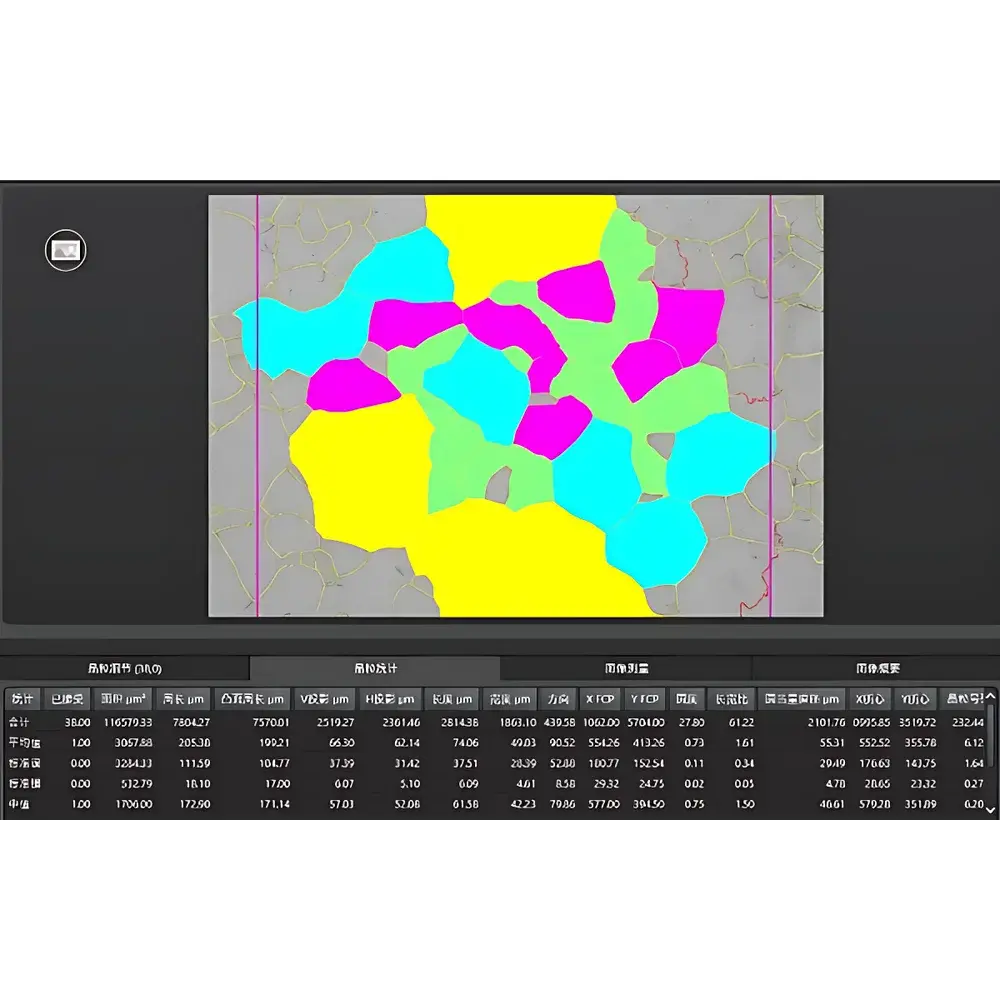
Leica LAS X Professional Analysis is a modular, standards-compliant image analysis software platform engineered for quantitative metallographic and microstructural evaluation on Leica optical and digital microscopy systems. Built upon a robust, audit-ready architecture, it implements rigorous computational metrology grounded in ISO/IEC 17025-aligned measurement principles—leveraging calibrated pixel-to-micron mapping, sub-pixel edge interpolation, and statistically validated segmentation algorithms. Unlike legacy manual or semi-automated methods, LAS X Professional Analysis applies traceable, two-dimensional morphometric analysis directly to high-resolution digital micrographs, eliminating reliance on stereological extrapolation. Its core engine supports reproducible, operator-independent quantification across diverse metallurgical specimen types—including ferrous alloys, cast irons, and clean steel sections—while maintaining full compliance with international testing protocols governing grain size, phase distribution, decarburization depth, graphite morphology, inclusion rating, and particulate contamination.
Key Features
- Modular expert modules—Grain Expert, Phase Expert, Decarburization Expert, Cast Iron Expert, Steel Expert, and Cleanliness Expert—each pre-configured with standardized measurement workflows and reporting templates.
- Automated, threshold-agnostic segmentation using adaptive local contrast normalization and multi-scale gradient-based edge detection for reliable feature isolation in heterogeneous microstructures.
- Full support for ASTM, ISO, DIN/EN, JIS, GOST, and regional standards—including real-time validation against acceptance criteria (e.g., ASTM E112 grain size number calculation, ISO 945-2 graphite nodule classification).
- Calibration traceability via integrated stage micrometer verification and dynamic pixel-size compensation across objective magnifications and camera binning modes.
- GLP/GMP-ready audit trail: All measurement parameters, user actions, timestamped calibration events, and raw image metadata are logged in an encrypted, non-modifiable database compliant with FDA 21 CFR Part 11 requirements.
Sample Compatibility & Compliance
The software operates on digitized micrographs acquired from Leica DM series upright and inverted metallographic microscopes equipped with DFC or ICC50 HD cameras. It accepts TIFF, JPEG2000, and Leica’s native LIF format with embedded spatial calibration data. All expert modules comply with relevant international standards: Grain Expert (ASTM E112, ISO 643, JIS G0551); Phase Expert (ISO 13083, ASTM E562); Decarburization Expert (ASTM E1077, ISO 3887); Cast Iron Expert (ASTM A247, ISO 945-2); Steel Expert (ASTM E45, ISO 4967, EN 10247); Cleanliness Expert (ISO 16232, VDA 19.1/19.2, USP ). Custom standard definitions can be imported via XML schema, enabling alignment with internal QA specifications or customer-specific release criteria.
Software & Data Management
LAS X Professional Analysis runs on Windows 10/11 (64-bit) with NVIDIA GPU acceleration for real-time rendering of large-area stitched images (up to 100k × 100k pixels). Data management follows ISO/IEC 17025 clause 7.5.2: all processed images retain original acquisition metadata; analysis reports export as PDF/A-1b or Excel (.xlsx) with embedded digital signatures and cryptographic hash verification. Version-controlled method files (.lasx) store complete analytical configurations—including ROI definitions, color space models (CIELAB, HSV), morphological filters, and statistical sampling strategies—for cross-laboratory method transfer and regulatory revalidation. Integration with Leica Application Suite X (LAS X) Core enables seamless linkage to microscope hardware control, Z-stack acquisition, and multi-channel fluorescence registration.
Applications
This software serves as the primary quantitative engine in quality control laboratories performing routine metallurgical certification per automotive OEM specifications (e.g., VW 60300, Ford WSS-M1A292-A), aerospace material approvals (AMS 2300, AMS 2301), and nuclear-grade component inspection (ASME BPVC Section III). Typical use cases include: automated ferrite/pearlite ratio determination in low-carbon steels; nodularity and spheroidization grading in ductile iron castings; decarburization layer mapping for heat-treated crankshafts; non-metallic inclusion rating under rotating beam fatigue qualification; and particulate contamination profiling of hydraulic valve components prior to high-pressure functional testing.
FAQ
Is LAS X Professional Analysis compatible with non-Leica microscopes?
No—it requires native integration with Leica microscope control firmware and calibrated camera modules to ensure pixel-scale traceability and hardware-synchronized acquisition.
Can custom measurement protocols be validated for ISO/IEC 17025 accreditation?
Yes—method validation documentation, uncertainty budgets, and inter-laboratory comparison reports are supported through Leica’s Qualified Validation Package (QVP), available under separate service agreement.
Does the software support multi-user role-based access control?
Yes—administrator, analyst, and reviewer roles enforce separation of duties; password policies, session timeouts, and electronic signature enforcement align with 21 CFR Part 11 Subpart C.
How frequently are new standards incorporated into expert modules?
Leica releases biannual software updates (typically March and September) that include certified updates for newly published revisions of ASTM, ISO, and EN standards—available to customers under active maintenance contracts.
Is offline analysis permitted for regulated environments?
Yes—licensed installations operate without internet connectivity; calibration certificates, standard reference images, and validation reports are delivered on secure USB media for air-gapped deployment.