
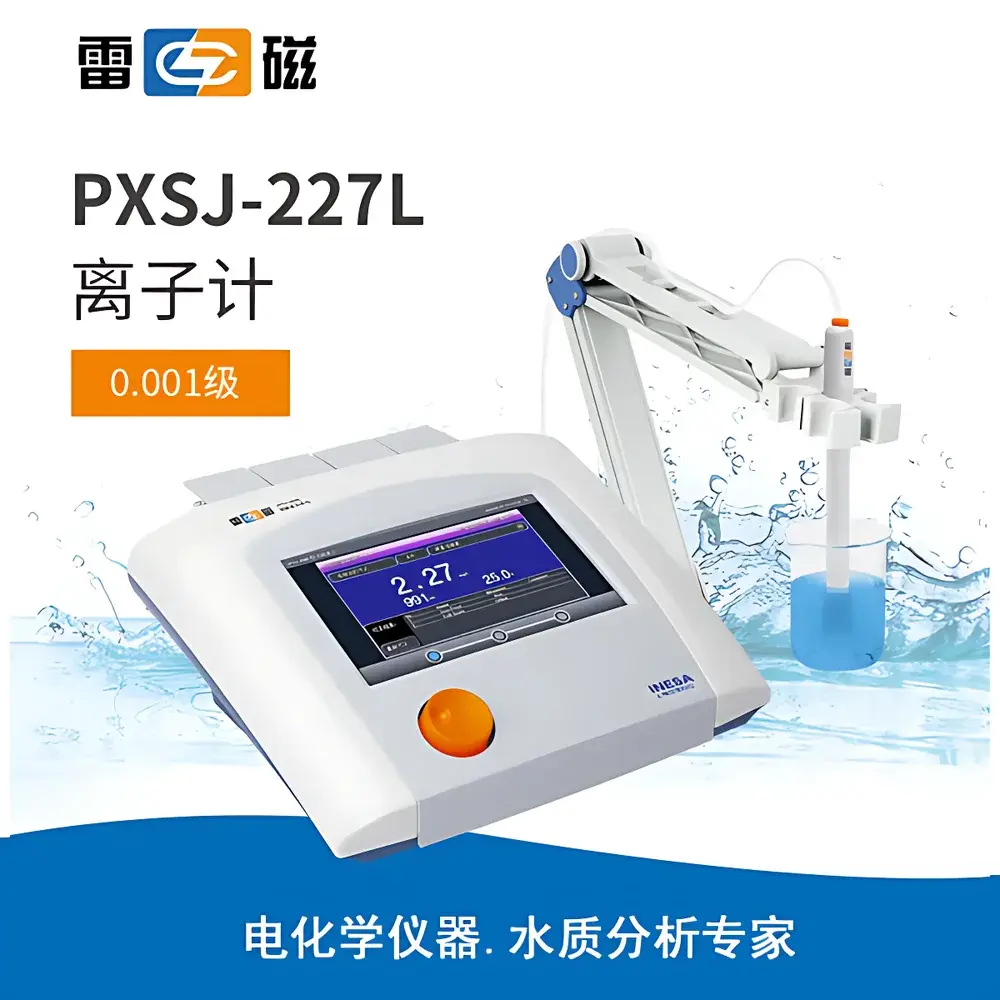
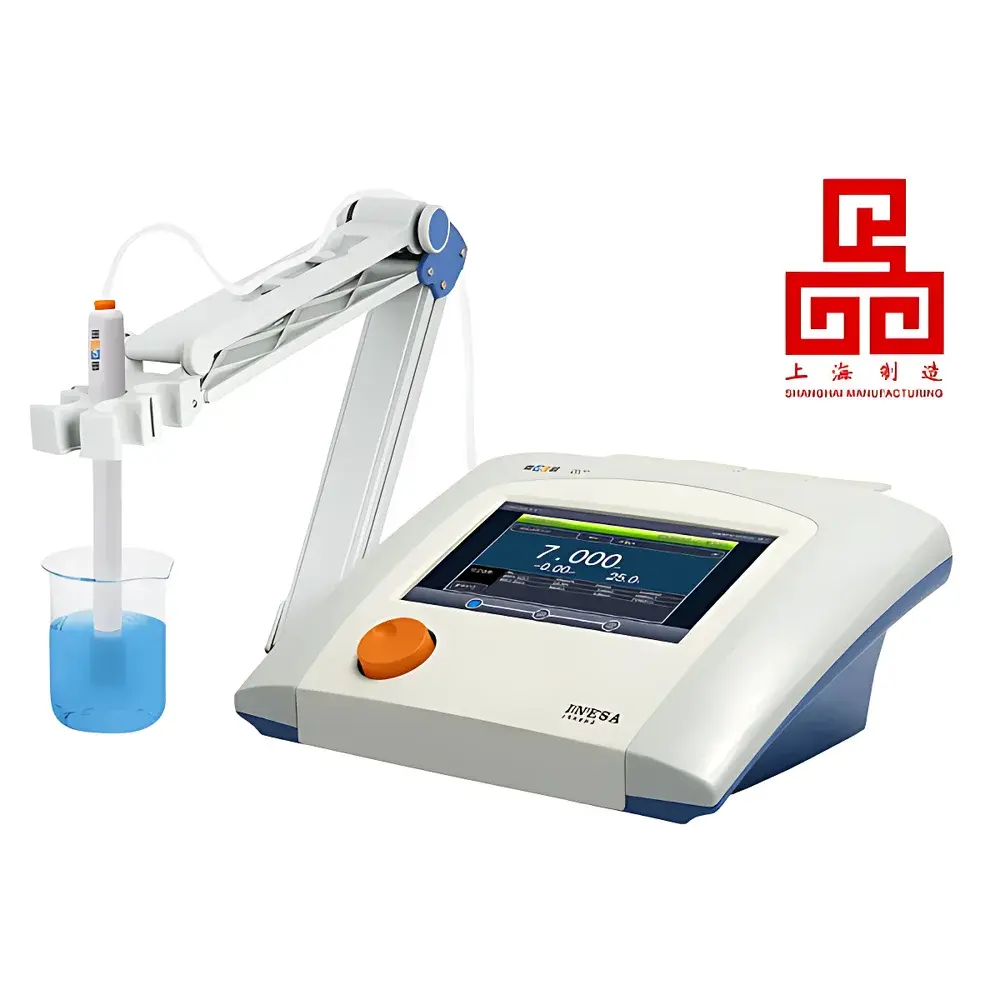
Leichi PXSJ-227L Benchtop Ion Analyzer
| Brand | Leichi |
|---|---|
| Model | PXSJ-227L |
| Type | Benchtop Multi-Ion Analyzer |
| Measurement Accuracy | Ion concentration displayed with four significant digits (scientific notation) |
| Temperature Range | (−5.0 to 130.0) °C |
| mV Range | (−2000.00 to +2000.00) mV |
| pH/pX Range | (−2.000 to 20.000) |
| pH/pX Resolution | 0.001 |
| mV Resolution | 0.01 mV |
| Temperature Resolution | 0.1 °C |
| Electronic Unit Error | ±0.002 pH/pX, ±0.03% FS for mV, ±0.3% for ion concentration, ±0.1 °C for temperature |
Overview
The Leichi PXSJ-227L Benchtop Ion Analyzer is a high-precision potentiometric measurement system engineered for quantitative determination of specific ionic species in aqueous solutions. Based on the Nernst equation and selective ion electrode (ISE) response principles, it delivers trace-level quantification of monovalent and multivalent ions—including H⁺, Na⁺, K⁺, NH₄⁺, Cl⁻, F⁻, and others—across six orders of magnitude (from μg/L to mol/L). Designed for routine laboratory use in environmental monitoring, municipal water treatment, industrial process control, and academic research, the instrument meets ISO/IEC 17025 technical competence requirements for ion-selective analysis and supports full traceability under Good Laboratory Practice (GLP) frameworks.
Key Features
- Potentiometric measurement architecture with automatic endpoint detection: supports auto-read, timed-read, interval-read, and manual-read modes for optimized workflow efficiency.
- Integrated automatic temperature compensation (ATC) across −5.0 °C to 130.0 °C, ensuring thermodynamic consistency in ion activity calculations.
- Flexible calibration management: 1–6 point calibration with built-in support for GB, DIN, and NIST standard buffer sets; user-defined calibration protocols are fully editable and storable.
- Multi-mode ion quantification: direct concentration measurement, standard addition, sample addition, and Gran plot analysis—all accessible via intuitive navigation.
- Comprehensive unit handling: seamless switching among μg/L, mg/L, g/L, mol/L, mmol/L, and pX units without recalibration or manual conversion.
- Robust hardware design: 280 × 280 × 130 mm footprint, 2.5 kg mass, and universal AC input (100–240 VAC) with regulated 24 VDC output ensure stable operation in diverse lab environments.
Sample Compatibility & Compliance
The PXSJ-227L is compatible with all commercially available liquid-contacting ion-selective electrodes (e.g., fluoride, chloride, ammonium, sodium), combination pH/ISE probes, and redox (ORP) sensors meeting standard BNC or DIN connectors. It complies with international metrological standards for electrochemical instrumentation: its 0.001-class accuracy rating aligns with JJG 757–2015 (China), ASTM D1293 (pH of water), and ISO 10523 (water quality – pH determination). Data integrity conforms to GLP requirements, including electronic signature-capable user authentication, audit-trail-enabled method/electrode/calibration logs, and tamper-evident storage of raw mV and temperature readings.
Software & Data Management
The embedded firmware provides full lifecycle data governance: up to 1000 complete measurement records—including electrode ID, calibration history, temperature-stamped mV values, and calculated concentrations—are stored locally with timestamp, operator ID, and method version. Export options include USB flash drive (FAT32 formatted) and PC connectivity via RS-232 or optional USB-to-serial adapter. All exported CSV files retain metadata headers compliant with LIMS ingestion standards. Method templates, electrode profiles, and user permissions (admin/operator/guest tiers) are centrally managed to enforce procedural consistency and regulatory readiness.
Applications
- Environmental laboratories: quantification of fluoride in groundwater per WHO guidelines; chloride monitoring in wastewater effluents per EPA Method 300.0.
- Drinking water utilities: verification of sodium and ammonium levels against EU Directive 98/83/EC and US EPA National Primary Drinking Water Regulations.
- Pharmaceutical QC: residual chloride assay in parenteral formulations per USP and ion balance validation in buffer preparation.
- Academic research: kinetic studies of ion exchange resins, speciation modeling in natural waters, and sensor response characterization under controlled ionic strength conditions.
- Industrial process labs: real-time monitoring of nitrate in fertilizer production streams or potassium in food-grade brine solutions.
FAQ
Does the PXSJ-227L support FDA 21 CFR Part 11 compliance?
No—while it supports GLP-compliant audit trails and user access control, it does not provide electronic signature functionality or system validation documentation required for Part 11 enforcement.
Can the instrument perform simultaneous multi-ion measurements?
No—it performs sequential single-ion analysis per electrode connection; concurrent measurement requires external multiplexing hardware not supplied with the base unit.
Is the temperature probe integrated or external?
A removable, Pt1000-compatible temperature sensor is included and connects via dedicated port; external probes with 2-, 3-, or 4-wire configurations may be substituted if impedance-matched.
What electrode types are validated for use with this analyzer?
Leichi-certified ISEs (e.g., PFB-1 fluoride, PCL-1 chloride, PAN-1 ammonium) and third-party electrodes conforming to ISO 8655-4 electrical interface specifications.
How is calibration verification performed between scheduled runs?
The system issues configurable alerts for overdue calibrations and allows quick verification using a single-point check standard; deviation thresholds are user-definable per ion mode.







