
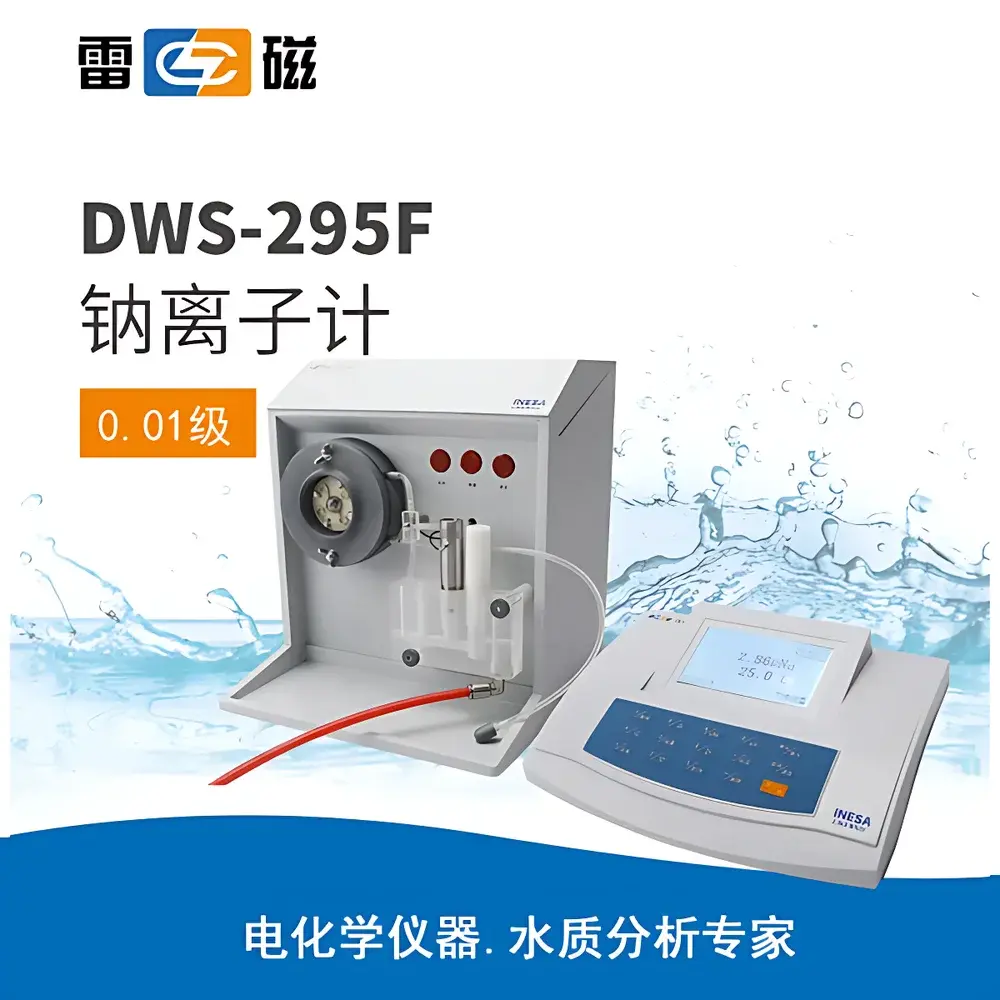
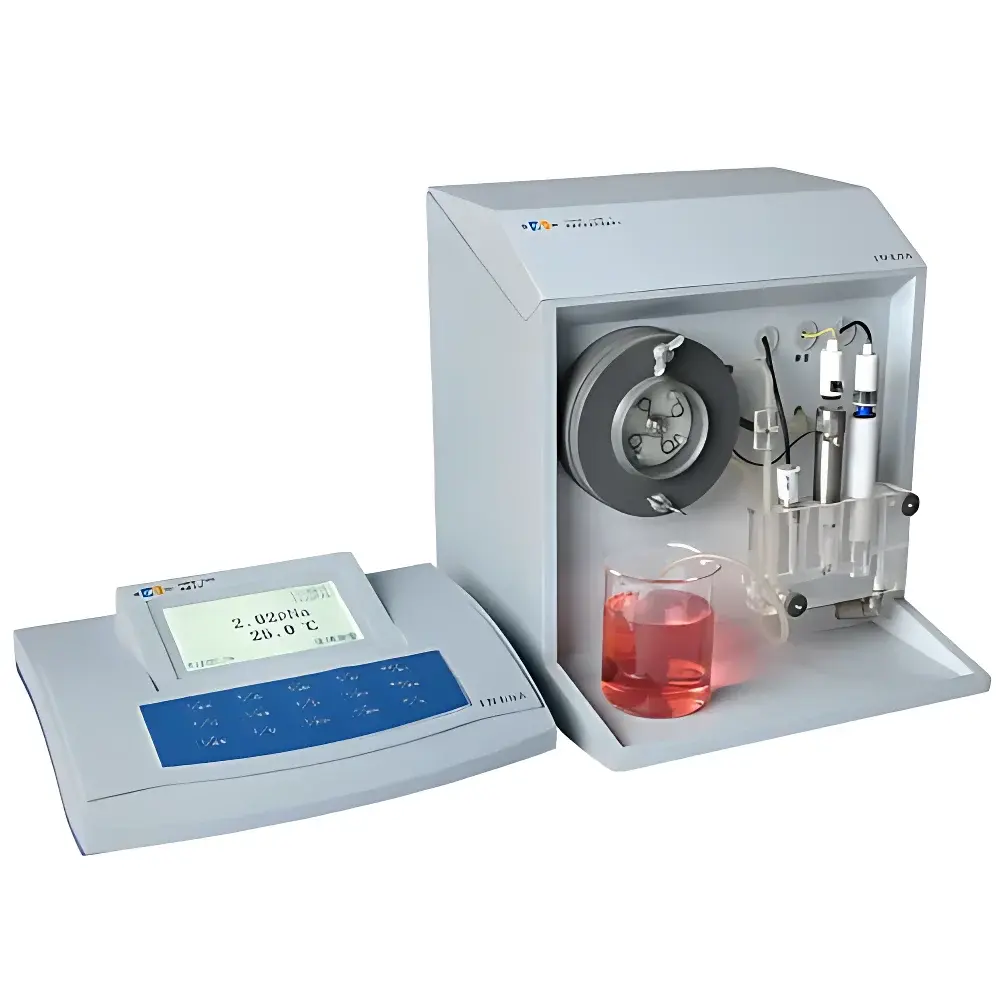
Leici DWS-295F Sodium Ion Analyzer
| Brand | Leici |
|---|---|
| Model | DWS-295F |
| Type | Benchtop Sodium Ion Analyzer |
| Measurement Accuracy | ±0.01 pNa |
| Temperature Range | −5.0 to 110.0 °C |
| pNa Range | 0.00–9.00 pNa |
| mV Range | −1999 to +1999 mV |
| [Na⁺] Concentration Range | 2.3×10⁻² to 2.3×10⁷ µg/L |
| Temperature Accuracy | ±0.2 °C |
| Data Storage Capacity | 50 sets (pNa, mV, or [Na⁺] with temperature) |
| Interface | USB |
| Power Supply | DC 9 V, 800 mA (center-positive) |
| Dimensions | 280 × 215 × 92 mm |
| Weight | 1 kg |
Overview
The Leici DWS-295F Sodium Ion Analyzer is a benchtop potentiometric instrument engineered for precise and reliable quantification of sodium ion activity in aqueous samples using a selective ion-sensitive electrode (ISE). Based on the Nernst equation, the analyzer measures the potential difference between a sodium-selective glass electrode and a reference electrode, converting the resulting electromotive force (EMF) into pNa (−log₁₀[Na⁺]) or direct Na⁺ concentration (µg/L), with simultaneous temperature compensation. It is specifically designed for high-purity water analysis in thermal power plants, semiconductor manufacturing, pharmaceutical water systems, and research laboratories—where trace-level sodium monitoring (<10 µg/L) is critical to prevent corrosion, scaling, or process contamination in steam cycles, boiler feedwater, condensate, and ultrapure water (UPW) distribution loops.
Key Features
- Triple-electrode measurement architecture: sodium-selective electrode, reference electrode, and temperature sensor—enabling concurrent display of pNa/mV/[Na⁺] paired with real-time temperature (°C).
- Automatic temperature compensation (ATC) across −5.0 to 110.0 °C, using integrated Pt1000 or thermistor input; eliminates manual correction and ensures thermodynamic consistency per IUPAC guidelines.
- Self-calibrating slope verification: calculates and displays electrode theoretical slope (% of Nernstian response, 59.16 mV/pNa at 25 °C) after two-point calibration, supporting routine electrode performance validation.
- Non-volatile memory retention: retains up to 50 measurement records—including pNa, mV, [Na⁺], and temperature—with timestamp—preserved during power interruption per IEC 61000-4-2 compliance for industrial environments.
- Dual print modes: supports both raw data export (CSV-compatible format) and formatted analytical reports via USB-connected printers or host PCs.
- USB 2.0 full-speed interface compliant with CDC ACM class drivers—enables bidirectional communication with Windows/macOS/Linux hosts for remote control, data logging, and firmware updates without proprietary software.
Sample Compatibility & Compliance
The DWS-295F is validated for use with low-conductivity, low-ionic-strength matrices typical of high-purity water systems (e.g., <0.1 µS/cm resistivity). It accommodates samples with turbidity ≤5 NTU and suspended solids <1 mg/L—requiring filtration (0.45 µm membrane) prior to analysis per ASTM D4195 and ISO 10523 standards. The instrument meets GB/T 27025 (equivalent to ISO/IEC 17025) requirements for calibration traceability when used with NIST-traceable sodium standard solutions (e.g., 0.01 pNa and 4.00 pNa buffers). Its design supports GLP-compliant workflows through audit-ready data storage, user-accessible calibration logs, and parameter lockout functionality to prevent unauthorized configuration changes.
Software & Data Management
Data acquisition and management are facilitated via native USB CDC serial protocol, allowing integration with third-party laboratory information management systems (LIMS) or custom Python/Matlab scripts using standard pySerial or libusb libraries. Each stored record includes pNa value, corresponding mV reading, calculated [Na⁺] (µg/L), measured temperature, calibration date/time, and electrode slope (%). Exported files adhere to UTF-8 encoding and RFC 4180 CSV structure—ensuring compatibility with Excel, OriginLab, and statistical process control (SPC) platforms. No proprietary runtime or dongle licensing is required; all firmware and configuration tools are distributed as open binary images under Leici’s public technical support portal.
Applications
- Steam cycle chemistry control: continuous monitoring of sodium in turbine condensate and boiler feedwater per EPRI TR-102129 and ASME PTC 19.11 guidelines.
- Ultrapure water (UPW) qualification in semiconductor fabs: detection of sodium leachates from piping, valves, and ion exchange resins at sub-ppb levels.
- Pharmaceutical purified water (PW) and water for injection (WFI) system validation per USP and EU Annex 1.
- Research-scale desalination and electrodialysis studies requiring real-time Na⁺ flux quantification.
- Educational laboratories: hands-on instruction in ion-selective electrode theory, Nernstian behavior, and error propagation in trace ion analysis.
FAQ
What sodium-selective electrode is compatible with the DWS-295F?
The instrument is optimized for Leici’s 6801-01 sodium glass electrode (pNa range: 0.00–7.00) and 232-01 double-junction reference electrode with KNO₃ electrolyte—both certified to ISO 17025-accredited calibration reports.
Does the DWS-295F support automatic calibration verification (ACV)?
No; ACV requires dynamic standard addition and flow-cell integration. The DWS-295F performs static two-point calibration only—but includes slope diagnostics and drift alerts based on consecutive readings.
Can it measure sodium in seawater or brine?
Not recommended. High ionic strength (>100 mM total dissolved solids) causes significant activity coefficient deviation and junction potential errors. Use for freshwater, deionized water, and steam condensate only.
Is FDA 21 CFR Part 11 compliance supported?
The device itself does not include electronic signature or audit trail modules. However, exported CSV data may be imported into Part 11-compliant LIMS or ELN systems that enforce user authentication, change control, and archival integrity.







