
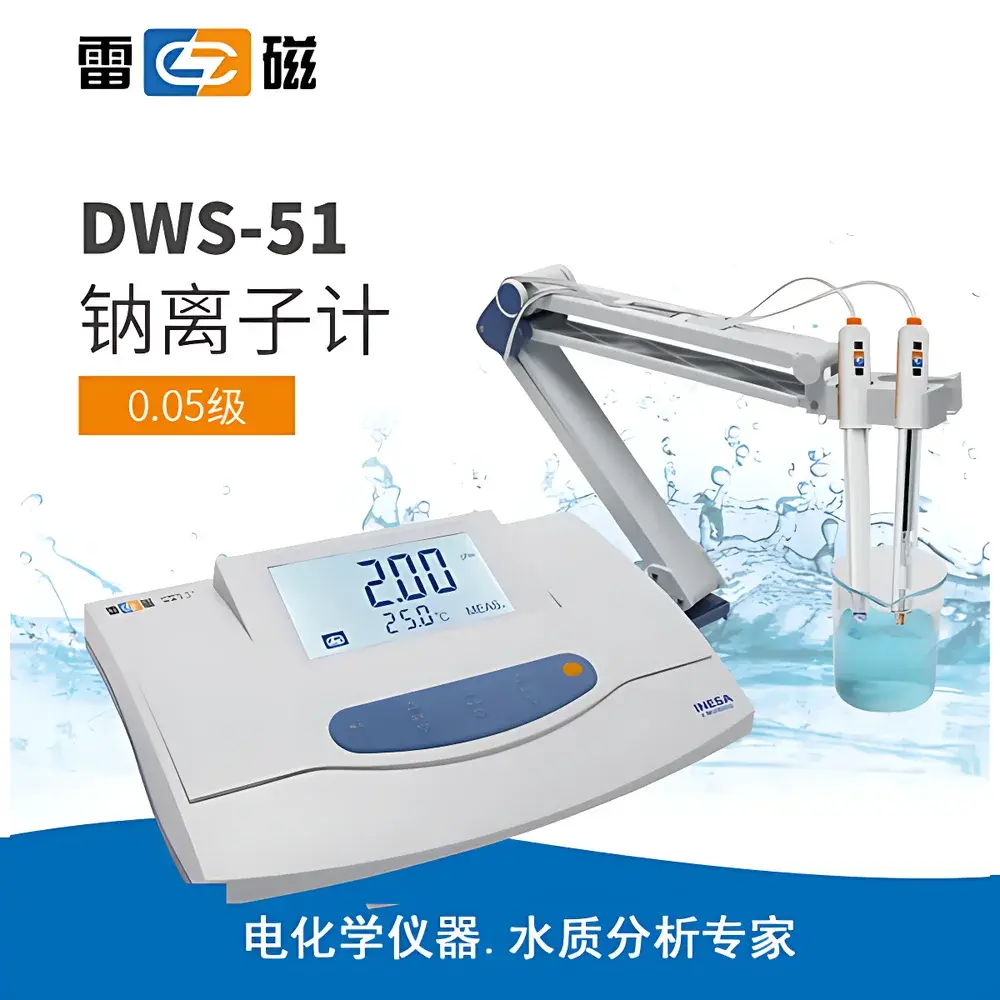
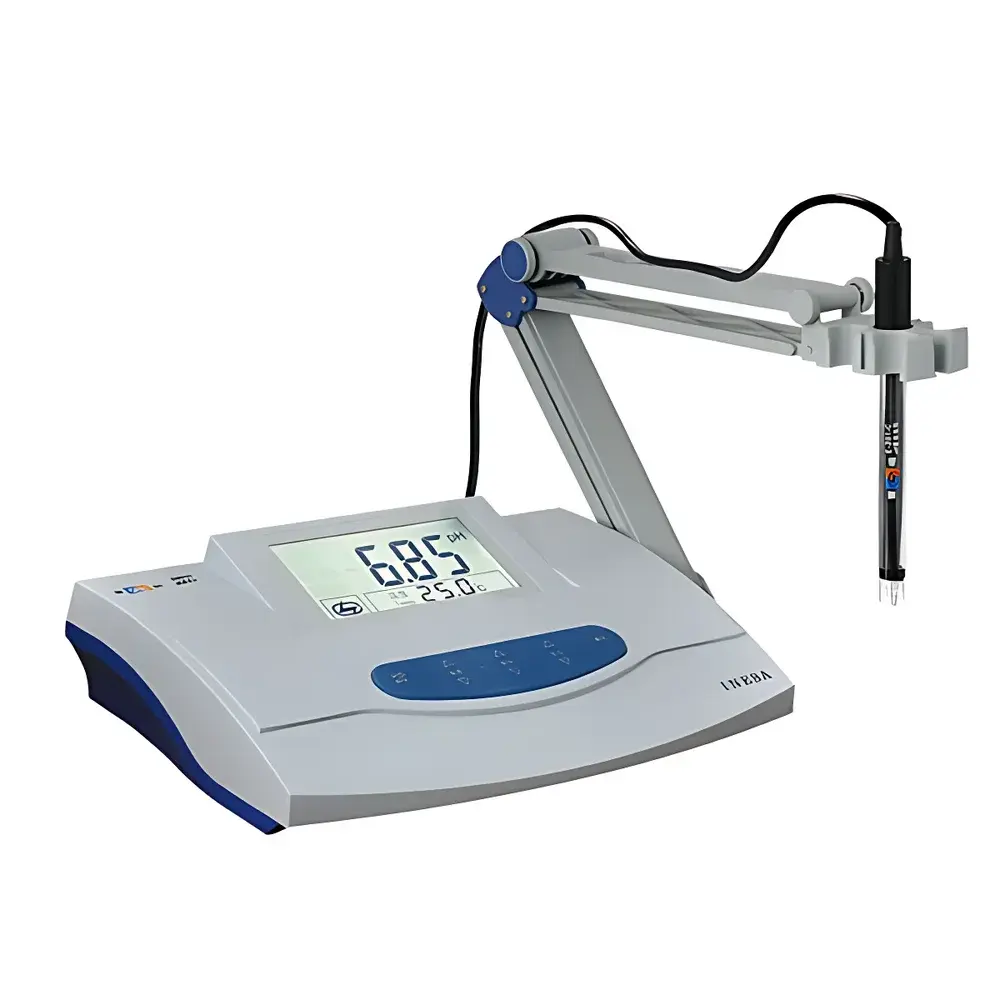
Leici DWS-51 Sodium Ion Meter
| Brand | Leici |
|---|---|
| Origin | Shanghai, China |
| Manufacturer Type | Authorized Distributor |
| Country of Origin | China |
| Model | DWS-51 |
| Instrument Category | Sodium Ion Meter |
| Form Factor | Benchtop |
| Measurement Accuracy | ±0.02 pNa |
| Display | LCD segment-type |
| Temperature Compensation | Manual |
| Calibration | Two-point (static/dynamic) |
| Measurement Modes | Static and Dynamic (with optional DWS-51-1 alkalizing unit) |
| Output | pNa and [Na⁺] concentration (μg/L) |
| Measurement Range | pNa 0.00–9.00 |
| Electronic Unit Error | ±3% conversion error (reading-based) |
| Power Supply | AC 220 V ±10%, 50 Hz ±2% |
| Dimensions | 290 × 210 × 95 mm |
| Weight | 1.5 kg |
Overview
The Leici DWS-51 Sodium Ion Meter is a benchtop potentiometric analyzer engineered for precise, trace-level sodium ion quantification in low-conductivity aqueous matrices—particularly critical in high-purity water systems used in power generation, semiconductor manufacturing, pharmaceutical water-for-injection (WFI) loops, and steam-cycle chemistry monitoring. It operates on the principle of selective ion detection via a solid-state sodium-selective electrode (SSE), generating a Nernstian potential response proportional to the logarithmic activity of Na⁺ ions in solution. The instrument reports results in both pNa units (−log₁₀[Na⁺]) and direct mass concentration (μg/L), enabling seamless integration into regulatory reporting frameworks requiring trace metal compliance (e.g., ASTM D4582, ASTM D1129, IAPWS guidelines for boiler feedwater). Its 0.05-class accuracy per JJG 757–2015 (Chinese national metrological verification regulation for ion meters) ensures reproducibility suitable for routine QC and GLP-aligned environmental and industrial water labs.
Key Features
- Benchtop design with compact footprint (290 × 210 × 95 mm) and lightweight construction (1.5 kg), optimized for space-constrained analytical workstations.
- Segment-type LCD display providing simultaneous, high-contrast readout of pNa value and corresponding [Na⁺] concentration in μg/L—eliminating manual log-conversion errors.
- Manual temperature compensation (0–50 °C range), allowing correction based on user-measured sample temperature for improved thermodynamic consistency.
- Two-point calibration protocol supporting both static (immersed electrode in standard solutions) and dynamic (flow-through mode with optional DWS-51-1 alkalizing unit) configurations—enabling adaptation to either grab-sample analysis or inline process stream monitoring.
- Integrated pNa ↔ [Na⁺] conversion algorithm compliant with IUPAC-recommended activity coefficient approximations for dilute aqueous systems, with ≤±3% relative error in concentration derivation from measured pNa.
- Rugged housing and EMI-resistant analog front-end designed for stable operation in electrically noisy environments common in power plant control rooms and industrial laboratories.
Sample Compatibility & Compliance
The DWS-51 is validated for use with deionized water, condensate, boiler feedwater, turbine drain samples, and ultrapure process rinse waters. It requires minimal sample pretreatment—no filtration or acidification is needed for typical applications—though alkalization (via optional DWS-51-1 unit) is recommended for sub-ppb-level measurements to suppress H⁺ interference and maintain electrode selectivity. The instrument meets Chinese national metrological standard JJG 757–2015 for ion meters and supports documentation practices aligned with ISO/IEC 17025 clause 7.7 (uncertainty estimation) and FDA 21 CFR Part 11 principles when paired with external electronic lab notebooks (ELN). While not intrinsically certified for hazardous locations, its CE-marked power supply complies with EN 61010-1:2010 safety requirements for laboratory electrical equipment.
Software & Data Management
The DWS-51 operates as a standalone analog-digital hybrid instrument without embedded firmware-based data logging. All measurement data—including timestamped pNa readings, calibrated [Na⁺] values, temperature inputs, and calibration history—are recorded manually or exported via RS-232 interface (optional adapter) to third-party LIMS or Excel-based QA templates. This architecture ensures full audit trail transparency and avoids proprietary software lock-in. Laboratories implementing GMP or GLP workflows routinely integrate the DWS-51 into structured paper-based SOPs that mandate dual-operator verification, calibration certificate archiving, and daily system suitability checks using certified reference materials (e.g., NIST-traceable Na⁺ standards at 0.1, 1.0, and 10 μg/L levels).
Applications
- Monitoring sodium breakthrough in mixed-bed ion exchange resins and EDI modules serving ultra-pure water systems.
- Verifying sodium carryover in steam generators and assessing corrosion risk in supercritical boiler circuits.
- Validating cleaning efficacy in pharmaceutical clean-in-place (CIP) cycles where residual Na⁺ indicates inadequate rinsing.
- Supporting environmental compliance testing under China’s GB 3838–2002 surface water quality standards (Class I–II limits: ≤0.2 mg/L Na⁺).
- Calibration and verification of online sodium analyzers in continuous emission monitoring systems (CEMS) for thermal power plants.
FAQ
What is the minimum detectable sodium concentration with the DWS-51?
The theoretical lower limit corresponds to pNa 9.00, equivalent to 2.3×10⁻² μg/L; however, practical detection in field use is typically ≥0.1 μg/L due to electrode conditioning, junction potential stability, and ambient contamination control.
Can the DWS-51 measure sodium in seawater or high-salinity brines?
No—it is optimized for low-ionic-strength matrices (<100 μS/cm); high background cation concentrations cause severe selectivity loss and non-Nernstian response; use dedicated high-range ion chromatography or ICP-MS instead.
Is automatic temperature compensation available?
No—the DWS-51 implements manual temperature entry only; users must measure sample temperature separately using a calibrated thermometer prior to analysis.
Does the instrument support GLP-compliant calibration recordkeeping?
Yes—when used with standardized calibration logs (including standard lot numbers, expiry dates, operator ID, and environmental conditions), it satisfies core GLP documentation requirements for traceable ion analysis.
What electrode types are compatible with the DWS-51?
It accepts standard BNC-input sodium-selective electrodes meeting DIN 19263 or ASTM D1129 specifications; Leici’s own 6801-01 solid-state Na⁺ electrode is recommended for optimal slope stability and lifetime (>12 months under proper storage).
Related Products







