
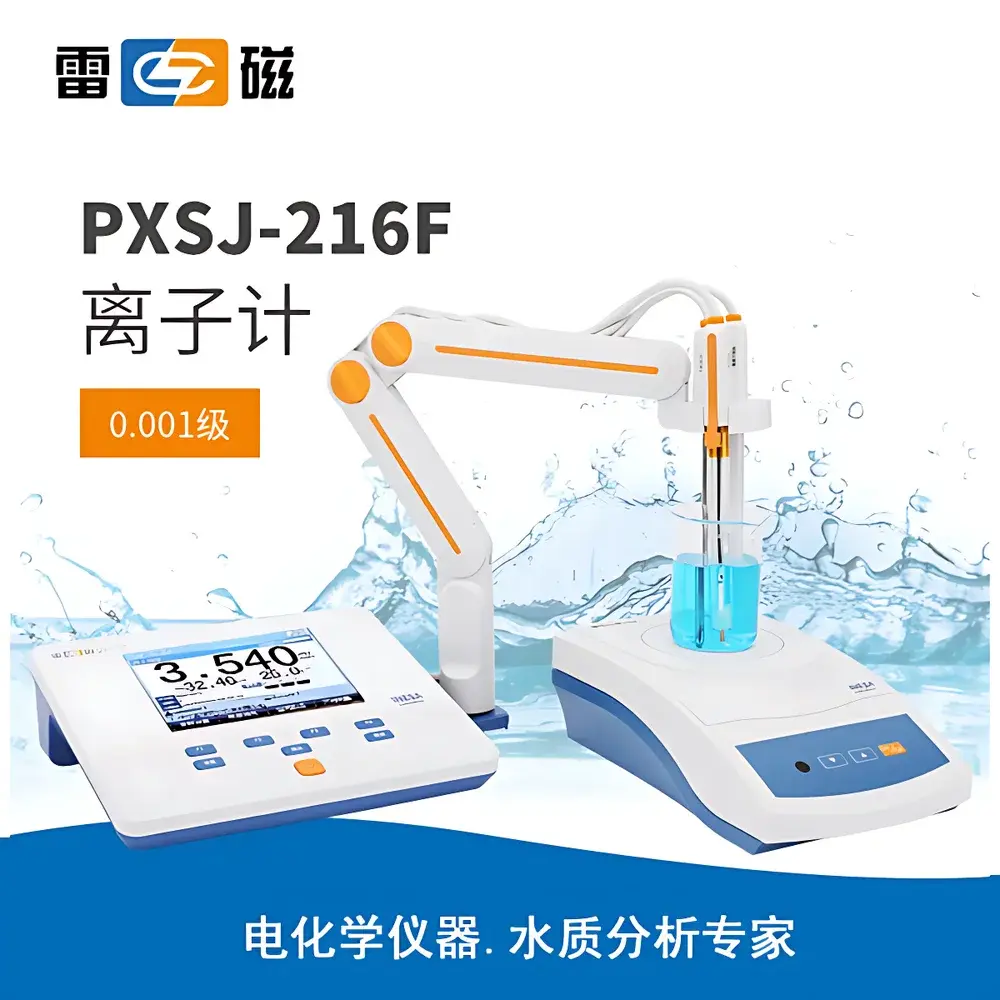
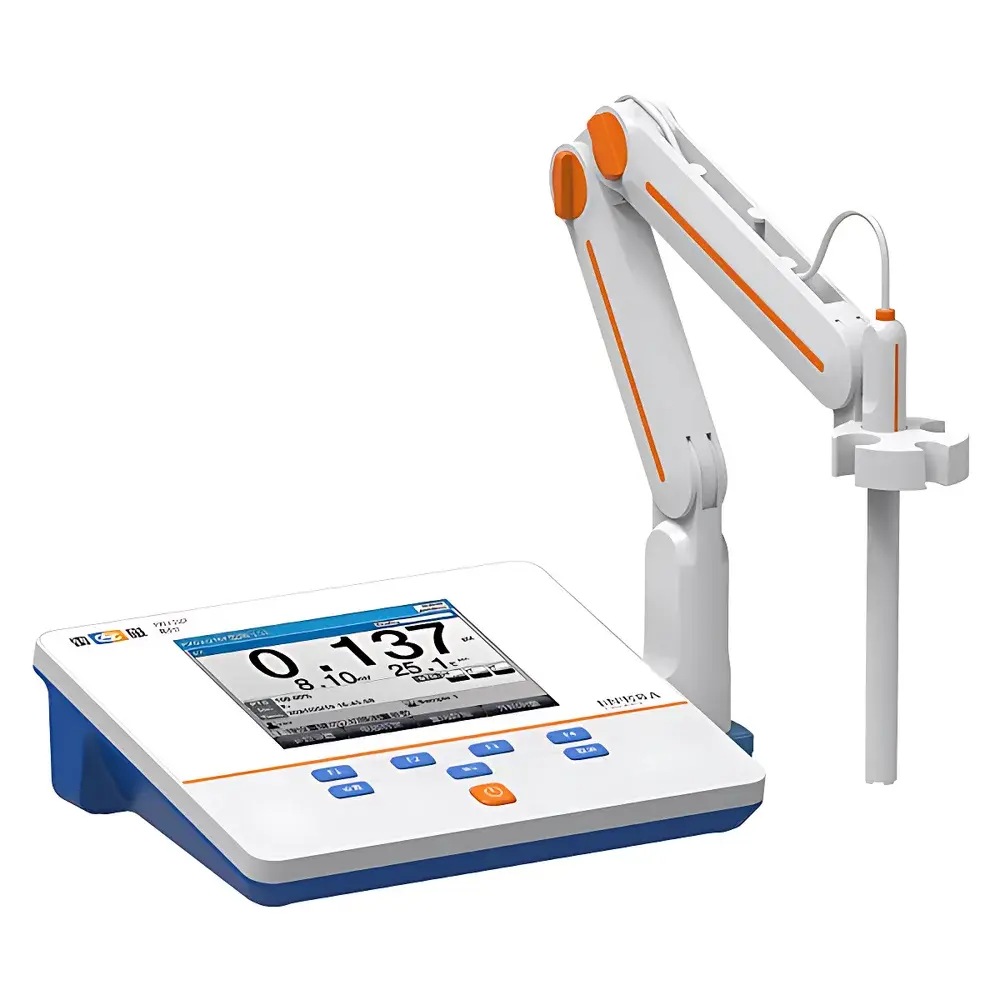
Leici PXSJ-216F Benchtop Ion Analyzer
| Brand | Leici |
|---|---|
| Origin | Shanghai, China |
| Model | PXSJ-216F |
| Instrument Type | Benchtop |
| Ion Measurement Range | (−2.000 to 20.000) pX |
| Resolution | 0.001 pX |
| Temperature Range | (−10.0 to 135.0) °C |
| Temperature Resolution | 0.1 °C |
| mV Range | (−2000.00 to 2000.00) mV |
| mV Resolution | 0.01 mV |
| pH Range | (−2.000 to 20.000) pH |
| pH Resolution | 0.001 pH |
| Ion Concentration Units | mol/L, mmol/L, g/L, mg/L, μg/L |
| Data Storage Capacity | 500 sets |
| Compliance | GLP-compliant data logging |
| Interface | RS-232, USB |
| IP Rating | IP54 |
| Power Supply | DC 9 V (AC 100–240 V input adapter) |
| Dimensions | 242 × 195 × 68 mm |
| Weight | 0.9 kg |
Overview
The Leici PXSJ-216F Benchtop Ion Analyzer is a high-precision potentiometric measurement system engineered for quantitative determination of monovalent and multivalent ionic species in aqueous solutions. Operating on the Nernst equation principle, it measures the electromotive force (EMF) generated across an ion-selective electrode (ISE) membrane relative to a stable reference electrode, enabling direct calculation of ion activity and concentration. Designed for routine and regulatory water quality analysis, the instrument supports rigorous applications in environmental monitoring laboratories, municipal water treatment facilities, academic research, and industrial process control—where trace-level quantification of F⁻, Cl⁻, NO₃⁻, NH₄⁺, K⁺, Na⁺, and other target ions is required under ISO 10523, ASTM D1293, EPA Method 300.0, and GB/T 5750 series standards.
Key Features
- High-resolution color LCD display with intuitive graphical interface for real-time parameter visualization and menu navigation
- Selectable measurement resolution: 0.001 pX / 0.001 pH / 0.01 mV, configurable per application requirement
- Intelligent endpoint detection algorithms supporting auto-read, timed-read, interval-read, and manual acquisition modes
- Comprehensive temperature compensation: automatic or manual, with dual-unit support (°C/°F) and ±0.1 °C accuracy
- Multi-standard buffer recognition: preloaded calibration profiles for GB, DIN, NIST, USA, and MERK pH buffers; user-definable buffer groups and custom ISE calibration solutions
- IP54-rated enclosure ensuring dust resistance and limited water ingress protection for stable operation in non-sterile lab environments
- Built-in support for five primary ion modes (Na⁺, K⁺, NH₄⁺, Cl⁻, F⁻), with expandable user-defined ion configurations
- Flexible concentration unit conversion: seamless switching among mol/L, mmol/L, g/L, mg/L, and μg/L without recalibration
- Four validated analytical methods: direct concentration mode, standard addition, sample addition, and Gran plot titration for enhanced accuracy in complex matrices
Sample Compatibility & Compliance
The PXSJ-216F is optimized for aqueous liquid samples within −10.0 to 135.0 °C, accommodating both ambient and elevated-temperature measurements typical in wastewater effluent, drinking water, groundwater, and industrial rinse waters. Its design conforms to Good Laboratory Practice (GLP) requirements through mandatory audit-trail functionality: each stored record includes timestamp, operator ID (user-configurable), electrode serial number, calibration history, temperature value, and measurement mode. All data entries are immutable post-acquisition, satisfying traceability mandates under ISO/IEC 17025 and supporting FDA 21 CFR Part 11 readiness when paired with validated PC software and access-controlled user accounts. The instrument accepts standard double-junction reference electrodes and interchangeable ISEs compliant with international dimensional and electrical specifications (e.g., BNC input, 0–1000 mV output range).
Software & Data Management
Data integrity and workflow integration are ensured via dual communication interfaces: RS-232 enables direct connection to dot-matrix or thermal label printers for GLP-compliant hardcopy reports—with customizable print templates including sample ID, date/time, electrode status, and statistical summaries. USB connectivity allows bidirectional transfer of up to 500 measurement records to Windows-based PCs using Leici’s certified communication suite, which supports CSV export, batch editing, trend plotting, and electronic signature capture. Internal memory retains full metadata for every entry—including calibration coefficients, slope (%), asymmetry potential, and residual error—facilitating retrospective method validation and inter-laboratory comparison studies. Firmware updates are performed locally via USB drive, preserving configuration settings while enabling future protocol enhancements.
Applications
- Regulatory compliance testing for fluoride in drinking water per WHO guidelines (1.5 mg/L) and US EPA MCL (4.0 mg/L)
- Ammonium monitoring in activated sludge systems and nitrification/denitrification control loops
- Chloride quantification in boiler feedwater to prevent stress corrosion cracking
- Soil leachate analysis for nitrate migration assessment in agricultural runoff studies
- Electrolyte concentration verification in pharmaceutical excipient solutions (USP )
- Calibration verification of online ISE sensors used in continuous water quality monitoring networks
FAQ
Does the PXSJ-216F support calibration verification with certified reference materials?
Yes—it accepts CRM traceable to NIST or BAM standards for both pH and ion-specific calibrations; slope and offset diagnostics are automatically logged.
Can the instrument perform multi-point ion calibration?
It supports 1–5 point calibration for pH and pX modes, with linear and non-linear (e.g., Gran) fitting options enabled per ion type.
Is temperature compensation mandatory during ion concentration measurement?
Temperature compensation is recommended for all quantitative analyses; the system applies the Nernstian temperature coefficient (dE/dT) dynamically unless manually disabled.
What electrode types are compatible beyond the included F⁻ sensor?
Any standardized BNC-connectable ISE meeting IUPAC-recommended impedance (<10⁹ Ω) and response time (<30 s) specifications may be used.
How is data security maintained during USB transfer?
No encryption is applied at the device level; secure handling requires encrypted host storage and controlled network access per organizational IT policy.
Related Products







