
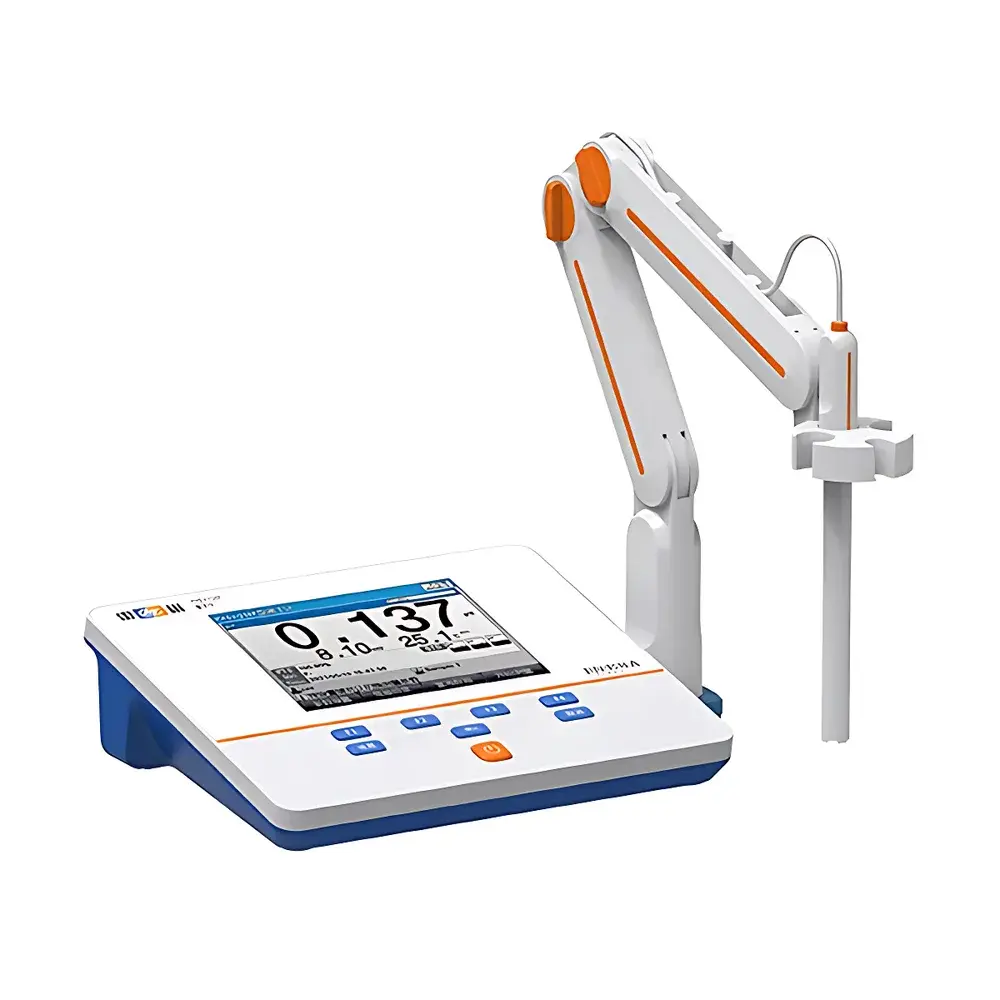
Leici PXSJ-216F Benchtop Multi-Ion Analyzer
| Brand | Leici |
|---|---|
| Origin | Shanghai, China |
| Model | PXSJ-216F |
| Instrument Type | Benchtop |
| Measurement Range | pH (−2.000 to 20.000) |
| Detection Range | 0–19990 (units: µg/L, mg/L, g/L, mol/L, mmol/L) |
| Response Time | 10 s |
| Accuracy | ±0.002 pH/pX |
| Temperature Range | −5.0 to 110.0 °C |
Overview
The Leici PXSJ-216F Benchtop Multi-Ion Analyzer is a high-precision potentiometric measurement system engineered for quantitative determination of hydrogen ion activity (pH) and specific monovalent and multivalent ions in aqueous solutions. Based on the Nernst equation principle, it measures the potential difference between an ion-selective electrode (ISE) and a reference electrode under controlled temperature conditions, converting millivolt signals into logarithmic pX or concentration values. Designed for routine and regulatory-compliant water quality analysis, the instrument supports direct potentiometric, standard addition, sample addition, and Gran plot methodologies—enabling trace-level quantification across environmental, municipal, industrial wastewater, and drinking water laboratories. Its architecture integrates real-time thermocompensation, multi-point calibration validation, and dual-mode operation (pH/pX/mV/temperature), ensuring metrological traceability and measurement integrity in variable matrix conditions.
Key Features
- Smart-Read algorithm: Automatically detects electrochemical equilibrium with configurable stability criteria (±0.001 pH/pX over 3–10 s), minimizing operator-dependent endpoint judgment.
- Timed-Read and Cont-Read modes: Enable time-series logging at user-defined intervals (1–3600 s) and continuous real-time monitoring of dynamic ion concentration shifts during titration or process changes.
- Electrode health diagnostics: Monitors slope deviation, asymmetry potential, and zero-point drift; alerts users when calibration validity falls outside ISO 17025–recommended thresholds.
- Firmware upgradability via USB: Ensures long-term compliance with evolving metrological standards without hardware replacement.
- GLP-compliant data governance: Assigns unique operator IDs, timestamps all calibrations and measurements, and logs full audit trails—including electrode ID, buffer lot numbers, ambient temperature, and calibration residuals.
- High-resolution graphical LCD: 128 × 64 dot-matrix display with backlight; shows concurrent readings of pX, concentration (with unit), mV, temperature, ion type, calibration status, and date/time.
- Auto-buffer recognition: Identifies and applies correction factors for GB, NIST, and DIN pH standard buffer sets during 2–5 point calibration sequences.
Sample Compatibility & Compliance
The PXSJ-216F is validated for use with standard ISEs (e.g., Ag⁺, F⁻, Cl⁻, NO₃⁻, Ca²⁺, Pb²⁺) and combination pH electrodes meeting IUPAC-recommended specifications. It accommodates samples with total dissolved solids (TDS) ≤ 5000 mg/L and turbidity < 10 NTU without filtration. All stored data conform to GLP requirements per OECD Series on Principles of Good Laboratory Practice and support FDA 21 CFR Part 11 readiness when paired with validated PC software (Leici LabLink Pro v3.2+). Calibration records include uncertainty estimates derived from buffer certificate tolerances and electrode slope linearity (R² ≥ 0.9998 over 3-point fit). The instrument meets IEC 61010-1:2010 safety standards for laboratory electrical equipment and operates within Class II electromagnetic compatibility limits.
Software & Data Management
Data export and remote control are enabled via USB 2.0 interface using Leici LabLink Pro software (Windows 10/11 compatible). The software provides secure user authentication (role-based access control), electronic signature capture for critical actions, and automated report generation compliant with ISO/IEC 17025 clause 7.8. Up to 1400 complete measurement records are retained onboard: 200 pH entries, 100 pX datasets per ion type (six preconfigured ions), and 100 corresponding concentration results—including raw mV, temperature, electrode ID, calibration coefficients, and residual errors. Internal memory employs non-volatile flash storage with power-loss protection; data can be exported as CSV or PDF with embedded metadata for third-party LIMS integration.
Applications
- Environmental monitoring: Quantification of fluoride in groundwater (per WHO Guideline Limits), nitrate in surface runoff (EPA Method 300.0), and heavy metals (Pb²⁺, Cu²⁺) in effluent per ISO 10566.
- Drinking water compliance: Routine verification of chloride, sodium, and ammonium against EU Directive 98/83/EC and GB 5749–2022.
- Industrial process control: Monitoring of etchant bath composition (e.g., HF/NO₃⁻ ratios in semiconductor cleaning) and boiler feedwater cation balance.
- Educational laboratories: Teaching potentiometric principles, Gran plot analysis, and ISE selectivity coefficient determination (log Kpot) using mixed-ion standard solutions.
- Research applications: Kinetic studies of ion exchange resins, membrane transport assays, and speciation modeling in natural waters using sequential pX/mV/temperature acquisition.
FAQ
Does the PXSJ-216F support automatic temperature compensation during pX measurements?
Yes—integrated Pt1000 sensor enables real-time ATC across −5.0 to 110.0 °C, applying Nernstian temperature correction to both slope and intercept terms in pX calculation.
Can custom ions be defined beyond the 13 preloaded types?
Yes—users may configure up to 10 additional ion definitions by entering valence, selectivity coefficient (if known), and default unit preferences via the setup menu.
Is the internal memory battery-backed to prevent data loss during power interruption?
Yes—the instrument uses EEPROM with built-in power-fail detection circuitry, preserving all GLP records even during unexpected AC loss.
What is the maximum number of calibration points supported for a single ion?
Up to five points, with linear or polynomial (quadratic) fitting options; residual error per point is displayed post-calibration.
Does the USB interface support direct connection to modern macOS or Linux systems?
No—USB communication requires Windows-based Leici LabLink Pro software; cross-platform connectivity is achievable only via exported CSV files.







