
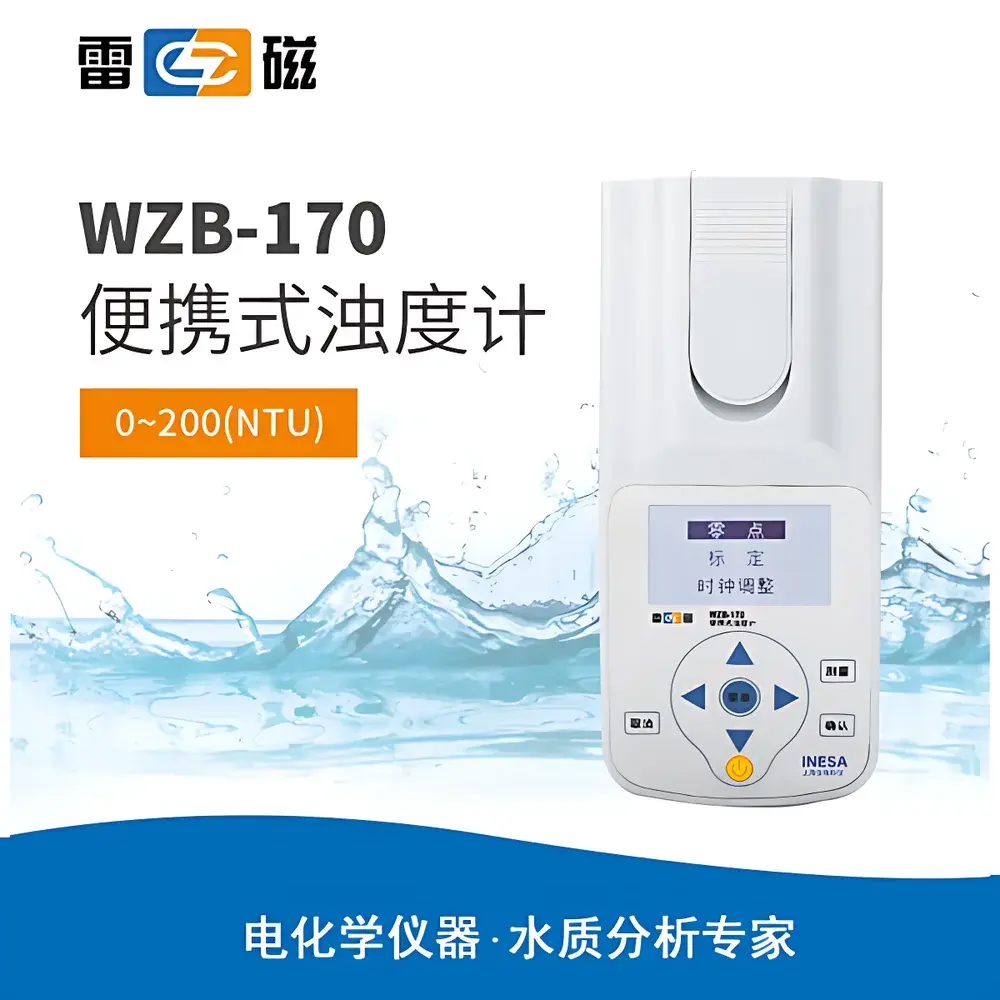
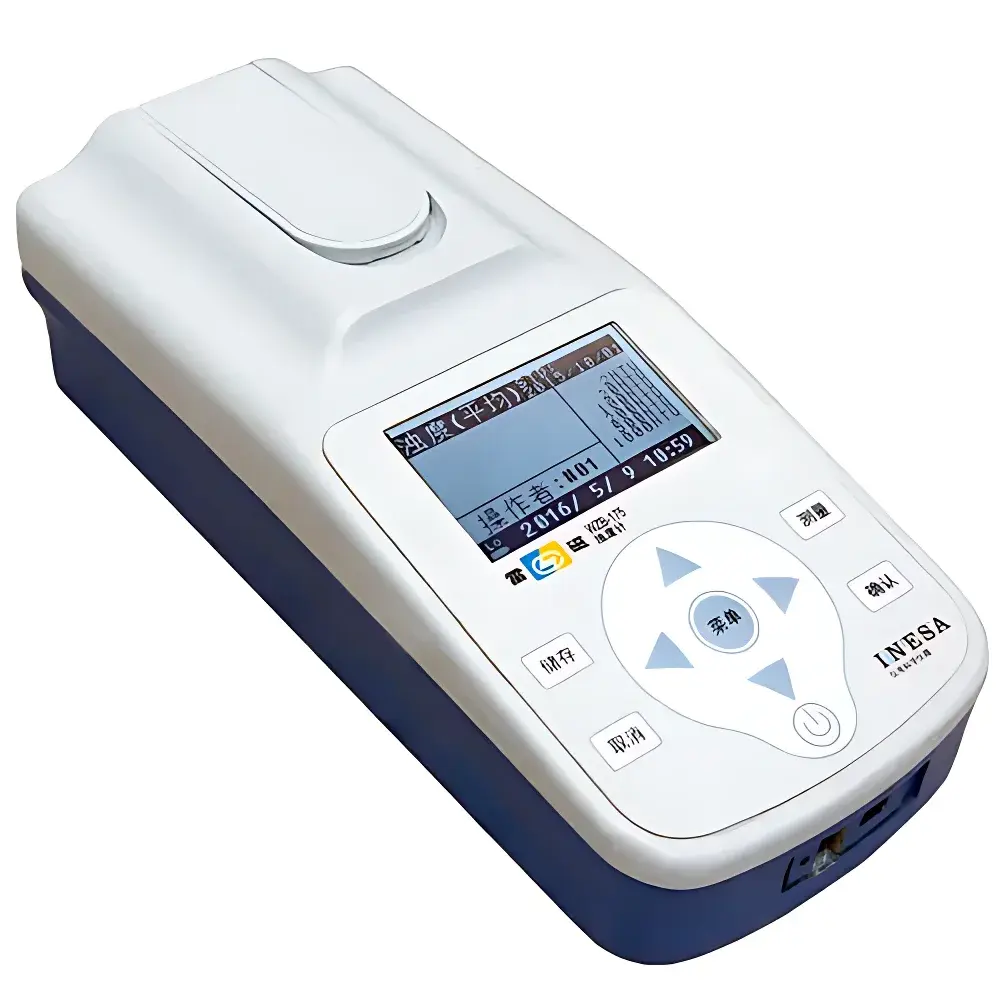
Leici WZB-170 Portable Turbidimeter
| Brand | Leici |
|---|---|
| Model | WZB-170 |
| Type | Portable Turbidimeter |
| Measurement Range | 0.00–20.00 NTU, 20.0–200.0 NTU, 200–1000 NTU |
| Resolution | 0.01 / 0.1 / 1 NTU (auto-ranging) |
| Accuracy | ±8% FS |
| Repeatability | ≤1.0% |
| Zero Drift | ±1.0% FS / 30 min |
| Stability | ±0.5% FS / 30 min |
| Light Source | 860 nm infrared LED compliant with ISO 7027 and HJ 1075 |
| Operating Temperature | (5–35) °C |
| Protection Rating | IP65 |
| Display | Monochrome LCD |
| Power Supply | 4 × AA batteries or DC 5 V adapter (AC 200–240 V input) |
| Dimensions | 100 × 220 × 80 mm |
| Weight | ~0.8 kg |
| Calibration Options | Zero-point correction + up to 3-point calibration (2, 20, 200 NTU) |
| Standard Accessories | 400 NTU formazin standard solution, calibrated turbidity vials, rugged carrying case |
Overview
The Leici WZB-170 Portable Turbidimeter is an optical measurement instrument engineered for field-deployable, on-site water quality assessment in accordance with internationally recognized photometric standards. It operates on the principle of nephelometric turbidity measurement—detecting the intensity of light scattered at 90° by suspended particles in aqueous samples using a stable 860 nm infrared LED source. This wavelength minimizes interference from sample coloration and ensures compliance with ISO 7027 (Water quality — Determination of turbidity) and China’s HJ 1075-2019 (Standard Methods for Environmental Monitoring), making it suitable for regulatory monitoring, environmental field surveys, drinking water distribution system verification, and wastewater effluent screening. Its compact, battery-powered architecture enables uninterrupted operation across remote sampling locations, mobile laboratories, and emergency response scenarios where AC power is unavailable.
Key Features
- Infrared LED light source (860 nm) with spectral stability and long-term output consistency—designed to meet ISO 7027 spectral requirements and eliminate chromatic interference common in colored water matrices.
- Auto-ranging measurement capability spanning three dynamic ranges: 0.00–20.00 NTU (high-resolution low-range mode), 20.0–200.0 NTU (mid-range), and 200–1000 NTU (high-range)—ensuring optimal signal-to-noise ratio across diverse sample types.
- Integrated zero-point correction function and programmable multi-point calibration (up to three points: 2, 20, and 200 NTU) using NIST-traceable formazin standards, supporting both single-point verification and full calibration curve validation.
- IP65-rated enclosure provides dust-tight sealing and protection against low-pressure water jets—enabling reliable use in humid outdoor environments, rain-exposed sampling sites, or near splash-prone treatment infrastructure.
- Monochrome LCD display with high-contrast character rendering and intuitive icon-driven navigation—optimized for readability under direct sunlight and gloved operation.
- Built-in power management with automatic shutdown and non-volatile memory retention—preserving calibration settings, last-measured values, and configuration parameters during battery replacement or extended storage.
Sample Compatibility & Compliance
The WZB-170 is validated for use with clear to highly turbid aqueous samples, including surface water, groundwater, potable water, filtered effluents, and process streams in municipal and industrial water treatment facilities. It accommodates standard 25-mm round glass vials (included) with precision-matched optical path geometry to minimize cell-to-cell variability. All measurement protocols align with ISO/IEC 17025 documentation practices when used within a defined quality management system. While not certified for GLP or FDA 21 CFR Part 11 compliance out-of-the-box, its audit-ready calibration logs (date/time-stamped zero and standard checks) support traceability in regulated environments when integrated into laboratory SOPs. The instrument meets CE marking requirements for electromagnetic compatibility (EN 61326-1) and safety (EN 61010-1).
Software & Data Management
The WZB-170 operates as a standalone field instrument without proprietary software dependencies. All calibration events, measurement timestamps, and range-switching actions are stored internally and displayed on-screen for immediate review. No USB or Bluetooth interface is provided; data export requires manual transcription or optional external logging via analog output (if equipped per regional variant). For laboratories requiring electronic records, integration with LIMS or ELN systems can be achieved through standardized manual entry protocols aligned with ISO/IEC 17025 clause 7.5.2 (control of recorded information). Calibration certificates for included 400 NTU standard solution are supplied with batch-specific uncertainty statements traceable to national metrology institutes.
Applications
- Field verification of filtration efficiency in drinking water plants and membrane pilot studies.
- Routine monitoring of raw intake water turbidity for early warning of algal blooms or sediment resuspension events.
- Compliance checks against local discharge limits (e.g., <5 NTU for municipal wastewater effluent per China’s GB 18918-2002).
- Educational demonstrations of light scattering principles and calibration methodology in university environmental science labs.
- Emergency response testing following natural disasters or infrastructure failures where rapid turbidity assessment informs boil-water advisories.
FAQ
Does the WZB-170 require annual recalibration by an accredited lab?
No—user-performed zero and multi-point calibrations using certified standards satisfy routine verification requirements. External recalibration is recommended only if performance drift exceeds ±8% FS during internal QC checks.
Can the instrument measure samples with air bubbles or floating debris?
Air bubbles and large particulates introduce positive bias due to enhanced light scatter. Samples must be gently inverted—not shaken—to de-gas, and allowed to settle prior to measurement per ISO 7027 section 7.3.
Is the 400 NTU standard solution certified to ISO 8772?
The supplied standard is prepared per formazin polymerization protocol described in ISO 7027 Annex A and accompanied by a certificate indicating nominal value, batch number, expiration date, and expanded uncertainty (k=2).
What battery life can be expected during continuous operation?
With alkaline AA cells, typical operational duration exceeds 10 hours at room temperature with backlight disabled; battery status indicator alerts users at ≤20% remaining capacity.
How is thermal drift managed during extended field use?
The optical module incorporates passive thermal stabilization; however, users are advised to allow 15 minutes of warm-up time after ambient temperature shifts >5°C before initiating critical measurements.




