
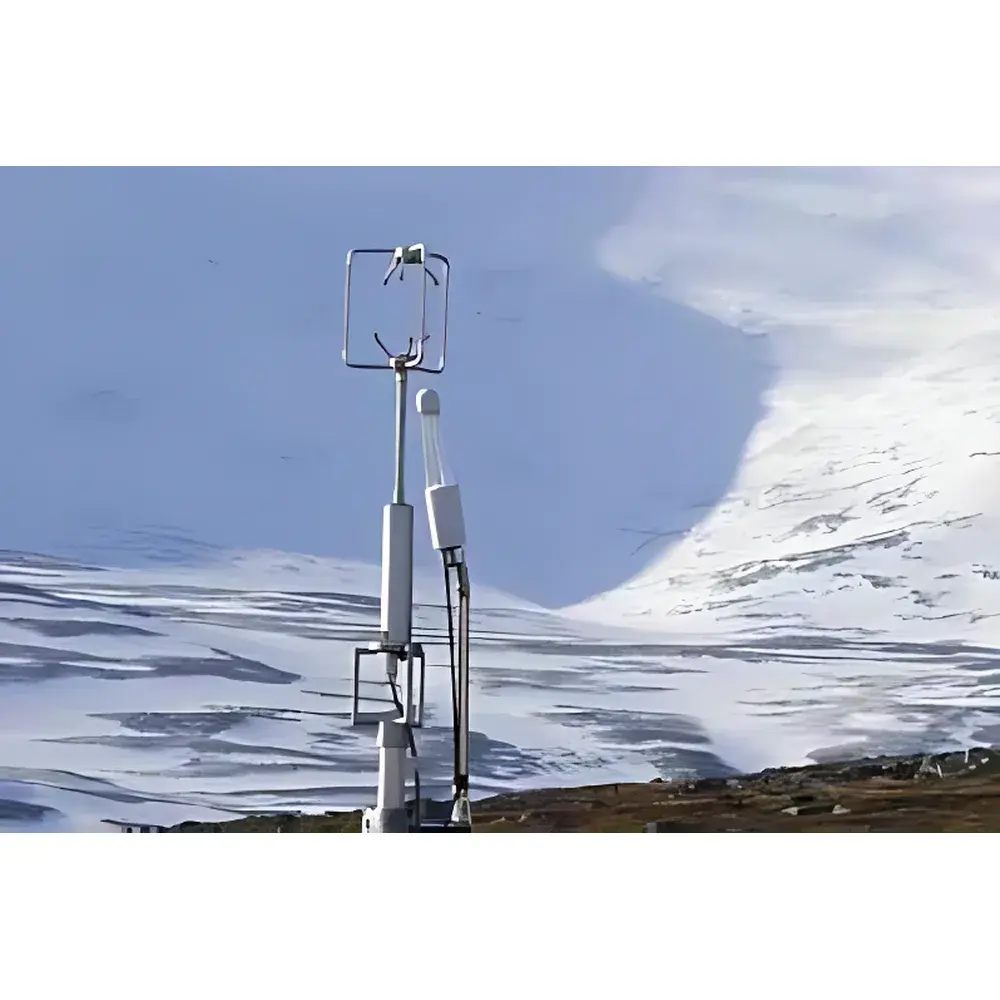
LI-COR LI-7500DS Open-Path CO₂/H₂O Eddy Covariance Flux Analysis System
| Brand | LI-COR |
|---|---|
| Origin | USA |
| Model | LI-7500DS |
| Power Consumption | 4 W (typical), up to 8 W (operational range) |
| CO₂ Measurement Range | 0–3000 µmol/mol |
| H₂O Measurement Range | 0–60 mmol/mol |
| Accuracy | <1% for both CO₂ and H₂O |
| Zero Drift (CO₂) | ±0.1 µmol/mol/°C (typ.), ±0.3 µmol/mol/°C (max.) |
| Zero Drift (H₂O) | ±0.03 mmol/mol/°C (typ.), ±0.05 mmol/mol/°C (max.) |
| RMS Noise @5 Hz (CO₂) | 0.08 µmol/mol |
| RMS Noise @5 Hz (H₂O) | 0.0034 mmol/mol |
| Bandwidth Options | 5, 10, or 20 Hz |
| Sampling Frequency | 150 Hz |
| Detector | Thermoelectrically Cooled PbSe |
| Optical Path Length | 12.5 cm |
| Data Interface | Ethernet |
| Operating Temperature | −25 to +50 °C (extendable to −40 to +50 °C) |
| IP Rating | IP65 |
| Air Temperature Sensor | 10 kΩ thermistor (−40 to +70 °C, ±0.25 °C accuracy) |
| Pressure Sensor | 20–110 kPa (±0.4 kPa accuracy) |
| Probe Dimensions | Ø6.5 × 30 cm |
| Weight | 0.67 kg (probe only), 1.3 kg (with base) |
| DSI Box Dimensions | 13.24 × 14.64 × 6.24 cm (H×W×D) |
| Weight | 0.93 kg |
Overview
The LI-COR LI-7500DS is an open-path, dual-gas (CO₂ and H₂O) eddy covariance flux analysis system engineered for high-temporal-resolution, long-term atmospheric flux measurements in ecological, agricultural, and climate research. It operates on the principle of non-dispersive infrared (NDIR) absorption spectroscopy, utilizing thermoelectrically cooled lead selenide (PbSe) detectors and a fixed 12.5 cm optical path to deliver absolute, calibration-free concentration measurements at native 150 Hz sampling. Designed specifically for integration with three-dimensional ultrasonic anemometers, the LI-7500DS enables direct calculation of turbulent vertical fluxes of carbon dioxide and water vapor using the eddy covariance method — the internationally accepted standard for ecosystem-scale gas exchange quantification (ISO 16620-2, Ameriflux & FLUXNET protocols). Its low power draw (4 W typical), robust IP65-rated enclosure, and extended operational temperature range (−40 to +50 °C) make it suitable for unattended deployment across remote field sites, including tundra, forest canopies, grasslands, and agricultural fields.
Key Features
- Open-path NDIR architecture eliminates sample tubing, pumps, and drying systems — reducing lag time, maintenance requirements, and measurement artifacts associated with closed-path configurations.
- Dual-gas simultaneous detection with cross-sensitivity compensation: CO₂ response corrected for H₂O interference (±2.0 × 10⁻⁵ mol CO₂/mol H₂O typ.), and H₂O response corrected for CO₂ interference (±0.02 mol H₂O/mol CO₂ typ.).
- SmartFlux® embedded processing unit integrated into the DSI (Data Signal Interface) box performs real-time eddy covariance flux computation using identical algorithms as desktop EddyPro® software — ensuring full traceability and audit compliance with GLP/GMP data integrity standards.
- Configurable bandwidth (5/10/20 Hz) allows optimization for signal-to-noise ratio versus temporal resolution based on site-specific turbulence characteristics and instrument height.
- Onboard air temperature (10 kΩ thermistor) and barometric pressure sensors provide essential ancillary meteorological inputs required for density corrections (Webb-Pearman-Leuning) and flux partitioning.
- Ethernet communication interface supports remote configuration, firmware updates, and streaming of raw 150 Hz data or pre-processed flux outputs via TCP/IP or Modbus protocols.
Sample Compatibility & Compliance
The LI-7500DS is designed for continuous, in-situ measurement of ambient atmospheric CO₂ and H₂O mole fractions without physical sampling. It complies with international flux network best practices defined by FLUXNET, AmeriFlux, and ICOS, and meets key performance benchmarks referenced in ISO 16620-2 (greenhouse gas flux measurement) and ASTM D6348 (standard test method for gaseous emissions). Its zero and gain stability specifications support multi-year deployments under GLP-compliant environmental monitoring programs. The system satisfies FDA 21 CFR Part 11 requirements when deployed with SmartFlux® and FluxSuite® — enabling electronic signatures, audit trails, and secure user access control for regulated carbon accounting applications.
Software & Data Management
Raw high-frequency data from the LI-7500DS are ingested and processed using LI-COR’s EddyPro® software (v8.2+), which implements standardized post-processing steps including coordinate rotation, sonic temperature correction, WPL density correction, spectral correction, and gap-filling. When paired with SmartFlux®, all these operations occur in real time at the tower edge — eliminating latency between data acquisition and actionable flux metrics. FluxSuite® provides cloud-based visualization, alarm notification, and metadata synchronization across distributed networks. All data exports conform to NetCDF CF-1.8 conventions and include embedded provenance metadata (instrument ID, calibration history, processing flags), facilitating FAIR (Findable, Accessible, Interoperable, Reusable) data management.
Applications
- Long-term carbon and water flux monitoring across terrestrial ecosystems (forests, wetlands, croplands, tundra).
- Validation of satellite-derived gross primary productivity (GPP) and evapotranspiration (ET) models.
- Soil respiration partitioning studies using automated chamber coupling and nighttime flux analysis.
- Urban boundary layer studies assessing anthropogenic CO₂ emissions and urban heat island effects.
- Climate change impact assessments requiring decadal-scale trend detection in net ecosystem exchange (NEE).
- Regulatory reporting for carbon offset verification under Verra, Gold Standard, or California Cap-and-Trade Program protocols.
FAQ
What distinguishes the LI-7500DS from earlier LI-7500 models?
The LI-7500DS replaces analog signal processing with a fully digital architecture, integrating the SmartFlux® computing engine directly into the DSI box — enabling real-time flux computation, enhanced noise rejection, and simplified cabling.
Can the LI-7500DS be used with third-party ultrasonic anemometers?
Yes — it supports synchronized analog and digital triggering with any anemometer providing TTL pulse output or compatible RS-232/RS-485 timing signals, provided spatial separation and alignment meet FLUXNET geometric criteria.
Is factory calibration traceable to NIST standards?
Yes — each unit ships with a certificate of calibration traceable to NIST-standard gas mixtures, and field recalibration is supported using certified span gases and zero-air generators per ISO 6141.
How is data security ensured during remote transmission?
FluxSuite® supports TLS 1.2 encryption, role-based access control, and immutable audit logs compliant with ISO/IEC 27001 information security management frameworks.
What maintenance is required for long-term operation?
Optical windows require periodic cleaning (typically quarterly in dusty environments); no consumables, filters, or internal recalibrations are needed under normal operating conditions.
Related Products







