
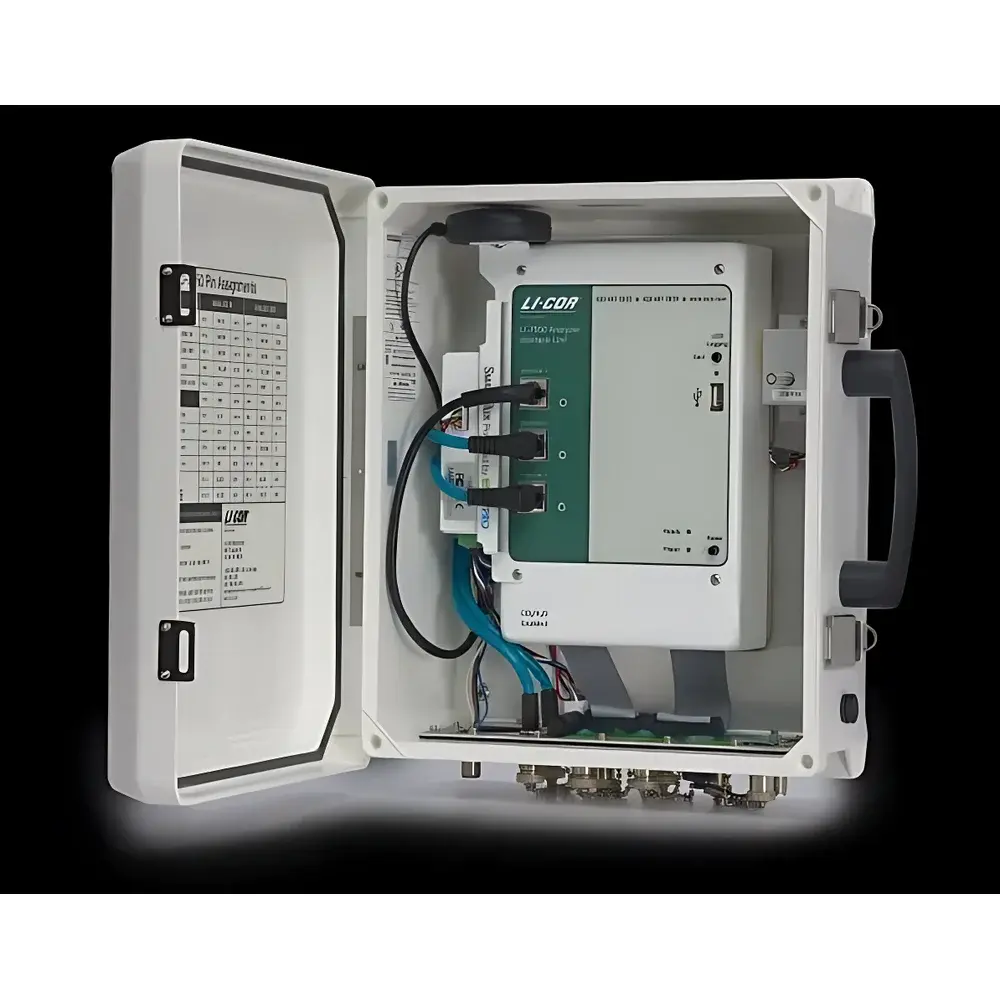
LI-COR SMARTFlux Real-Time Online Eddy Covariance Flux Processing Module
| Brand | LI-COR |
|---|---|
| Origin | USA |
| Model | SMARTFlux |
| Instrument Type | Eddy Covariance Flux Processing Module |
| Compatibility | LI-7500DS, LI-7200RS gas analyzers |
| Clock Synchronization | GPS + IEEE 1588 Precision Time Protocol (PTP) |
| Data Processing | Onboard EddyPro® software v8.2+ |
| Power Output | 24 VDC for 3D sonic anemometers |
| Interface | Digital SDI-12 & RS-485 support for sonic anemometers |
| Enclosure Rating | IP65-rated housing optional |
| Remote Monitoring | Integrated FluxSuite® web interface with email alerting |
Overview
The LI-COR SMARTFlux Real-Time Online Eddy Covariance Flux Processing Module is a field-deployable, embedded computing platform engineered to execute full-stack eddy covariance (EC) flux processing in situ—without reliance on post-hoc desktop computation. Built around the industry-standard EddyPro® software suite, the SMARTFlux module implements the complete EC data processing pipeline—including coordinate rotation (double-rotation or planar fit), spectral correction, time-lag optimization, density corrections (WPL), and high-frequency covariance computation—in real time. It synchronizes high-speed 3D sonic anemometer wind velocity data (typically at 10–60 Hz) with concurrent CO2, H2O, CH4, and auxiliary biometeorological measurements (e.g., net radiation, soil heat flux, air temperature, humidity) using GPS-disciplined oscillators and IEEE 1588 Precision Time Protocol (PTP). This ensures sub-millisecond temporal alignment across heterogeneous sensors—a prerequisite for physically valid turbulent flux estimates under evolving atmospheric stability conditions.
Key Features
- Onboard EddyPro® software (v8.2 or later) running on a ruggedized, fanless industrial computer with Linux OS—enabling autonomous, unattended operation for >12 months per deployment cycle
- Native digital interface support for SDI-12 and RS-485–enabled 3D sonic anemometers (including Campbell Scientific CSAT3B/CSAT3A, METEK uSonic-3 Class A, Gill WindMaster Pro, and R.M. Young 81000 series), eliminating analog signal degradation and ADC quantization errors
- Dedicated 24 VDC power output for direct powering of compatible sonic anemometers—reducing cabling complexity and voltage drop over tower runs
- USB 3.0 host port for automatic ingestion and archiving of raw high-frequency time series from connected gas analyzers (LI-7500DS, LI-7200RS) and biomet loggers (CR6, CR1000X)
- GPS + PTP time synchronization with <±100 ns jitter—meeting ISO 18222:2021 and AmeriFlux QA/QC requirements for inter-site comparability
- IP65-rated enclosure option for direct mounting at tower base or within weatherproof cabinets—supporting deployments in arctic, tropical, and desert environments
Sample Compatibility & Compliance
The SMARTFlux module is validated for integration with LI-COR’s closed-path gas analyzers (LI-7500DS, LI-7200RS) and open-path alternatives when paired with appropriate signal conditioning. It accepts synchronized analog and digital inputs from third-party 3D sonic anemometers and biometeorological sensor suites compliant with Campbell Scientific SDI-12, Modbus RTU, and analog voltage/current (0–5 V, 4–20 mA) standards. All flux outputs adhere to AmeriFlux Level 1–3 processing protocols and are traceable to NIST-calibrated reference standards. The system supports audit-ready metadata logging—including instrument configuration files, calibration coefficients, and processing parameter history—in accordance with GLP-compliant workflows and FDA 21 CFR Part 11 requirements when deployed in regulated environmental research (e.g., carbon accounting verification, IPCC Tier 3 reporting).
Software & Data Management
EddyPro® firmware embedded in the SMARTFlux module executes deterministic, script-driven processing pipelines—each step logged with timestamps, version identifiers, and user-modifiable parameters (e.g., integration period, spike detection thresholds, detrending method). Processed fluxes (H, LE, FCO₂, FH₂O, FCH₄) and quality flags (e.g., stationarity, integral turbulence characteristics) are written to internal microSD and externally attached USB drives in CF/NetCDF-4 format, fully compatible with FLUXNET, ICOS, and NEON data submission templates. When network-connected, the module serves real-time dashboards via FluxSuite®—a responsive web application accessible from iOS, Android, and desktop browsers. Email alerts (SMTP-configurable) notify users of power loss, sensor disconnection, clock drift >10 ms, or flux uncertainty exceeding user-defined thresholds—enabling proactive maintenance without site visits.
Applications
The SMARTFlux module is deployed globally in eddy covariance flux towers supporting long-term ecosystem monitoring (e.g., LTER, NEON, ICOS), agricultural water-use efficiency studies, urban carbon budget assessments, wetland methane dynamics, and validation of satellite-derived evapotranspiration products (e.g., MOD16, SSEBop). Its deterministic real-time processing eliminates latency between data acquisition and scientific interpretation—critical for adaptive experimental designs such as drought manipulation trials or controlled CO2 enrichment studies where immediate feedback on ecosystem response informs actuator control logic. Field researchers use its onboard diagnostics to validate instrument performance during installation and seasonal recalibration campaigns.
FAQ
Can SMARTFlux process data from non-LI-COR gas analyzers?
Yes—when interfaced via analog outputs or supported digital protocols (e.g., Modbus TCP), provided high-frequency sampling rates (≥10 Hz) and precise time synchronization are maintained.
Does SMARTFlux require continuous internet connectivity?
No—offline operation is fully supported; network access is optional and only required for remote monitoring via FluxSuite® or automated data upload.
Is EddyPro® license included with the hardware?
Yes—the module ships with a perpetual, node-locked EddyPro® Professional license pre-installed and activated.
How is firmware updated in the field?
Updates are delivered via USB drive or secure HTTPS push; all changes are version-controlled and logged with SHA-256 checksums for reproducibility.
What biomet data loggers are natively supported?
Campbell Scientific CR6 and CR1000X are fully integrated; other loggers (e.g., Delta-T DL6, Onset HOBO RX3000) may be supported via custom ASCII parsing scripts.
Related Products







