
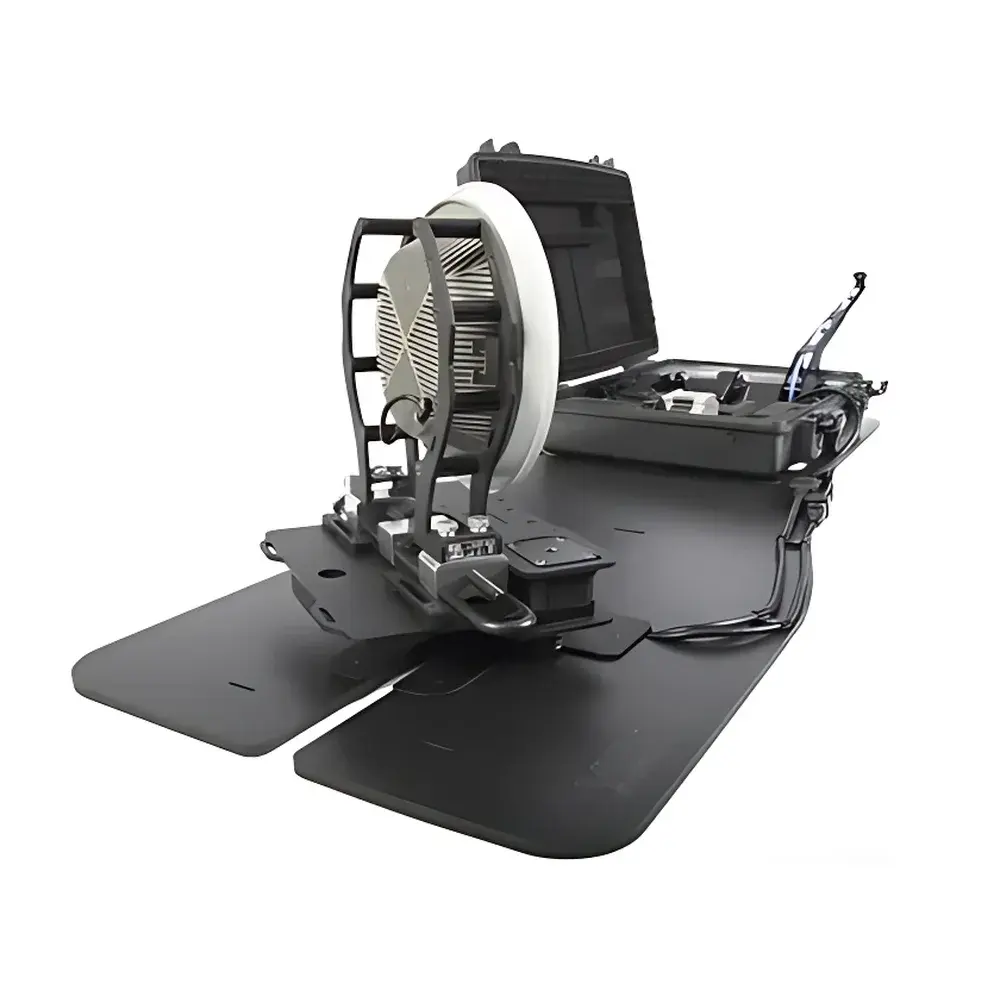
LightSpion EXTENDER Portable Distributed Photometer Extender
| Origin | Denmark |
|---|---|
| Manufacturer Type | Authorized Distributor |
| Origin Category | Imported |
| Model | LIGHTSPION EXTENDER |
| Price | USD 34,500 (approx.) |
| Detector Distance Options | 115 cm / 182 cm |
| Lamp Diameter Range | 0–220 mm |
| Max Lamp Weight | 5 kg |
| Transport Weight | 8 kg |
| Dimensions (L×W×H) | 175 × 43 × 28 cm |
| Power Input | 90–260 VAC, 50/60 Hz |
| USB Current Draw | 200 mA |
| Power Analyzer Voltage Range | 90–260 VAC (±0.2 V) |
| Current Range | 0–3 A (±0.1 mA avg.) |
| Power Range | 0–300 W (±0.001 W avg.) |
| Sampling Rate | 70,000 samples/sec |
| Luminous Flux Range | 10–375,000 lm |
| Luminous Intensity Range | 0.05–1,500,000 cd |
| Photometric Accuracy (LED) | ±4% |
| (Other Sources) | ±7.82% |
| CCT Range | 1,000–10,000 K (±35 K) |
| CRI Range | 0–100 (±0.7) |
| Angular Resolution | 4°/step (LOW mode), 1°/step (HIGH mode) |
| Spectral Sensor | STS Ocean Insight OEM module |
| Calibration Interval | Every 24 months |
| Software Platform | Light Inspector v5.x (Auto-detection & recalibration support) |
Overview
The LightSpion EXTENDER is a purpose-engineered portable distributed photometer extender designed to expand the physical measurement envelope of the base LightSpion goniophotometer system. It operates on the principle of far-field photometric measurement in accordance with CIE S 025/E:2015 and IES LM-79-19 standards, enabling accurate spatial characterization of luminous intensity distribution (LID), total luminous flux (lumens), chromaticity coordinates, correlated color temperature (CCT), and color rendering index (CRI) for medium-to-large light sources. Unlike conventional integrating sphere systems, the EXTENDER maintains goniometric traceability by extending the effective source-to-detector distance—offering two calibrated optical baselines (115 cm and 182 cm)—thereby satisfying the far-field condition (d ≥ 5√A, where A is the largest source dimension) for lamps up to 220 mm in diameter. Its modular architecture allows seamless integration with existing LightSpion portable platforms via industrial-grade RJ45 interconnect, preserving full metrological continuity without hardware reconfiguration.
Key Features
- Two configurable detector distances (115 cm and 182 cm) validated per CIE 121-1996 for compliance with far-field measurement criteria
- Supports luminaires up to 220 mm diameter and 5 kg mass—ideal for LED modules, downlights, track heads, and compact linear fixtures
- OEM-integrated STS spectrometer from Ocean Insight, factory-calibrated across 380–780 nm with NIST-traceable spectral irradiance reference
- Real-time power analysis synchronized with photometric acquisition: voltage (±0.2 V), current (±0.1 mA), and active power (±0.001 W) sampled at 70 kHz
- Angular resolution selectable between 4°/step (high-speed mapping) and 1°/step (high-fidelity LID reconstruction)
- Auto-detection and firmware-aware calibration update within Light Inspector software—no manual parameter entry required
- Ruggedized transport enclosure (8 kg gross weight) with shock-absorbing foam, IP52-rated internal electronics, and ESD-safe handling interface
Sample Compatibility & Compliance
The EXTENDER accommodates a broad spectrum of solid-state and conventional light sources—including COB LEDs, multi-die arrays, filament LEDs, halogen capsules, and compact fluorescent lamps—within defined mechanical and thermal limits (max surface temperature <70°C during measurement). All photometric outputs conform to IESNA LM-79-19, EN 13032-4:2015, and CIE S 025/E:2015 requirements for electrical and photometric testing of LED lamps and luminaires. Chromaticity data meets CIE 15:2018 tolerances; CCT uncertainty is maintained at ±35 K across the 1,000–10,000 K range through dual-point blackbody reference calibration. The system supports GLP-compliant audit trails, including timestamped calibration logs, operator ID tagging, and instrument configuration snapshots—fully compatible with FDA 21 CFR Part 11–enabled environments when deployed with validated Light Inspector v5.x deployment packages.
Software & Data Management
Light Inspector v5.x serves as the unified control, acquisition, and reporting engine. Upon RJ45 connection, the software autonomously identifies the EXTENDER module, loads its unique geometric and spectral calibration matrices, and adjusts goniometer step logic accordingly. Raw spectral, photometric, and electrical datasets are stored in vendor-neutral HDF5 format with embedded metadata (CIE illuminant tag, measurement geometry, ambient conditions). Export options include IES LM-63, EULUMDAT (.ldt), CIE 13.3–1995, and CSV-compatible photometric tables. Batch processing supports automated pass/fail evaluation against user-defined specification limits (e.g., binning thresholds for CCT or R9), with PDF reports embeddable with digital signatures and cryptographic hash verification for ISO/IEC 17025 laboratory accreditation.
Applications
- Pre-compliance photometric validation for DLC, ENERGY STAR, and CE marking submissions
- R&D characterization of asymmetric LED optics and secondary reflectors under controlled thermal soak conditions
- Quality assurance of production-line luminaires using rapid 4°-step angular scans with auto-flagging of beam angle deviations >±1.5°
- Chromaticity shift analysis across dimming curves (0–100% PWM or CCR) with synchronized electrical load profiling
- Third-party test lab support for IEC 62717 and IEC 62612 lamp lifetime studies requiring periodic photometric re-measurement
- Educational use in optical engineering labs for hands-on instruction in goniophotometry, spectral radiometry, and photobiological safety assessment (IEC 62471)
FAQ
Does the EXTENDER require separate recalibration when switching between 115 cm and 182 cm detector positions?
No—the dual-distance calibration is performed during factory certification and embedded in the module’s firmware. Light Inspector automatically selects the appropriate correction matrix upon position confirmation.
Can the EXTENDER be used with non-LightSpion goniometers?
No—it is mechanically and electrically locked to the LightSpion platform via proprietary RJ45 pinout and firmware handshake protocol.
Is spectral recalibration needed after each transport?
No—STS sensor stability is verified at shipment; recalibration is recommended every 24 months or after exposure to >85% RH or mechanical shock exceeding 50 g.
What ambient conditions are required for Class L photometric accuracy?
Stable ambient temperature (25 ±1°C), relative humidity <65%, and absence of stray light (illuminance <0.1 lux at detector plane) per CIE 122-2005.
Does the system support flicker measurement per IEEE 1789-2015?
Yes—70 kS/s sampling enables calculation of percent flicker, flicker index, and SVM (stroboscopic visibility measure) in real time alongside photometric data.
Related Products







