
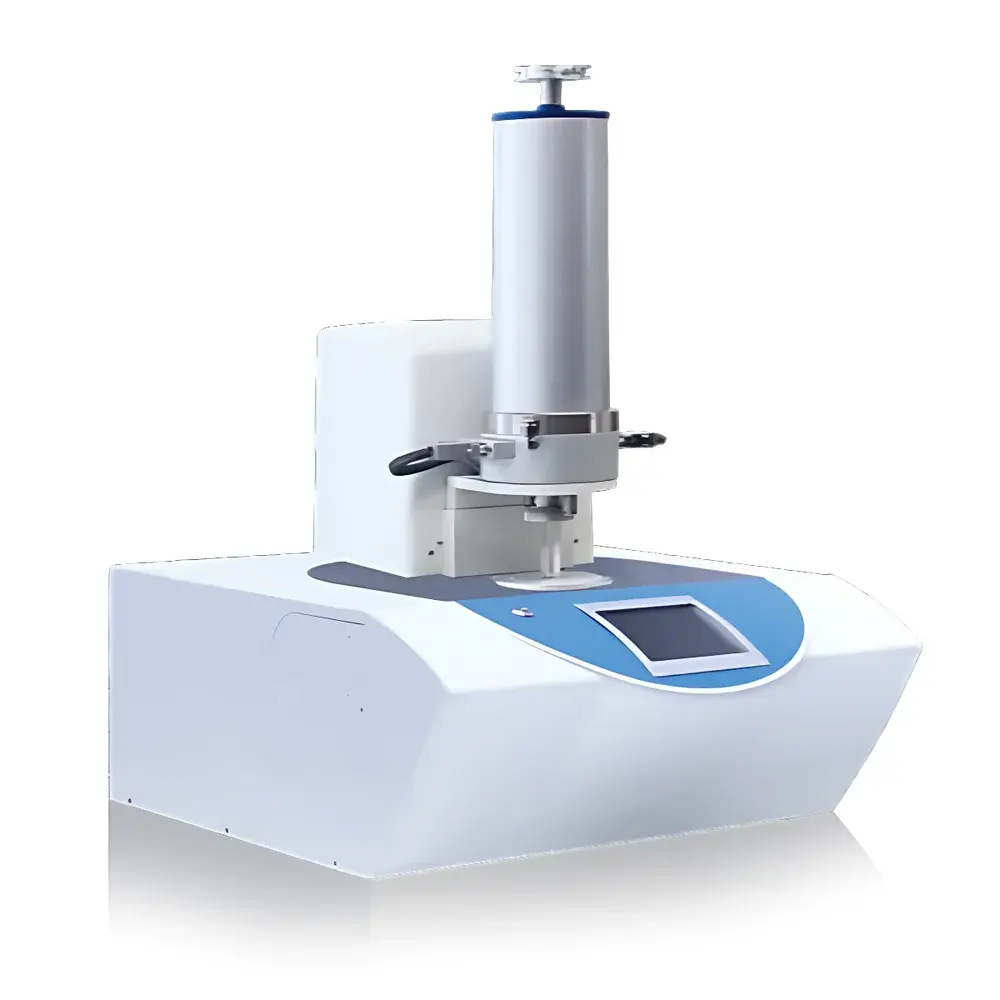
LINSEIS TMA L71 Thermomechanical Analyzer
| Brand | LINSEIS |
|---|---|
| Origin | Germany |
| Model | TMA L71 (TMA PT1000) |
| Temperature Range | –260 to 1000 °C |
| Force Range | up to 1 / 5.7 / 20 N |
| Frequency Range | 1 Hz |
| Resolution | 0.125 nm |
| Atmosphere Options | Oxidizing, Reducing, Inert, Static or Dynamic |
| Sample Dimensions | up to 30 mm × 30 mm |
| Interface | USB |
| Optional Modules | DTA Analysis Software, Rate-Controlled Sintering (RCS) Software |
Overview
The LINSEIS TMA L71 is a high-precision thermomechanical analyzer engineered for quantitative measurement of dimensional changes in solid and semi-solid materials under controlled temperature programs and applied mechanical stress. Based on the principle of contact-based linear displacement detection—using a highly sensitive quartz or ceramic probe coupled with a low-noise capacitive or optical position sensor—the instrument delivers sub-nanometer resolution in thermal expansion, contraction, softening, creep, and stress-relaxation behavior. Its modular furnace design supports ultra-low temperature capability down to –260 °C (with liquid helium cryostat option) and high-temperature operation up to 1000 °C, enabling characterization across the full spectrum of material transitions—from cryogenic brittleness to high-temperature sintering dynamics. The system’s vacuum-tight construction and integrated gas control manifold allow precise atmosphere management, ensuring reproducible measurements under inert (N₂, Ar), oxidizing (air, O₂), or reducing (H₂/N₂) conditions—critical for evaluating oxidation-induced embrittlement, catalytic decomposition, or moisture-sensitive polymer degradation.
Key Features
- Vacuum-sealed furnace chamber with optional mass flow-controlled gas dosing for static or dynamic atmosphere operation
- Triple-force-range load cell configuration (1 N, 5.7 N, and 20 N) enabling high-sensitivity expansion measurements on fragile films and robust modulus evaluation on ceramics or metals
- Sub-nanometer displacement resolution (0.125 nm) achieved via optimized probe mechanics and digital signal processing with real-time noise suppression
- Modular temperature control architecture supporting both standard resistive heating (RT–1000 °C) and cryogenic extension (–260 °C with optional cryostat)
- Interchangeable sample holders for diverse geometries: rods, fibers, thin films, powders (in crucibles), liquids (in capillary cells), and layered composites
- Integrated electronics with USB 2.0 interface and deterministic data acquisition timing synchronized to temperature ramp rate and force application profile
Sample Compatibility & Compliance
The TMA L71 accommodates specimens up to 30 mm in lateral dimension and variable thickness—enabling direct analysis of industrial components such as coated substrates, battery electrode laminates, optical lens blanks, and fiber-reinforced thermosets. Its mechanical probing geometry complies with ASTM E831 (Linear Thermal Expansion of Solid Materials), ISO 11359-2 (Thermomechanical Analysis of Polymers), and USP (Thermal Analysis of Pharmaceutical Excipients). When operated with audit-trail-enabled software and electronic signature modules, the system meets FDA 21 CFR Part 11 requirements for regulated environments. All thermal calibration procedures are traceable to NIST-certified reference materials (e.g., SRM 735a fused quartz, SRM 736a aluminum), and force calibration follows ISO 376 guidelines using certified dead-weight standards.
Software & Data Management
Acquisition and analysis are performed using LINSEIS ThermoSoft™ v6.x—a platform compliant with GLP/GMP workflows. The software provides multi-channel real-time visualization (displacement, temperature, force, atmosphere flow), automated baseline correction, derivative peak detection (dT/da), and customizable report generation with embedded metadata (operator ID, instrument serial number, calibration date). Optional modules include DTA analysis for simultaneous thermal event correlation (e.g., glass transition onset vs. expansion inflection), and Rate-Controlled Sintering (RCS) routines that dynamically adjust heating rates based on measured shrinkage velocity—essential for optimizing ceramic densification protocols. Raw data is stored in vendor-neutral ASCII format with time-stamped headers, facilitating third-party integration with LIMS or statistical process control (SPC) systems.
Applications
- Determination of coefficient of linear thermal expansion (CTE) in aerospace composites and microelectronic packaging substrates
- Identification of glass transition temperature (Tg) and heat distortion temperature (HDT) in thermoplastics (e.g., polycarbonate, PEEK) under load
- Quantification of sintering kinetics and pore closure behavior in powder metallurgy and solid oxide fuel cell (SOFC) anodes
- Evaluation of interfacial adhesion and delamination onset in multilayer thin-film stacks through constrained-layer expansion analysis
- Characterization of viscoelastic relaxation spectra in elastomers and pressure-sensitive adhesives using isothermal stress-decay protocols
- Monitoring of thermal aging effects in cable insulation polymers and encapsulant materials used in photovoltaic modules
FAQ
What temperature accuracy and stability does the TMA L71 achieve across its full range?
The system maintains ±0.5 °C accuracy from –150 °C to 1000 °C, verified against calibrated Pt100 and thermocouple references; short-term stability is better than ±0.1 °C over 30-minute intervals at isothermal setpoints.
Can the TMA L71 perform dynamic mechanical measurements such as creep-recovery or stress relaxation?
Yes—it supports programmable force profiles including constant-load creep, stepwise stress relaxation, and cyclic loading (1 Hz maximum frequency), with displacement resolution maintained throughout.
Is the instrument compatible with corrosive atmospheres such as HCl or SO₂?
Standard configurations support inert, oxidizing, and reducing gases; for aggressive chemistries, optional quartz-lined furnace tubes and corrosion-resistant probe coatings (e.g., alumina or gold-plated) are available upon request.
How is thermal calibration performed, and how often is it required?
Initial calibration uses NIST-traceable standards; routine verification is recommended before each critical measurement series or after major maintenance—typically every 3–6 months depending on usage intensity and environmental conditions.
Does the system support automated sample changers or high-throughput modes?
The base TMA L71 is manually loaded; however, custom automation interfaces (e.g., robotic arm integration or motorized stage upgrades) can be implemented for unattended multi-sample campaigns in R&D or quality control laboratories.



