
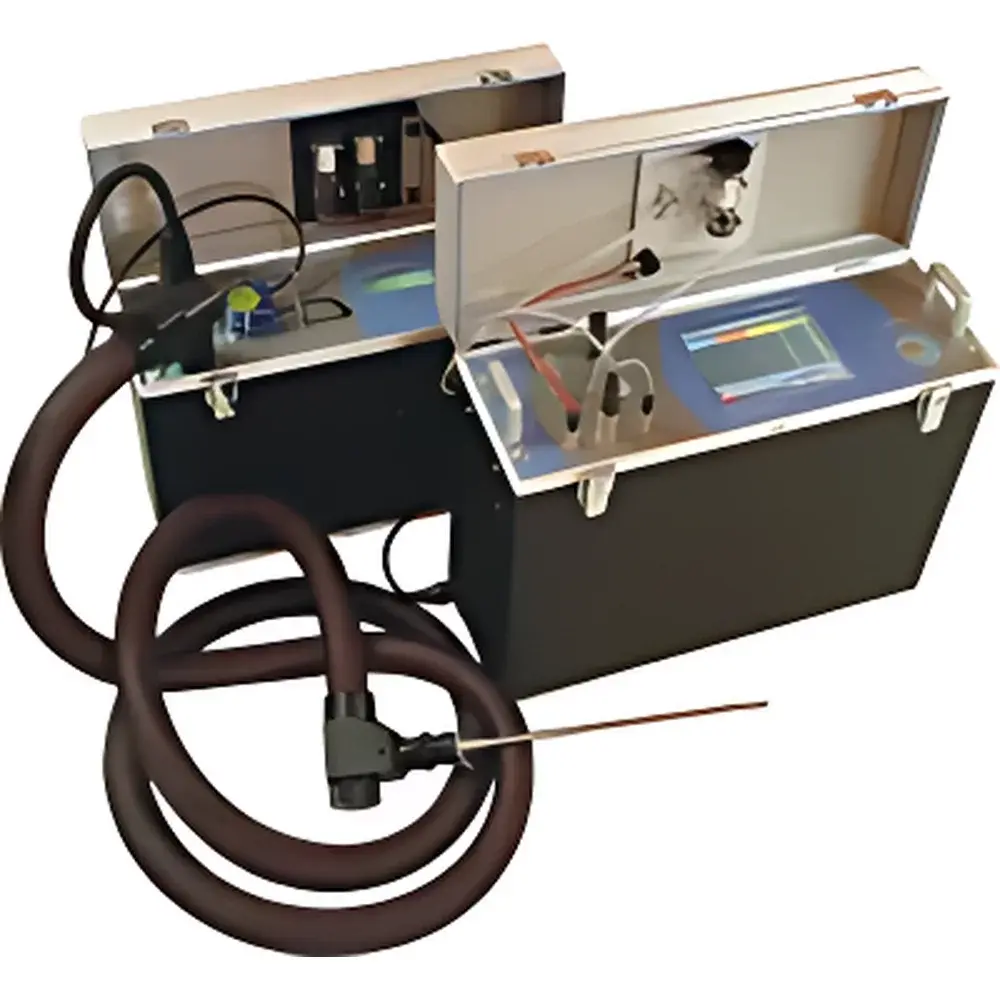
Madur PHOTON Portable NDIR-Based Flue Gas Analyzer
| Brand | Madur |
|---|---|
| Origin | Austria |
| Model | PHOTON |
| Instrument Type | Portable Flue Gas Analyzer |
| Measurement Principle | Non-Dispersive Infrared (NDIR) + Electrochemical Sensors |
| Accuracy | ≤3% FS |
| Repeatability | ≤2% FS |
| Response Time (T90) | 45 s |
| Stability | ≤5% FS |
| Measured Gases | SO₂, NO, NO₂, CO, CO₂, CH₄, VOCs (via optional electrochemical sensors), O₂ |
| Operating Temperature | 0–50 °C |
| Storage Temperature | −20–+55 °C |
| Dimensions (W×H×D) | 500 × 340 × 150 mm |
| Weight | ~7 kg |
| Power Supply | 90–230 VAC, 50–60 Hz |
| Display | Backlit LCD, 320 × 240 px |
| Data Memory | 65,535 records |
| Analog I/O | 8-channel configurable voltage/current input/output |
| Compliance | Designed for EN 15267, EN 14181, ISO 12039, and EPA Method 6C/7E compatibility |
Overview
The Madur PHOTON is a high-integrity portable flue gas analyzer engineered for precision emissions monitoring in industrial combustion processes, energy efficiency audits, and environmental compliance verification. At its core, the PHOTON employs non-dispersive infrared (NDIR) spectroscopy for simultaneous, interference-compensated quantification of key combustion-related gases—including CO, CO₂, CH₄, NO, NO₂, N₂O, and SO₂—within a single optical path. This fundamental architecture ensures long-term baseline stability and eliminates cross-sensitivity inherent in broad-band filter-based systems. Complementing the NDIR platform, up to nine electrochemical sensor slots allow modular integration of O₂, H₂S, Cl₂, H₂, and additional NO₂ or VOC-specific sensors—enabling full-stack stack gas profiling without external analyzers. The system operates under rigorous thermodynamic and pressure compensation protocols: each NDIR channel incorporates real-time temperature and barometric pressure correction algorithms, while all electrochemical sensors feature active drift compensation against ambient temperature gradients and inter-gas interference matrices. Designed and manufactured in Austria, the PHOTON meets the mechanical robustness and metrological traceability expectations of EU Notified Body-certified instrumentation.
Key Features
- Modular sensor architecture: Configurable NDIR core with up to 9 hot-swappable electrochemical sensor bays for field-adaptable gas coverage
- Multi-parameter combustion analysis: Integrated measurement of gas concentrations, flue gas temperature (−10 to 1000 °C), ambient temperature (−10 to 100 °C), static/differential pressure (±25 hPa, 0.1 Pa resolution), and barometric pressure (800–1200 mbar)
- Advanced on-board computation engine: Real-time calculation of λ (excess air ratio), combustion efficiency (η), heat loss (qA), CO/CO₂ ratio, and stoichiometric parameters per EN 267, EN 676, and VDI 2066
- Configurable averaging: User-selectable time-weighted averaging intervals (2–180 s) and extended XL averaging (10 s–30 min) for regulatory reporting compliance
- Dual data handling: Internal flash memory (65,535 records) + RS232 interface with full-featured PC software supporting automated zero calibration, fuel database management (22 preloaded + custom fuels), and audit-log generation
- Ruggedized human-machine interface: Backlit 320 × 240 pixel LCD, sealed membrane keypad, integrated thermal printer (57 mm paper width), and embedded real-time clock with battery-backed calendar
Sample Compatibility & Compliance
The PHOTON is validated for direct sampling of hot, humid, and particulate-laden flue gases from boilers, furnaces, incinerators, and gas turbines—without requiring external conditioning when operated within its specified 0–50 °C ambient range. Its NDIR optical cells are resistant to condensation-induced signal attenuation due to heated sample path design and dynamic dew-point monitoring. All gas measurements adhere to the accuracy specifications defined in EN 14181 (QAL2/QAL3 validation framework) and align with performance criteria outlined in ISO 12039 for CO/CO₂/NOx determination. When configured with certified electrochemical O₂ and SO₂ modules, the system satisfies the instrumental requirements of EPA Methods 6C (SO₂) and 7E (NOx) for relative accuracy testing (RAT). Optional Bacharach soot test functionality enables standardized smoke number assessment per ASTM D2156. Full traceability is maintained through firmware-embedded calibration certificates, timestamped raw data logging, and software-enforced 21 CFR Part 11–compliant electronic signatures for audit-ready reporting.
Software & Data Management
The included PC software suite provides full bidirectional communication via RS232, enabling remote configuration, live data streaming, historical archive retrieval, and automated report generation in PDF/CSV formats. Calibration workflows are guided step-by-step with pass/fail validation logic and automatic certificate generation including uncertainty budgets per ISO/IEC 17025 principles. The software implements role-based access control (operator, technician, administrator), full audit trail logging (user actions, parameter changes, calibration events), and secure data export with digital signature embedding. All stored measurements include metadata: timestamp, GPS coordinates (if connected), ambient conditions, sensor health status, and active compensation flags. Data integrity is preserved through cyclic redundancy check (CRC) validation during transfer and write operations. Firmware updates are performed over serial link with rollback capability and version-controlled change logs.
Applications
- Regulatory stack testing for CEMS verification and periodic QA/QC per EN 15267-3 and MCERTS
- Boiler efficiency optimization and combustion tuning in power generation and district heating plants
- Emissions inventory development for ETS (EU Emissions Trading System) reporting
- Pre-commissioning and commissioning verification of waste-to-energy and biomass combustion units
- Field diagnostics of catalytic reduction (SCR/SNCR) system performance via NOx/NH3 slip analysis
- Industrial hygiene assessments involving CO, H₂S, Cl₂, and VOC exposure limits in confined-space entry scenarios
FAQ
Does the PHOTON support automatic zero calibration?
Yes—the instrument performs automatic zero calibration at startup and can be scheduled at user-defined intervals using the internal solenoid valve and clean air source.
Can CO₂ concentration be calculated if the CO₂ sensor is not installed?
Yes—using measured O₂ and carbon content assumptions based on selected fuel type, the PHOTON calculates theoretical CO₂ per DIN 1343 and VDI 2066 Annex A.
Is the system compliant with FDA 21 CFR Part 11 for electronic records?
The PC software supports audit trails, electronic signatures, and data integrity controls aligned with Part 11 requirements for regulated laboratory environments.
What is the maximum number of analog output channels available?
Eight configurable voltage (0–11 V) and eight current (0–25 mA) outputs are supported via optional I/O expansion module, each assignable to any measured or calculated parameter.
How is sensor cross-interference managed in multi-gas configurations?
The firmware applies proprietary multi-variate compensation algorithms derived from Madur’s gas matrix characterization database, continuously correcting for known electrochemical cross-sensitivities and NDIR spectral overlaps.
Related Products







