
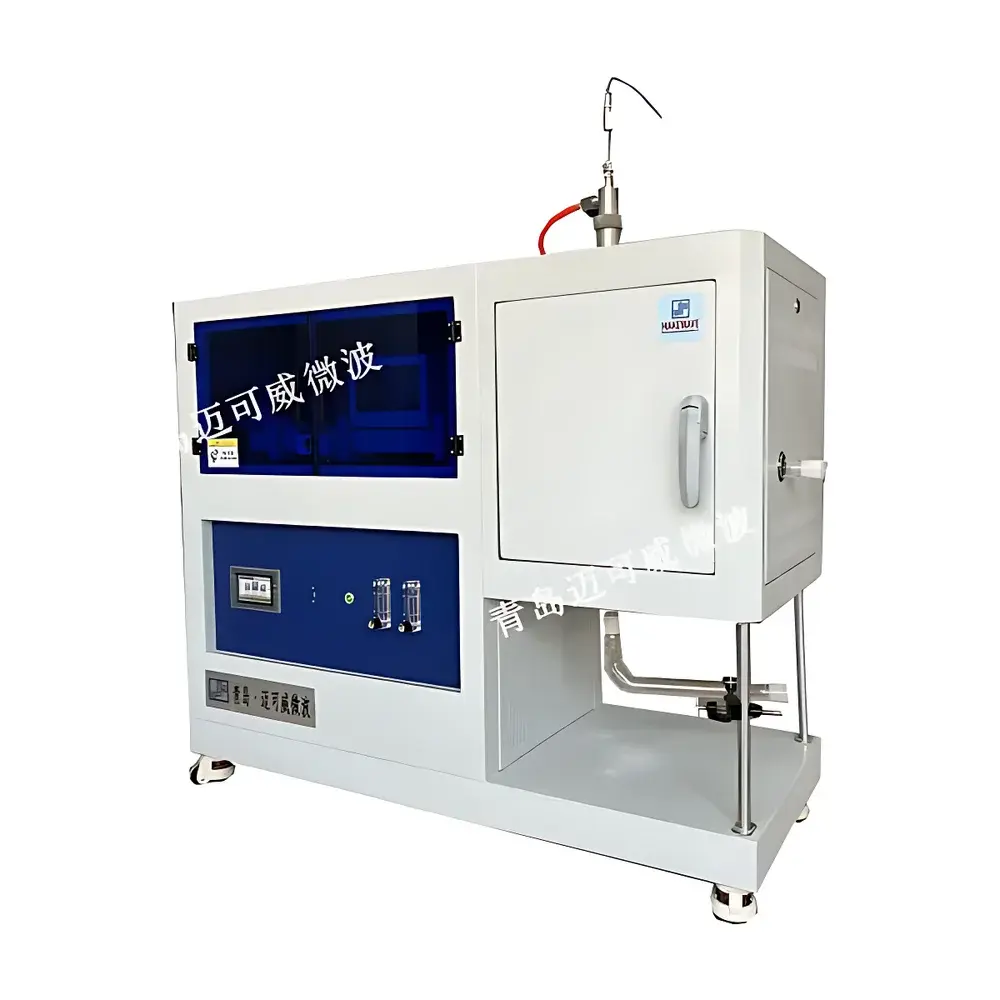
MakeWave MKG-WM2TA Microwave High-Temperature Tube Reactor with Microwave Slotted-Line Monitoring System
| Brand | MakeWave |
|---|---|
| Origin | Shandong, China |
| Manufacturer Type | Direct Manufacturer |
| Country of Origin | China |
| Model | MKG-WM2TA |
| Price Range | USD 7,000 – 14,000 (FOB) |
| Instrument Category | Tube Reactor |
| Volume Capacity | 5 L |
| Construction Material | AISI 304 Stainless Steel |
| Operating Pressure | Low-Pressure (up to 0.1 MPa gauge) |
| Vacuum Capability | Not equipped for vacuum operation |
| Compliance | ISO 9001 certified |
Overview
The MakeWave MKG-WM2TA Microwave High-Temperature Tube Reactor is an engineered platform integrating microwave volumetric heating with conventional tube furnace architecture to enable rapid, uniform, and atmospherically controlled high-temperature synthesis and thermal processing. Unlike conventional resistive-heated tube furnaces, this system employs continuous-wave 2450 MHz microwave energy—delivered via a dual-source 1600 W generator—to directly couple with dielectric or lossy materials, achieving faster thermal ramp rates and reduced thermal gradients. The reactor operates on the principle of microwave transmission line monitoring (slotted-line technique), enabling real-time measurement and dynamic tuning of incident and reflected power (S11 parameter), thereby optimizing energy transfer efficiency and ensuring process reproducibility under varying load conditions. Designed for laboratory-scale material synthesis, catalyst activation, ceramic sintering, and gas–solid reaction studies, it supports both open-batch (crucible-based) and flow-through tubular configurations—making it suitable for research in advanced ceramics, battery electrode materials, heterogeneous catalysis, and functional nanomaterials development.
Key Features
- Integrated microwave–resistive hybrid heating: Supports standalone microwave heating up to 1000 °C and combined microwave + electric heating up to 800 °C with enhanced thermal stability and uniformity.
- Slotted-line microwave monitoring system: Enables full characterization of forward and reflected microwave power, allowing adaptive impedance matching and minimizing standing-wave formation within the cavity.
- Dual-mode operational flexibility: Configurable as either a 5 L open-top microwave muffle furnace or a top-insertion Φ40 mm quartz tube reactor with integrated F-shaped gas distribution manifold and sample support structure.
- Multi-atmosphere control: Dual independent mass-flow-controlled gas inlets support inert, reducing, oxidizing, or mixed atmospheres; optional electrically heated outlet tubing prevents condensation of volatile reaction products.
- PLC-based closed-loop control: Touchscreen HMI displays real-time temperature (Type K thermocouple, direct contact), microwave power output, and time–temperature–power profiles; data logging and export (CSV) supported.
- Comprehensive safety architecture: Interlocked side-sliding door with λ/4 choke structure limits microwave leakage to <5 mW/cm² (per GB 10436 and IEC 61000-3-2); integrated exhaust port compatible with fume hood integration for safe handling of reactive off-gases.
Sample Compatibility & Compliance
The MKG-WM2TA accommodates solid powders, pellets, thin films, and supported catalysts placed in crucibles (100 × 100 mm footprint) or loaded into quartz tubes for continuous or semi-batch gas–solid reactions. Its low-pressure design (max. 0.1 MPa) permits operation under N₂, Ar, H₂/N₂ mixtures, CO, or air—with precise flow regulation (0–1000 mL/min per channel). While not rated for vacuum service, its gas-tight tube flange system ensures stable atmosphere maintenance during dynamic flow processes. The unit complies with ISO 9001:2015 quality management standards and meets electromagnetic compatibility (EMC) and occupational safety requirements for Class II microwave equipment. It supports GLP-aligned documentation practices through timestamped data logs and user-accessible program storage (≥50 protocols).
Software & Data Management
The embedded PLC controller provides deterministic real-time control without reliance on external PCs. All operational parameters—including setpoint temperature, ramp rate, hold time, microwave power level (% of max), and gas flow rates—are programmable in multi-step sequences. Temperature and power curves are rendered live on the 7-inch capacitive touchscreen and stored internally (≥10,000 data points). Export is supported via USB flash drive in CSV format for post-processing in MATLAB, Python, or Excel. Audit-trail functionality records operator ID (via login), program execution timestamps, and alarm events—facilitating traceability in regulated R&D environments aligned with FDA 21 CFR Part 11 readiness principles (though no electronic signature module is included by default).
Applications
This reactor is routinely deployed in academic and industrial laboratories for: rapid thermal annealing of transition metal oxides; carbothermal reduction of metal precursors; pyrolysis of MOFs and COFs under controlled atmospheres; sulfurization/selenization of chalcogenide precursors; thermal decomposition kinetics studies of energetic materials; and high-temperature phase transformation analysis of layered double hydroxides (LDHs). Its ability to sustain steady-state temperatures above 900 °C with <±3 °C spatial uniformity across the hot zone makes it especially valuable for reproducible scale-up screening prior to pilot-plant reactor deployment.
FAQ
Is vacuum operation supported?
No—the MKG-WM2TA is designed exclusively for low-pressure gas-flow or static atmosphere applications. It lacks vacuum-rated seals, pumping interfaces, or pressure transducers.
Can the quartz tube be replaced with alumina or other high-temperature ceramics?
Yes—customizable tube inserts (e.g., fused silica, high-purity alumina, or silicon carbide) can be fitted within the specified Φ40 mm bore, subject to microwave transparency and thermal expansion compatibility.
What is the maximum recommended continuous operating temperature?
1000 °C under pure microwave heating; 800 °C when using simultaneous microwave + electric heating to avoid localized overheating at the quartz–metal interface.
Does the system support remote monitoring or Ethernet connectivity?
Not natively—the current configuration relies on local HMI interaction. Optional RS485 or Modbus TCP gateway modules are available upon request for SCADA integration.
How is temperature calibration performed?
Calibration is conducted using NIST-traceable Type K thermocouples during factory acceptance testing; users may perform field verification using secondary reference thermocouples inserted alongside the sample.



