
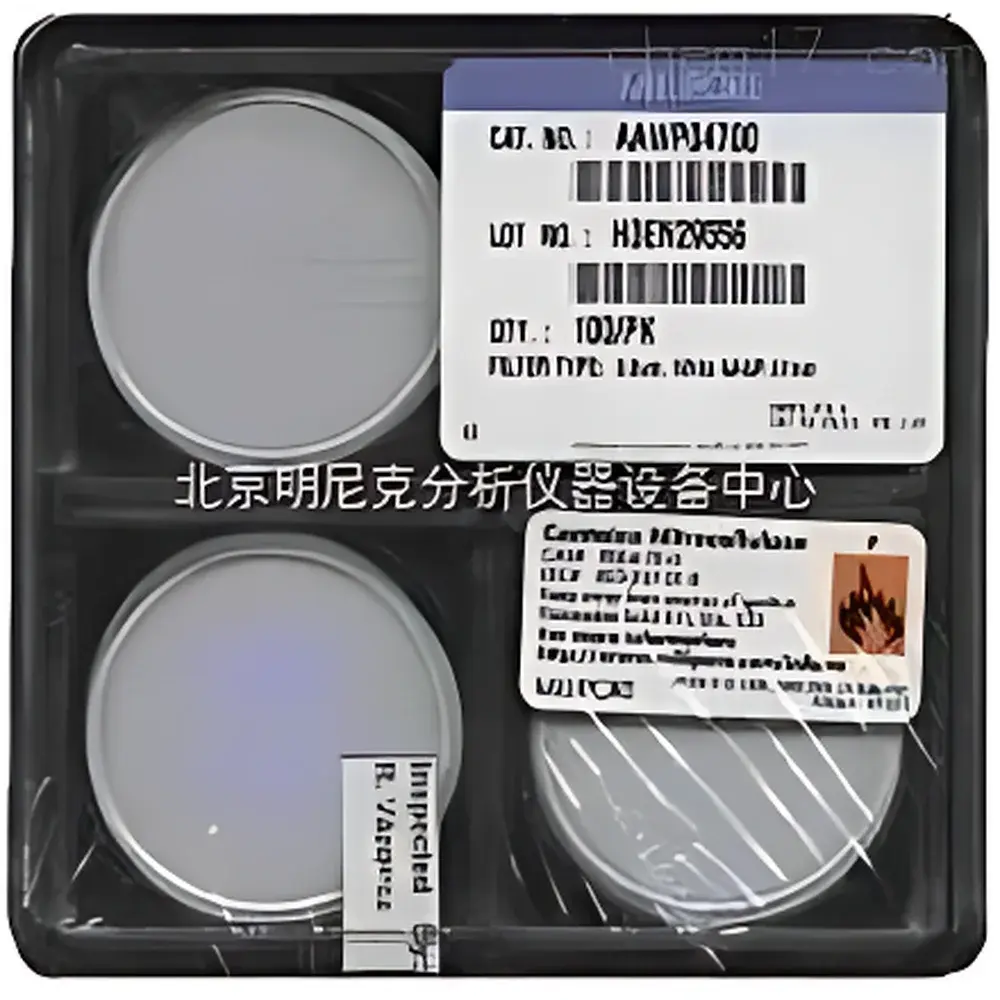
Merck MNKSAG0609 Cellulose Ester Membrane Filters for Petroleum Oxidation Stability Testing
| Brand | Merck |
|---|---|
| Origin | USA |
| Manufacturer Type | Authorized Distributor |
| Origin Category | Imported |
| Model | MNKSAG0609 |
| Pricing | Upon Request |
| Diameter | 47 mm |
| Pore Size | 0.8 µm |
| Pack Size | 100 per Box |
| Compliance | SH/T 0175–2004, ASTM D2274 |
Overview
The Merck MNKSAG0609 cellulose ester membrane filters are precision-engineered consumables designed exclusively for the quantitative determination of sediment formation in distillate fuel oils under accelerated oxidation conditions. These filters operate as a critical separation component within standardized test protocols—specifically SH/T 0175–2004 (Chinese national standard, technically aligned with ASTM D2274) —where oxidized fuel samples are vacuum-filtered to isolate and gravimetrically quantify insoluble oxidation products. The filter’s consistent pore morphology, low extractables, and high flow-through reproducibility ensure measurement integrity across repeated determinations, supporting trace-level particulate recovery without interference from membrane leachables or structural deformation under hydrocarbon solvent exposure.
Key Features
- Manufactured from high-purity mixed cellulose esters (MCE), offering balanced hydrophilicity and chemical resistance to aliphatic and aromatic hydrocarbons encountered in diesel, jet fuel, and middle-distillate matrices.
- Strictly controlled pore size distribution of 0.8 µm (±0.1 µm), validated via bubble point and porometry testing to meet ASTM E128–17 requirements for nominal pore rating verification.
- 47 mm diameter format optimized for compatibility with standard vacuum filtration apparatuses used in petroleum laboratories—including ASTM D2274-compliant glass funnels, filter holders, and analytical balances meeting Class I or II accuracy per ISO/IEC 17025 calibration protocols.
- Low non-volatile residue (<0.005% w/w after acetone extraction), minimizing background interference during post-filtration gravimetric analysis of sediment mass.
- Individually packaged in low-particulate polypropylene sleeves and supplied in sealed aluminum-laminated boxes (100 units/box) to prevent ambient contamination and moisture uptake during storage.
Sample Compatibility & Compliance
These membranes are validated for use with oxidized distillate fuels, including ultra-low-sulfur diesel (ULSD), aviation turbine fuel (Jet A-1), and kerosene-based blends subjected to the 16-hr, 95 °C accelerated oxidation procedure defined in SH/T 0175–2004 and ASTM D2274. They exhibit no measurable swelling, dissolution, or pore collapse when exposed to hot, oxidized hydrocarbon phases containing organic acids, peroxides, and polymeric oxidation byproducts. Regulatory alignment includes full traceability to Merck’s certified manufacturing documentation, supporting GLP-compliant laboratory audits and method validation per CNAS-CL01:2018 and ISO/IEC 17025:2017 requirements. Each batch is accompanied by a Certificate of Analysis specifying pore size uniformity, thickness tolerance (130 ± 15 µm), and endotoxin levels (<0.25 EU/mL).
Software & Data Management
As a physical consumable—not an instrument—the MNKSAG0609 filter does not incorporate embedded electronics or firmware. However, its use is fully integrated into digital laboratory workflows through LIMS (Laboratory Information Management Systems) and electronic lab notebooks (ELN). Standardized barcode labeling (GS1-128 compliant) enables automated lot tracking, expiration date monitoring, and audit-ready chain-of-custody logging. When paired with validated gravimetric procedures, data generated using these filters satisfies FDA 21 CFR Part 11 requirements for electronic records when captured via calibrated balances with audit-trail-enabled software (e.g., Mettler Toledo LabX, Sartorius Cubis® II with Q-App modules).
Applications
- Oxidation stability assessment of refinery-produced middle distillates prior to shipment or blending.
- Quality control testing for fuel additives that inhibit sludge formation (e.g., antioxidants, metal deactivators).
- Research-scale evaluation of fuel degradation kinetics under thermal stress and dissolved oxygen exposure.
- Method transfer between contract testing laboratories and OEM engine development facilities requiring inter-laboratory reproducibility (RSD <3.5% per ASTM D6300).
- Supporting regulatory submissions to NATA, CNAS, or API RP 1529 where documented filter performance is required for sediment quantification.
FAQ
Are these filters suitable for use with biodiesel blends (e.g., B5, B20)?
Yes—MNKSAG0609 membranes demonstrate stable performance in FAME-containing distillates up to B20, provided oxidation testing follows SH/T 0175–2004 procedural modifications for oxygenated fuels.
What is the maximum operating temperature during filtration?
Filtration must be conducted at ambient temperature (20–25 °C) following sample cooling per Section 8.3 of ASTM D2274; the membrane itself remains dimensionally stable up to 55 °C but is not rated for hot filtration.
Is there a sterility certification available?
No—these filters are not sterilized or certified for microbiological applications; they are manufactured under cleanroom conditions (ISO Class 7) for chemical purity, not bioburden control.
Can the filters be reused after solvent rinsing?
No—per ASTM D2274 Section 9.2, single-use protocol is mandatory to avoid cross-contamination and pore occlusion from residual sediment.
How should expired filters be disposed?
Discard as non-hazardous solid waste in accordance with local regulations; no special hazardous classification applies due to absence of heavy metals or halogenated binders.




