
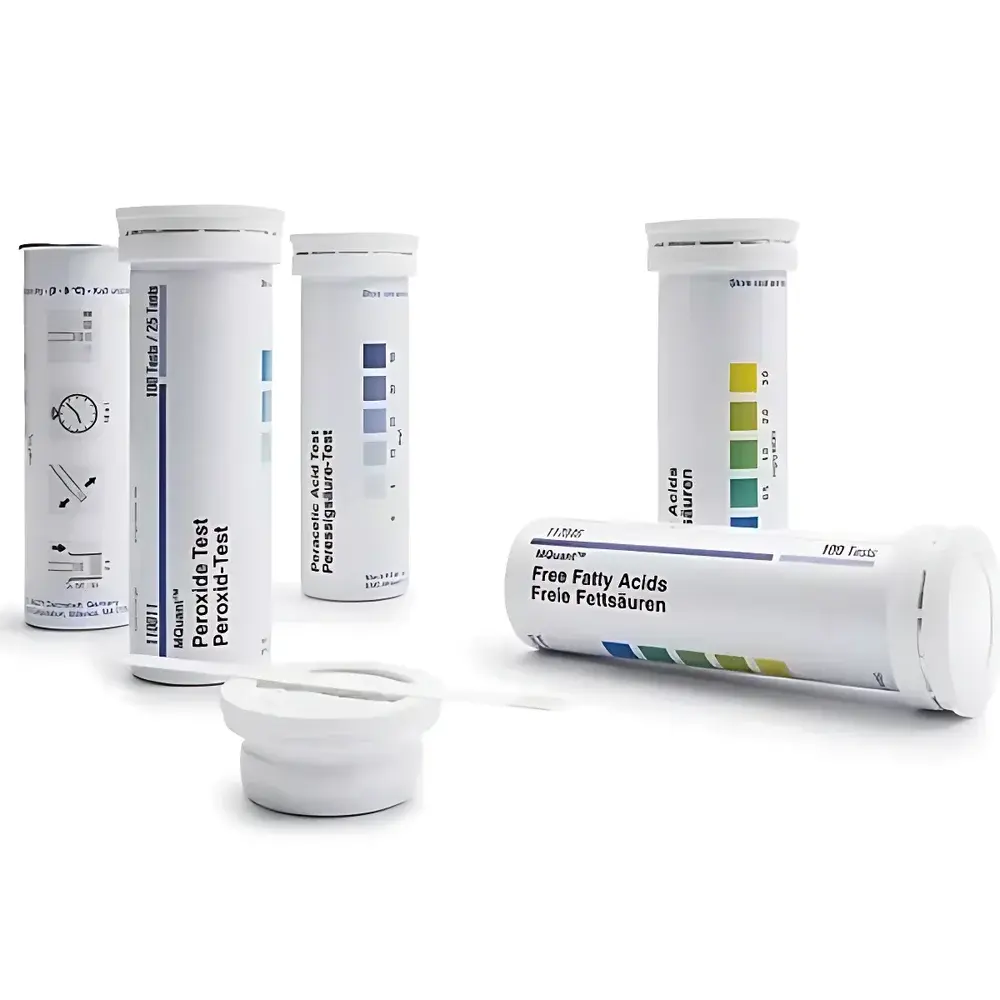
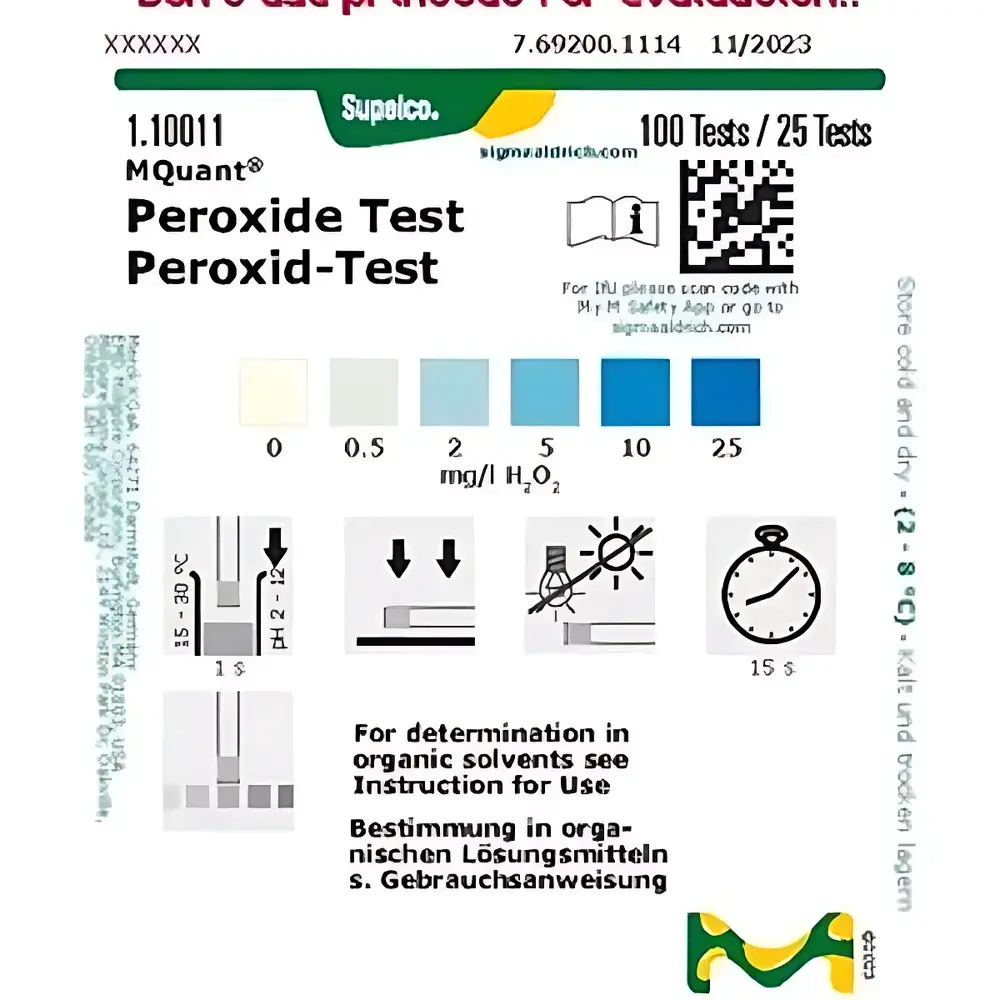
Merck MQuant® Hydrogen Peroxide Test Strips
| Brand | Merck |
|---|---|
| Origin | USA |
| Product Type | Imported Reagent Test Strips |
| Model Series | MQuant® Hydrogen Peroxide Test Strips |
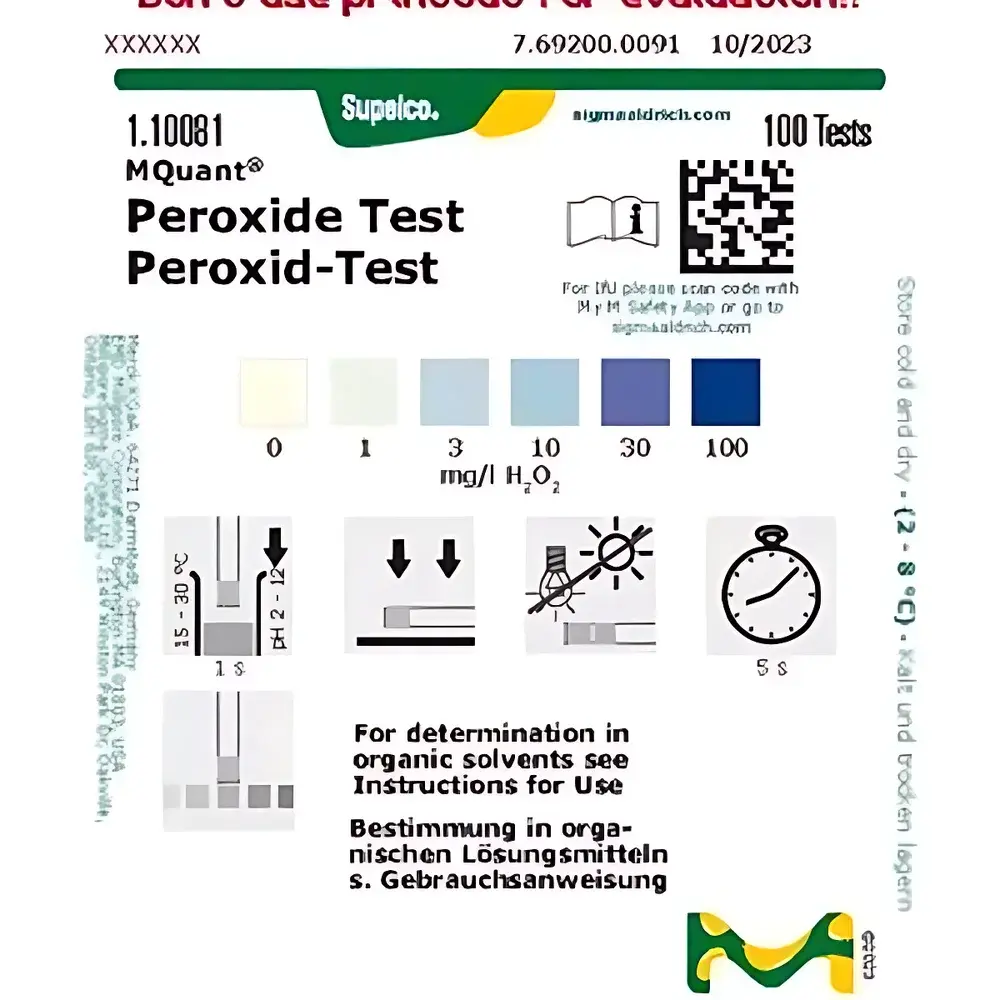
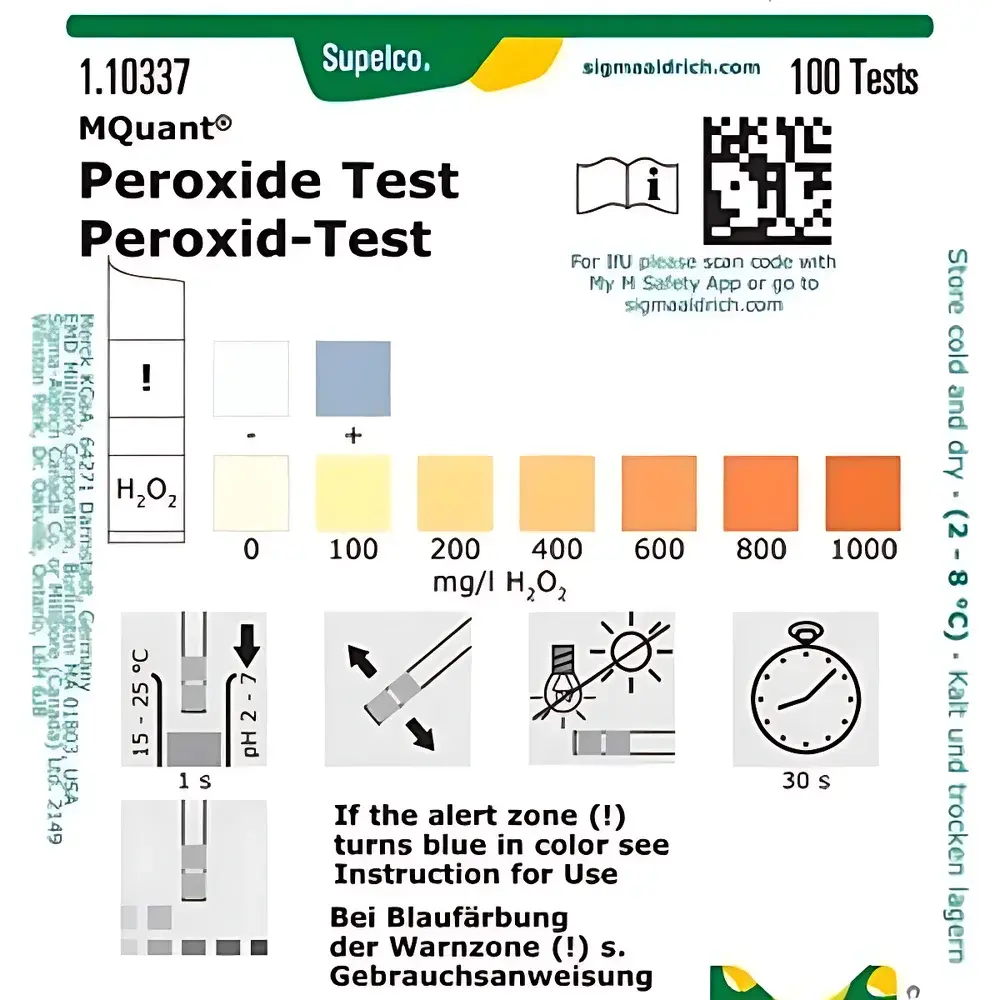
| Measurement Range | 0.1–100 mg/L (ppm) H₂O₂ |
| Detection Method | Colorimetric (Peroxidase-catalyzed oxidation of chromogen) |
| Shelf Life | 24 months from manufacture (unopened, stored at 2–8 °C) |
| Format | Individual foil-wrapped strips (100 strips per pack) |
| Compliance | Designed in accordance with ISO 8694:1986 (Water quality — Determination of hydrogen peroxide — Spectrophotometric method) and compatible with GLP/GMP documentation workflows |
Overview
The Merck MQuant® Hydrogen Peroxide Test Strips are precision-engineered qualitative and semi-quantitative analytical tools for the rapid, on-site determination of hydrogen peroxide (H₂O₂) concentration in aqueous samples. Based on a peroxidase-mediated colorimetric reaction, these test strips leverage enzymatic catalysis to oxidize a chromogenic substrate—typically tetramethylbenzidine (TMB) or a structurally optimized analog—yielding a stable, intensity-proportional blue-green color development. The reaction is highly selective for H₂O₂ in the presence of common interferents such as chlorine, chloramines, nitrite, and transition metal ions, provided sample pH remains within the validated range (pH 4.5–7.5). Developed and manufactured under Merck’s stringent quality control system in the United States, each strip batch undergoes lot-specific calibration verification against NIST-traceable reference standards. These strips are intended for routine use in environmental monitoring, wastewater treatment process control, pharmaceutical clean-in-place (CIP) validation, and food & beverage sanitation verification—where immediate, field-deployable results support real-time decision-making without reliance on benchtop instrumentation.
Key Features
- High specificity for hydrogen peroxide via peroxidase enzyme immobilization directly on the reactive pad—minimizing cross-reactivity with residual oxidants
- Visual readout calibrated to seven discrete concentration bands (0.1, 0.3, 1, 3, 10, 30, and 100 mg/L), enabling rapid semi-quantitative assessment within 60 seconds
- Foil-sealed individual packaging ensures reagent stability and prevents humidity-induced degradation during storage and transport
- Validated for use in drinking water, surface water, effluent streams, CIP rinse water, and sterile processing environments
- No external reagents, timers, or power sources required—fully self-contained operation suitable for glovebox, cleanroom, or remote field deployment
- Batch-certified performance data supplied with each package, including limit of detection (LOD ≈ 0.08 mg/L) and inter-batch repeatability (CV < 8% at 10 mg/L)
Sample Compatibility & Compliance
The MQuant® H₂O₂ test strips demonstrate robust performance across a wide range of matrix types, including potable water, municipal wastewater, industrial cooling water, and purified water (PW) used in pharmaceutical manufacturing. Turbidity up to 50 NTU and total dissolved solids (TDS) ≤ 500 mg/L do not significantly affect accuracy when standard dip-and-read protocol is followed. Interference testing confirms negligible response to ≤ 2 mg/L free chlorine, ≤ 0.5 mg/L chloramine, and ≤ 1 mg/L nitrite—making the strips suitable for post-disinfection monitoring where multiple oxidants may coexist. All test strip production adheres to ISO 13485:2016 (medical device quality management) and supports compliance with USP , EP 2.2.55, and FDA 21 CFR Part 11 requirements when integrated into electronic lab notebook (ELN) or LIMS workflows with audit-trail-enabled image capture and result annotation.
Software & Data Management
While the test strips operate independently of instrumentation, Merck provides optional digital support tools to enhance traceability and data integrity. The MQuant® Mobile Reader App (iOS/Android) enables standardized image acquisition under controlled lighting, automatic color-matching against embedded calibration references, and direct export of timestamped, geotagged results to CSV or PDF. When paired with Merck’s LabX® Lite software platform, strip readings can be linked to sample IDs, operator credentials, and environmental metadata—generating 21 CFR Part 11-compliant electronic records with full audit trail, electronic signature capability, and version-controlled SOP integration. Raw image files and processed outputs are stored with SHA-256 hash verification to ensure data immutability.
Applications
- Verification of hydrogen peroxide residuals following vaporized H₂O₂ (VHP®) decontamination cycles in isolators and RABS
- Monitoring H₂O₂ concentration decay kinetics during wastewater advanced oxidation processes (AOPs)
- Routine screening of disinfectant concentrations in hospital sterilization departments and dialysis centers
- Validation of H₂O₂ removal efficiency in catalytic quenching systems prior to biological treatment stages
- Field-based assessment of accidental H₂O₂ releases in aquatic ecosystems and groundwater plume delineation
- Quality control of H₂O₂-containing formulations in cosmetic and pharmaceutical manufacturing
FAQ
What is the shelf life of unopened MQuant® H₂O₂ test strips?
Unopened foil-wrapped strips retain full performance for 24 months when stored refrigerated at 2–8 °C in original packaging.
Can these strips be used in seawater or high-salinity samples?
Yes—validated for salinity up to 35 g/L (seawater strength); however, extended immersion (>10 seconds) may cause slight pad swelling; adhere strictly to the 1-second dip protocol.
Is there a documented method equivalence to standard laboratory techniques?
Yes—comparative studies per ISO 8694:1986 confirm correlation coefficients >0.995 (n=42) versus spectrophotometric reference methods using potassium titanium oxalate.
Do the strips require user calibration or instrument setup?
No—each strip is factory-calibrated and ready for immediate use; no user intervention, zeroing, or maintenance is required.
How should spent strips be disposed of?
Dispose as non-hazardous solid waste in accordance with local regulations; the immobilized enzyme and chromogen pose no significant environmental hazard at used-strip concentrations.
Related Products







