
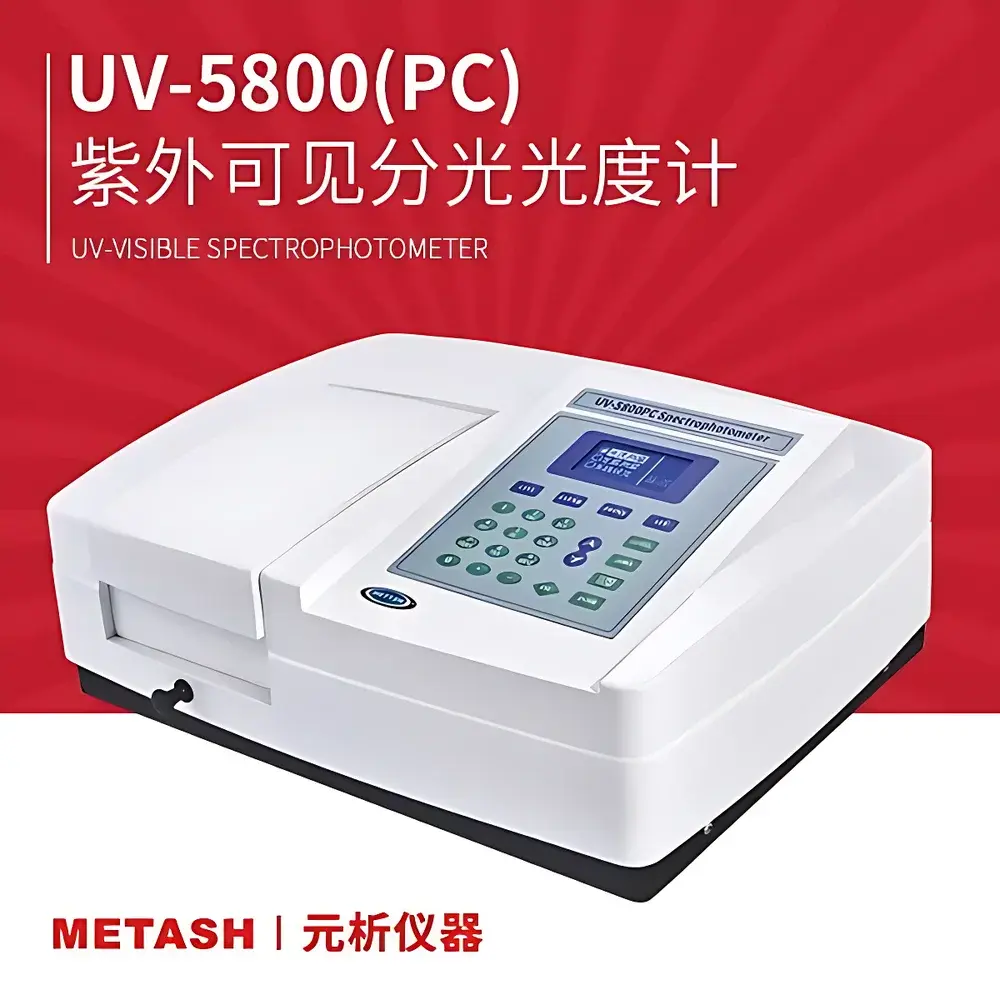
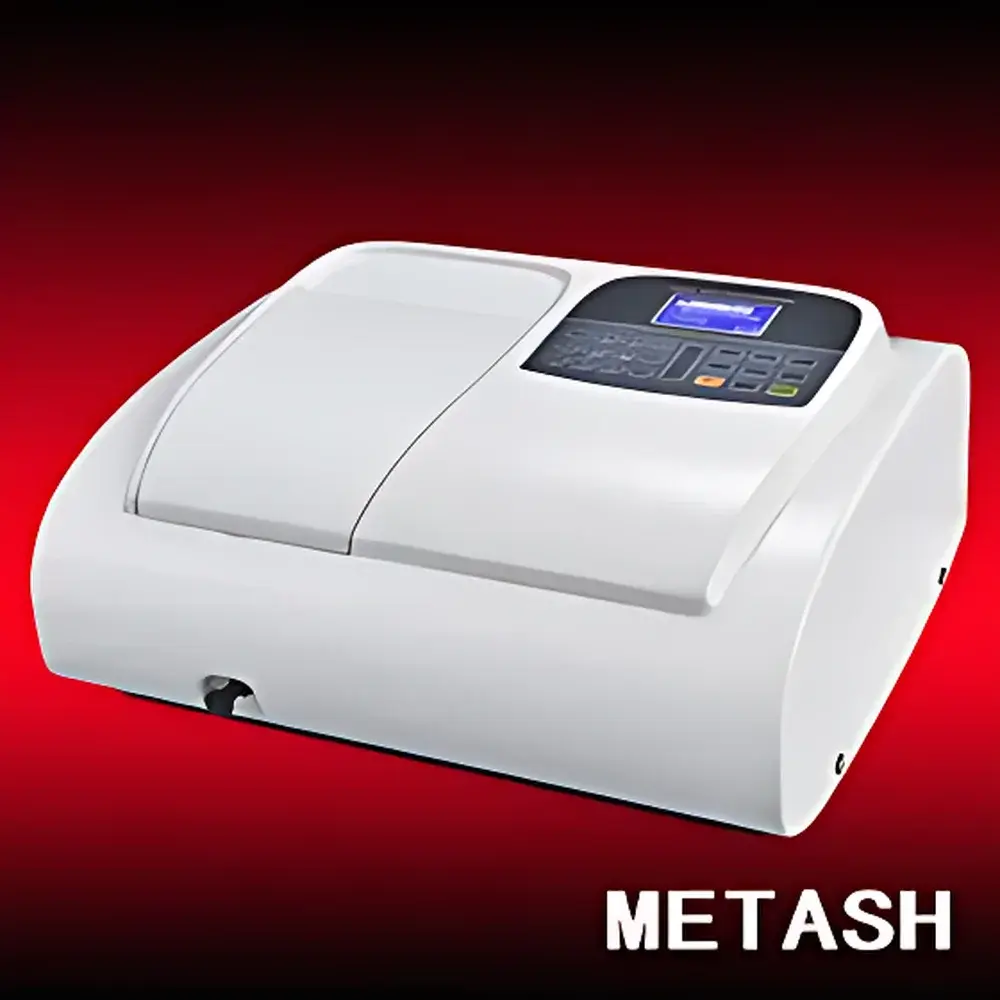
Metash UV-5800(PC) Dual-Beam Ultraviolet-Visible Spectrophotometer
| Brand | Metash Instruments |
|---|---|
| Origin | Shanghai, China |
| Manufacturer Type | Original Equipment Manufacturer (OEM) |
| Product Category | Domestic |
| Model | UV-5800(PC) |
| Price Range | USD 4,200–7,000 (FOB Shanghai) |
| Optical Design | Dual-beam ratio-monitoring |
| Detector Type | Silicon photodiode |
| Wavelength Range | 190–1100 nm |
| Wavelength Scanning Mode | Motorized automatic wavelength drive |
| Spectral Bandwidth | 2 nm |
| Wavelength Accuracy | ±0.5 nm |
| Wavelength Repeatability | ≤0.2 nm |
| Stray Light | ≤0.05% T at 220 nm and 360 nm |
| Display | 128 × 64 dot-matrix LCD |
| Data Interface | USB 2.0 |
| Software Compatibility | Optional Metash UV-Solution PC software (GLP/GMP-compliant) |
Overview
The Metash UV-5800(PC) is a dual-beam ratio-monitoring ultraviolet-visible spectrophotometer engineered for precision absorbance, transmittance, and concentration measurements across the full 190–1100 nm spectral range. Its optical architecture employs a dynamically balanced dual-beam configuration, wherein reference and sample beams are simultaneously directed through matched optical paths and detected by a single silicon photodiode. This design actively compensates for temporal fluctuations in lamp intensity—particularly critical during extended kinetic or temperature-dependent assays—thereby delivering high photometric stability (<0.001 A/h drift) and measurement reproducibility. The instrument integrates a pre-aligned deuterium lamp (for UV) and tungsten-halogen lamp (for visible/NIR), both housed in a flange-mount modular assembly that enables lamp replacement without realignment or optical recalibration. The entire optical train—including collimating mirrors, monochromator grating, and beam splitter—is rigidly suspended on a 8 mm thick aerospace-grade aluminum optical baseplate, decoupling the system from mechanical vibrations and thermal expansion effects common in shared laboratory environments.
Key Features
- Dual-beam ratio-monitoring optical system with real-time source fluctuation compensation for enhanced baseline stability and long-term photometric accuracy.
- Motorized automatic wavelength scanning and positioning, supporting programmable wavelength jumps, multi-point spectral acquisition, and step-scan modes.
- 2 nm fixed spectral bandwidth achieved via precision slit mechanism, optimized for resolution/sensitivity trade-off in routine QC and research applications.
- 128 × 64 dot-matrix LCD display with intuitive menu navigation; capable of showing absorbance, %T, concentration, and wavelength simultaneously across multiple data fields.
- Onboard data storage for up to 200 measurement sets and 200 user-defined calibration curves, with non-volatile memory retaining all settings and data during power interruption.
- Self-diagnostic wavelength calibration routine with auto-correction capability; eliminates need for manual peak alignment using holmium oxide or didymium filters.
- Modular accessory interface supporting standardized optical mounts for optional accessories including 8-cell auto-changer, micro-volume cuvette holder (down to 50 µL pathlength), Peltier-controlled temperature cell holder, integrating sphere reflectance module, and fiber-optic probe adapters.
Sample Compatibility & Compliance
The UV-5800(PC) accommodates standard 10 mm square quartz or glass cuvettes (pathlengths 1–100 mm), as well as microvolume cells, flow cells, and solid-sample reflection attachments. Its optical design conforms to ISO 9001 manufacturing protocols and meets core performance criteria outlined in ASTM E275 (Standard Practices for Describing and Measuring Performance of UV-Vis Spectrophotometers) and ISO/IEC 17025:2017 for testing laboratory competence. When operated with the optional UV-Solution software, the system supports audit-trail generation, electronic signatures, role-based user access control, and full data traceability—enabling compliance with FDA 21 CFR Part 11, EU Annex 11, and GLP/GMP documentation requirements for regulated pharmaceutical, food safety, and environmental testing laboratories.
Software & Data Management
The optional UV-Solution PC software provides a validated, Windows-based platform for method development, instrument control, and analytical reporting. It supports quantitative analysis via single- and multi-point calibration, kinetic time-course profiling (up to 9999 points), spectral scanning (190–1100 nm, 0.1–5.0 nm step), DNA/protein A260/A280 ratio calculation with built-in extinction coefficients, and derivative spectroscopy. All raw spectra and processed results are stored in encrypted binary format with embedded metadata (operator ID, timestamp, instrument serial number, calibration status). Export options include CSV, PDF, and XML formats compatible with LIMS integration. Audit logs record every parameter change, calibration event, and data export action—retained for ≥18 months per internal retention policy.
Applications
The UV-5800(PC) serves as a primary analytical tool in quality control laboratories for quantification of active pharmaceutical ingredients (APIs), excipients, and degradation products per USP and EP 2.2.25. It is routinely deployed in environmental labs for nitrate, phosphate, and heavy metal speciation (e.g., Cr(VI) via diphenylcarbazide assay); in biochemical labs for enzyme kinetics (NADH/NADPH monitoring at 340 nm), protein quantitation (Bradford/Lowry/BCA), and nucleic acid purity assessment; and in materials science for thin-film thickness estimation and bandgap analysis of semiconductor nanomaterials. Its robustness and repeatability make it suitable for ISO/IEC 17025-accredited testing workflows requiring documented uncertainty budgets.
FAQ
Does the UV-5800(PC) support wavelength calibration verification with certified reference standards?
Yes—built-in calibration routines accept NIST-traceable holmium oxide (HoO) and didymium (Nd) filters for periodic verification per ASTM E275 Section 7.3.
Can the instrument operate without a connected PC?
Yes—the standalone mode supports basic photometric measurements, fixed-wavelength absorbance, and pre-loaded calibration curves via front-panel controls and LCD interface.
Is the UV-Solution software compliant with FDA 21 CFR Part 11?
Yes—when configured with password-protected user roles, electronic signature enforcement, and immutable audit trails, it satisfies Part 11 requirements for electronic records and signatures.
What is the typical warm-up time required before achieving photometric stability?
Deuterium lamp stabilization requires ≤30 minutes; full optical and thermal equilibrium for high-precision work is achieved within 45 minutes after power-on.
Are firmware updates available, and how are they applied?
Firmware upgrades are distributed via Metash’s secure customer portal and installed via USB flash drive—no external service engineer required.




