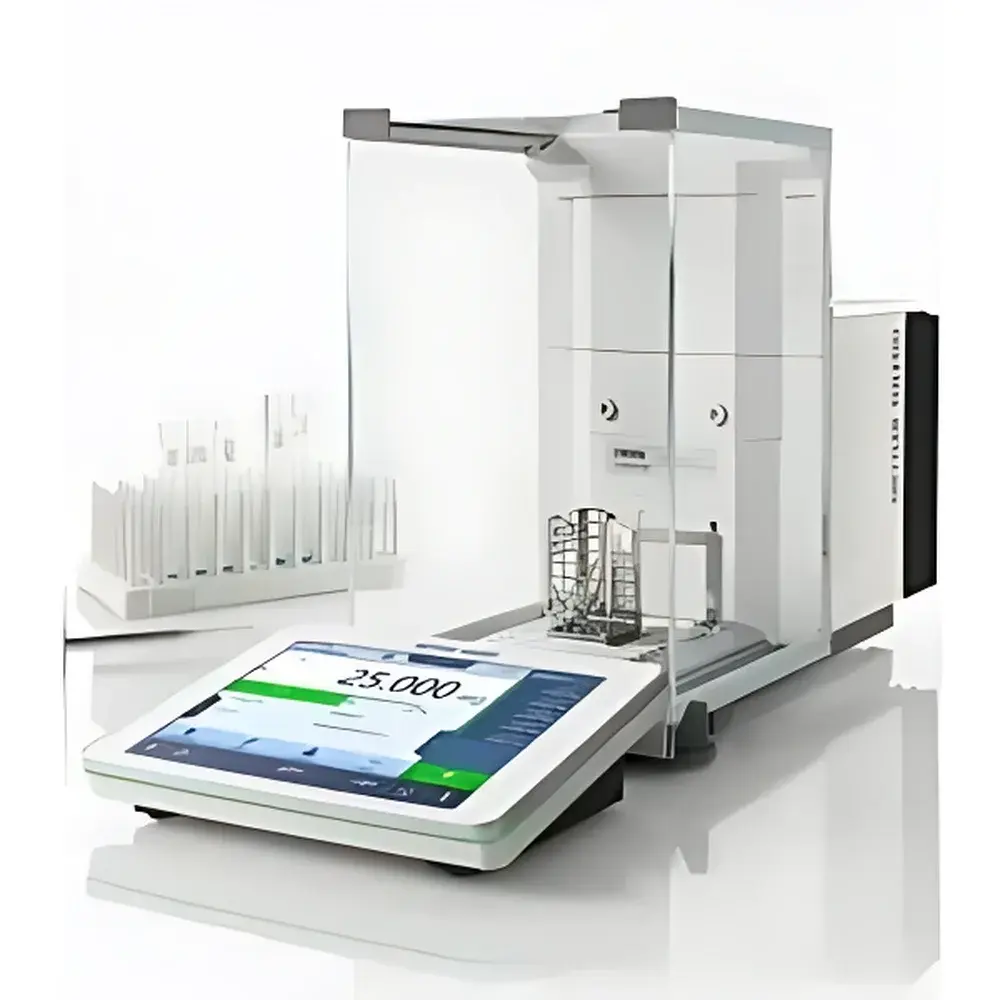
METTLER TOLEDO XPR Series Analytical Balance
| Brand | METTLER TOLEDO |
|---|---|
| Origin | Switzerland |
| Manufacturer Type | Authorized Distributor |
| Origin Category | Imported |
| Model | XPR Series |
| Instrument Type | Analytical Balance |
| Weighing Range | 20–100 g |
| Maximum Capacity | 52 g |
| Readability | 1 µg |
| Accuracy Class | ISO/IEC 17025-compliant analytical grade |
| Repeatability | 0.004 mg |
| Calibration | Fully Automatic Internal Calibration & Adjustment |
| Compliance Features | GWP® Approved, StatusLight™, LevelControl®, StaticDetect™, MinWeigh™ Warning |
Overview
The METTLER TOLEDO XPR Series Analytical Balance is engineered for precision-critical laboratory environments where trace-level mass determination, regulatory compliance, and sample conservation are non-negotiable. Based on electromagnetic force compensation (EMFC) technology, the XPR platform delivers metrologically traceable measurements with 1 µg readability and sub-milligram repeatability—enabling reliable quantification of microgram-scale samples in pharmaceutical development, reference standard preparation, catalyst formulation, and forensic toxicology. Its robust monolithic sensor architecture minimizes thermal drift and mechanical hysteresis, while the integrated environmental monitoring system continuously evaluates ambient conditions (temperature, air currents, vibration) to assess measurement validity in real time. Designed and manufactured in Switzerland under ISO 9001-certified processes, each XPR unit undergoes individual factory calibration against NIST-traceable mass standards and ships with a full metrological certificate.
Key Features
- StaticDetect™ Technology: Patented real-time electrostatic charge detection and neutralization system that identifies residual surface charge on samples or containers—eliminating one of the most frequent unobserved sources of weighing error in low-mass applications.
- GWP® Approved Integration: Embedded Good Weighing Practice software module that dynamically calculates minimum weight (MinWeigh™) based on user-defined accuracy requirements (e.g., USP , EP 2.1.6), triggers automatic calibration or performance verification when thresholds are exceeded, and logs all events with full audit trail.
- StatusLight™ & LevelControl®: Visual status indicator (green/yellow/red) provides immediate at-a-glance confirmation of balance readiness; LevelControl automatically detects out-of-level conditions and guides users through guided leveling via on-screen prompts—ensuring mechanical stability prior to measurement.
- SmartDraft Shield Compatibility: Optimized airflow management within the draft shield enclosure reduces turbulence-induced noise and accelerates stabilization time by up to 30% compared to conventional designs.
- AutoCal™ & AutoTare™: Fully automated internal calibration and tare functions triggered by time intervals, temperature shifts (>1.5 °C), or user command—ensuring continuous metrological integrity without manual intervention.
Sample Compatibility & Compliance
The XPR Series supports diverse sample formats including powders, crystalline solids, viscous suspensions, and static-prone materials (e.g., polymers, APIs, nanomaterials). Its modular pan design accommodates standard weighing boats, crucibles, filter papers (via optional FilterPaper Kit), and custom containers—including EasyTouch dispensing vessels that enable direct dosing into tared containers, minimizing transfer losses. All firmware and operational logic comply with ISO/IEC 17025:2017 clause 6.4.10 (measurement uncertainty estimation), USP and , and EU GMP Annex 11 requirements for electronic records. Built-in security protocols enforce role-based access control (RBAC), electronic signatures, and immutable event logging aligned with FDA 21 CFR Part 11 and MHRA Data Integrity Guidance.
Software & Data Management
Native integration with LabX™ Laboratory Software transforms the XPR into a networked, SOP-driven data acquisition node. LabX executes pre-configured weighing workflows directly on the balance display—guiding operators step-by-step through multi-stage procedures (e.g., “Weigh-to-Target”, “Differential Weighing”, “Density Determination”). All raw values, metadata (operator ID, timestamp, location, environmental parameters), calculations, and instrument diagnostics are automatically captured and transmitted to a centralized, encrypted SQL database. Audit trails include full change history, deletion prevention, and export capabilities compliant with ALCOA+ principles (Attributable, Legible, Contemporaneous, Original, Accurate + Complete, Consistent, Enduring, Available). Remote management of up to 30 instruments—including titrators, pH meters, and melting point apparatus—is supported from any web-enabled workstation.
Applications
- Pharmaceutical quality control: Active pharmaceutical ingredient (API) assay, reference standard preparation, dissolution testing sample dosing.
- Academic and industrial research: Catalyst loading in heterogeneous catalysis, nanomaterial dispersion quantification, isotopic tracer studies.
- Regulatory testing labs: EPA Method 502.2 sample preparation, ASTM E29-23 uncertainty-based acceptance criteria validation.
- Contract manufacturing organizations (CMOs): Batch release testing requiring documented traceability per ICH Q7 and Annex 15.
- Forensic chemistry: Controlled substance quantification where sub-milligram accuracy impacts legal thresholds.
FAQ
What is the smallest sample mass reliably measurable on the XPR Series?
The minimum weighable mass depends on required accuracy; for ±0.1% tolerance per USP , the validated minimum is 10 mg at 1 µg readability—verified dynamically by GWP® Approved.
Does the XPR support GLP/GMP-compliant electronic signatures?
Yes—LabX enforces multi-factor authentication, biometric or PIN-based sign-off, and cryptographic hashing of all critical entries per 21 CFR Part 11 Subpart B.
Can the balance operate independently without LabX?
Yes—the XPR includes standalone method storage (up to 99 user-defined workflows), local data logging (SD card), and direct USB/Ethernet output to LIMS or Excel.
How frequently must the balance be calibrated?
AutoCal™ initiates calibration automatically upon power-on, after significant temperature changes (>1.5 °C), or at user-defined intervals—no manual scheduling required.
Is static elimination effective for non-conductive samples like glass vials or plastic tubes?
StaticDetect™ actively measures surface potential across insulating substrates and applies counter-polarity ionization—validated for PET, borosilicate glass, and PTFE surfaces per IEC 61340-5-1.