
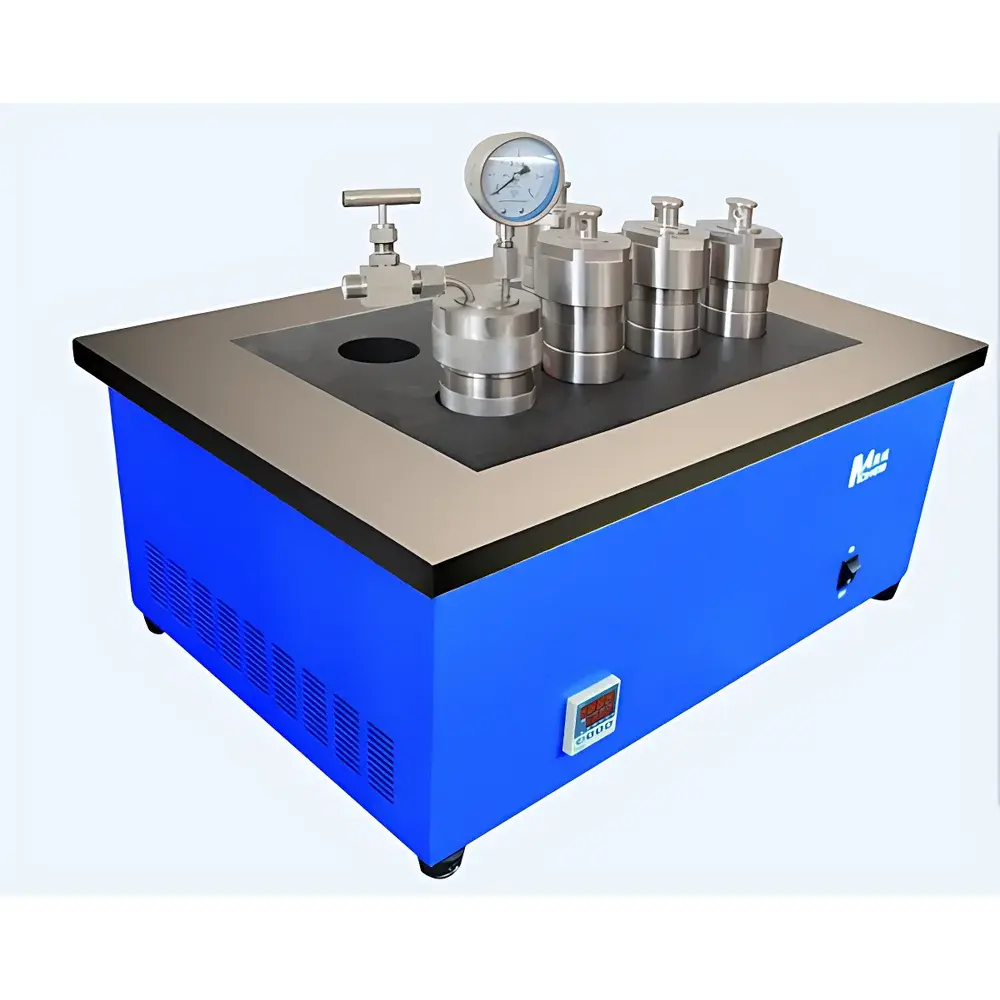
MICHEM DR-8H Graphite Block Digestion System for High-Pressure Reactor Vessels
| Brand | MICHEM |
|---|---|
| Origin | Beijing, China |
| Model | DR-8H |
| Instrument Type | Crucible Furnace |
| Max Temperature | 260 °C |
| Temperature Control Accuracy | ±0.2 °C |
| Max Power | 3000 W |
| Heating Rate | 260 °C (to max temp) |
| Heating Method | Electrical Resistance Heating |
| Internal Chamber Dimensions | 670 × 460 × 270 mm |
| Heating Block Material | High-Purity Graphite with PTFE Coating |
| Pressure Rating of Compatible Vessels | 10 MPa |
| Programmable Steps | 30-segment PID Profile |
| Sample Capacity | 8 × 100 mL High-Pressure Reactor Vessels |
| Power Supply | AC 220 V / 50 Hz, 16 A |
Overview
The MICHEM DR-8H Graphite Block Digestion System is a purpose-engineered thermal platform designed specifically for controlled, high-pressure acid digestion of samples in sealed reactor vessels. Unlike conventional muffle furnaces or convection ovens, the DR-8H employs a solid high-purity graphite heating block with uniform thermal mass distribution and integrated PTFE coating—enabling precise conductive heating of up to eight 100 mL high-pressure reaction vessels simultaneously. Its operational principle relies on direct, contact-based heat transfer to vessel bases under programmable temperature profiles, ensuring reproducible thermal input across all positions. This architecture supports standardized wet digestion protocols required prior to elemental analysis by techniques including Atomic Absorption Spectroscopy (AAS), Inductively Coupled Plasma Optical Emission Spectrometry (ICP-OES), and Inductively Coupled Plasma Mass Spectrometry (ICP-MS). The system is not a microwave digestion instrument; rather, it delivers robust, non-radiative thermal processing compatible with standard laboratory infrastructure and safety protocols.
Key Features
- High-purity graphite heating block with electrophoretically applied PTFE coating—resistant to concentrated HNO₃, HCl, HF, and aqua regia; surface hardness and chemical inertness ensure long-term integrity under aggressive digestion conditions.
- PID-based digital temperature control with 30-segment programmability—supports ramp-hold-cool profiles, gradient heating, and automatic termination upon completion; accuracy maintained at ±0.2 °C across full 260 °C operating range.
- Structurally reinforced cavity design accommodating dual-walled, high-pressure reactor vessels rated to 10 MPa—compliant with GB/T 150 (Chinese equivalent of ASME BPVC Section VIII) for pressure containment safety.
- Thermally optimized block geometry (670 × 460 × 270 mm internal volume) ensures minimal axial and radial temperature gradients (<1.5 °C deviation between positions at 200 °C).
- Integrated over-temperature protection, ground-fault circuit interruption (GFCI), and real-time power monitoring—meets IEC 61010-1:2010 safety requirements for laboratory electrical equipment.
Sample Compatibility & Compliance
The DR-8H is validated for use with standard 100 mL polytetrafluoroethylene (PTFE)-lined or quartz-lined high-pressure digestion vessels meeting ISO 17025 traceability requirements for sample preparation. It supports EPA Methods 3050B, 3051A, and 3052; ASTM D5175–91 (reapproved 2020); and GB/T 223.77–2008 for metal determination in environmental and geological matrices. While the instrument itself does not require GLP/GMP certification, its programmable profile logging, time-stamped temperature records, and non-volatile memory support audit-ready documentation when operated within a validated laboratory quality system aligned with ISO/IEC 17025:2017 clause 7.7.
Software & Data Management
The DR-8H utilizes an embedded microcontroller with local LCD interface and tactile keypad navigation—no external PC dependency. All 30-segment temperature programs—including setpoints, ramp rates, hold durations, and cooling parameters—are stored in non-volatile flash memory with timestamped execution logs retained for ≥100 cycles. Optional RS-485 serial output enables integration into centralized lab data acquisition systems supporting Modbus RTU protocol. Raw temperature vs. time data can be exported in CSV format for post-processing in LIMS or statistical analysis platforms compliant with FDA 21 CFR Part 11 requirements when paired with appropriate electronic signature and audit trail middleware.
Applications
- Digestion of soil, sediment, sludge, and plant tissue for multi-element analysis by ICP-MS.
- Decomposition of polymer composites and catalyst residues prior to noble metal quantification.
- Preparation of biological fluids (urine, serum) for trace element profiling under CLIA- and CAP-aligned workflows.
- Leachate testing per TCLP (Toxicity Characteristic Leaching Procedure) where controlled thermal extraction replaces open-vessel boiling.
- Method development for certified reference material (CRM) homogenization and validation in metrology laboratories.
FAQ
Can the DR-8H be used with non-MICHEM digestion vessels?
Yes—provided vessels conform to 100 mL nominal capacity, maximum outer diameter ≤65 mm, and pressure rating ≥10 MPa with compatible base geometry for full contact with the graphite block.
Is calibration traceable to national standards?
The unit ships with factory calibration verified using NIST-traceable Pt100 reference probes; users may perform field verification per ISO/IEC 17025 Annex A.3 using secondary standard thermocouples.
Does the system meet electromagnetic compatibility (EMC) requirements for EU laboratories?
Yes—it complies with EN 61326-1:2013 for laboratory equipment emissions and immunity, and carries CE marking under the Low Voltage Directive 2014/35/EU.
What maintenance is required for long-term stability?
Annual inspection of graphite block surface integrity, PTFE coating adhesion, and terminal lug torque; no consumables beyond routine cleaning with deionized water and mild detergent.
How is thermal uniformity validated during IQ/OQ protocols?
Using a 9-point thermocouple mapping procedure per ASTM E220–19, with acceptance criteria of ±2 °C maximum deviation at 200 °C across all vessel positions.



