
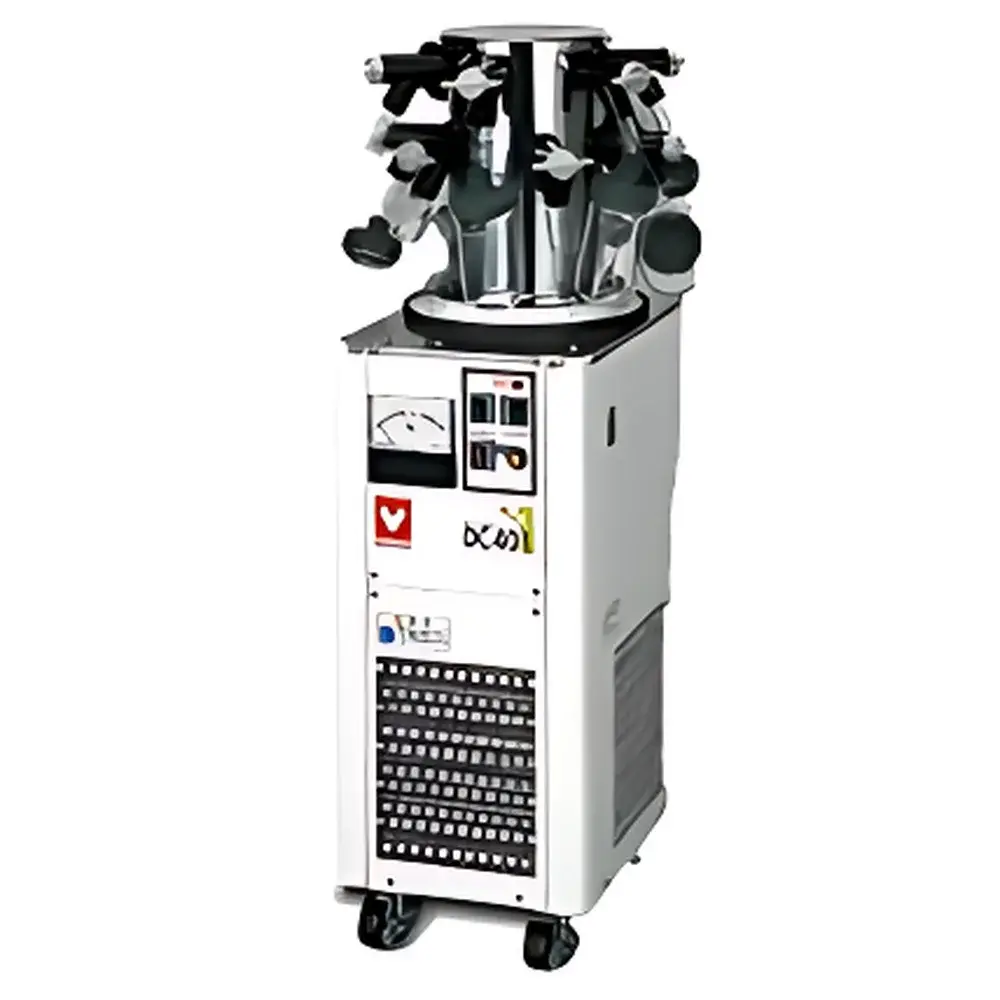
YAMATO DC401 Benchtop Freeze Dryer
| Brand | YAMATO |
|---|---|
| Origin | Japan |
| Model | DC401 |
| Instrument Type | Manifold Freeze Dryer |
| Application | Laboratory-Scale Lyophilization |
| Shelf Area | 0.12 m² |
| Ultimate Vacuum | 60 Pa |
| Condenser Capacity (24 h) | 0.6 L |
| Condenser Temperature | −45 °C |
| Dimensions (W × D × H) | 300 mm × 404 mm × 696 mm |
| Net Weight | ~32 kg |
| Power Supply | AC 100 V, 50/60 Hz |
| Compressor Power | 400 W |
| Refrigerant | R404A |
| Condenser Chamber | Ø153 mm × 235 mm (stainless steel cylindrical design) |
| Vacuum Gauge | Pirani-type |
| Defrost Method | Hot-Gas Bypass |
| Safety Features | Overcurrent leakage circuit breaker, compressor overload protection, reverse-flow prevention valve |
| Ambient Operating Temperature | 5–30 °C |
| Included Accessories | Vacuum silicone grease, vacuum hose, 10 A fuse |
Overview
The YAMATO DC401 is a compact, air-cooled benchtop manifold freeze dryer engineered for reliable, small-batch lyophilization in research laboratories, quality control environments, and pilot-scale development workflows. It operates on the fundamental principle of sublimation—removing water from frozen samples under deep vacuum while maintaining product integrity through precise thermal control. The system employs a hermetically sealed R404A refrigeration cycle to achieve a stable condenser temperature of −45 °C, enabling efficient capture of water vapor released during primary drying. With a nominal shelf area of 0.12 m² and a 4 L internal chamber volume, the DC401 supports simultaneous processing of up to eight samples via its standard manifold configuration—ideal for vial-based formulations, biological reagents, enzyme preparations, and heat-sensitive pharmaceutical intermediates. Its modular architecture integrates seamlessly with common laboratory vacuum pumps (50–60 L/min capacity), and its low-profile footprint (300 × 404 × 696 mm) ensures compatibility with standard fume hood or benchtop installations.
Key Features
- Air-cooled 400 W compressor system eliminates dependency on external chilled water or glycol loops—reducing infrastructure requirements and operational complexity.
- Cylindrical stainless-steel condenser chamber (Ø153 mm × 235 mm) provides uniform cold surface distribution and corrosion-resistant durability for repeated solvent exposure.
- Pirani-type vacuum gauge delivers real-time pressure monitoring within the 10⁻¹–10² Pa range, supporting accurate process validation and endpoint detection.
- Hot-gas bypass defrost mechanism enables rapid, controlled condenser regeneration without manual intervention or system venting—minimizing downtime between cycles.
- Dual-circuit safety architecture includes overcurrent/leakage circuit breakers, compressor thermal overload protection, and a non-return valve to prevent backstreaming during pump shutdown.
- Intuitive front-panel controls support manual operation and basic cycle sequencing; no proprietary software or PC interface is required for routine use.
Sample Compatibility & Compliance
The DC401 accommodates standard 10–22 mm OD glass vials, serum bottles, and open-dish configurations mounted on the manifold ports. It is routinely deployed in applications requiring adherence to GLP documentation practices and preliminary process development aligned with ICH Q5C stability guidelines. While not certified for GMP manufacturing, its consistent vacuum performance (≤60 Pa), reproducible condenser temperature stability (±1.5 °C), and traceable operational parameters make it suitable for method development, formulation screening, and reference standard preparation under ISO/IEC 17025-accredited laboratory conditions. All electrical components comply with JIS C 61010-1 and meet CE marking requirements for laboratory equipment safety.
Software & Data Management
The DC401 operates as a standalone instrument with no embedded data logging or network connectivity. Process parameters—including elapsed time, condenser temperature (monitored via thermistor), and vacuum level—are observable in real time but not stored internally. Users intending to fulfill FDA 21 CFR Part 11 compliance or establish audit trails must integrate external recording systems (e.g., calibrated chart recorders or validated SCADA interfaces). For routine lab documentation, operators typically log start/end times, batch identifiers, and final vacuum readings manually in bound laboratory notebooks or LIMS-compatible electronic forms.
Applications
- Stabilization of monoclonal antibodies, plasmid DNA, and viral vectors prior to long-term storage.
- Preparation of calibration standards for HPLC, GC-MS, and elemental analysis where residual moisture affects quantitation accuracy.
- Drying of microbial cultures, probiotic powders, and plant extract fractions without thermal degradation.
- Removal of volatile solvents (e.g., tert-butanol, ethyl acetate) from organic synthesis intermediates under cryogenic conditions.
- Archival preservation of forensic tissue samples and museum-grade biological specimens requiring structural fidelity.
FAQ
What vacuum pump specifications are recommended for optimal performance?
A two-stage rotary vane pump with ≥50 L/min free-air displacement and ultimate vacuum ≤5 Pa is advised. Oil mist filtration and cold trap integration are recommended when processing solvents with high vapor pressure.
Can the DC401 be used for drying acidic or halogenated samples?
Yes—provided the condenser and manifold surfaces remain uncoated and the vacuum pump is equipped with chemical-resistant oil or a dry scroll alternative. R404A refrigerant compatibility limits exposure to strong oxidizers or ammonia-based solutions.
Is the condenser temperature actively regulated or fixed?
The −45 °C setpoint is maintained passively by the refrigeration system’s thermostatic expansion valve; no user-adjustable temperature ramping is available.
How often does the vacuum pump oil require replacement?
Under continuous operation with aqueous samples, oil change intervals should follow the pump manufacturer’s schedule—typically every 200–500 hours—or after processing >100 g of total solvent load.
Does the unit include vacuum hose fittings compatible with standard NW25/KF25 flanges?
Yes—the supplied vacuum hose terminates in dual 8 mm ID barbed connectors, and an adapter kit for NW25 flange coupling is available as optional accessory (YAMATO P/N: ADP-NW25).



