
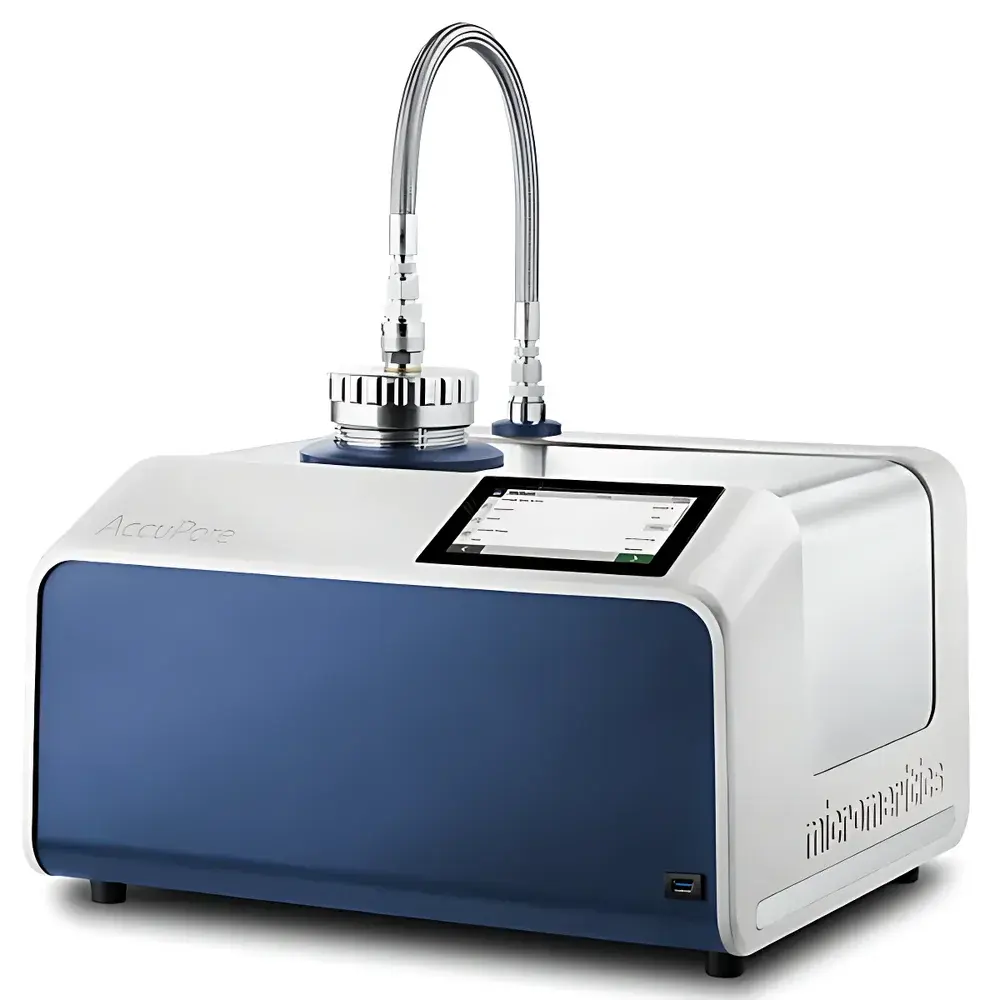
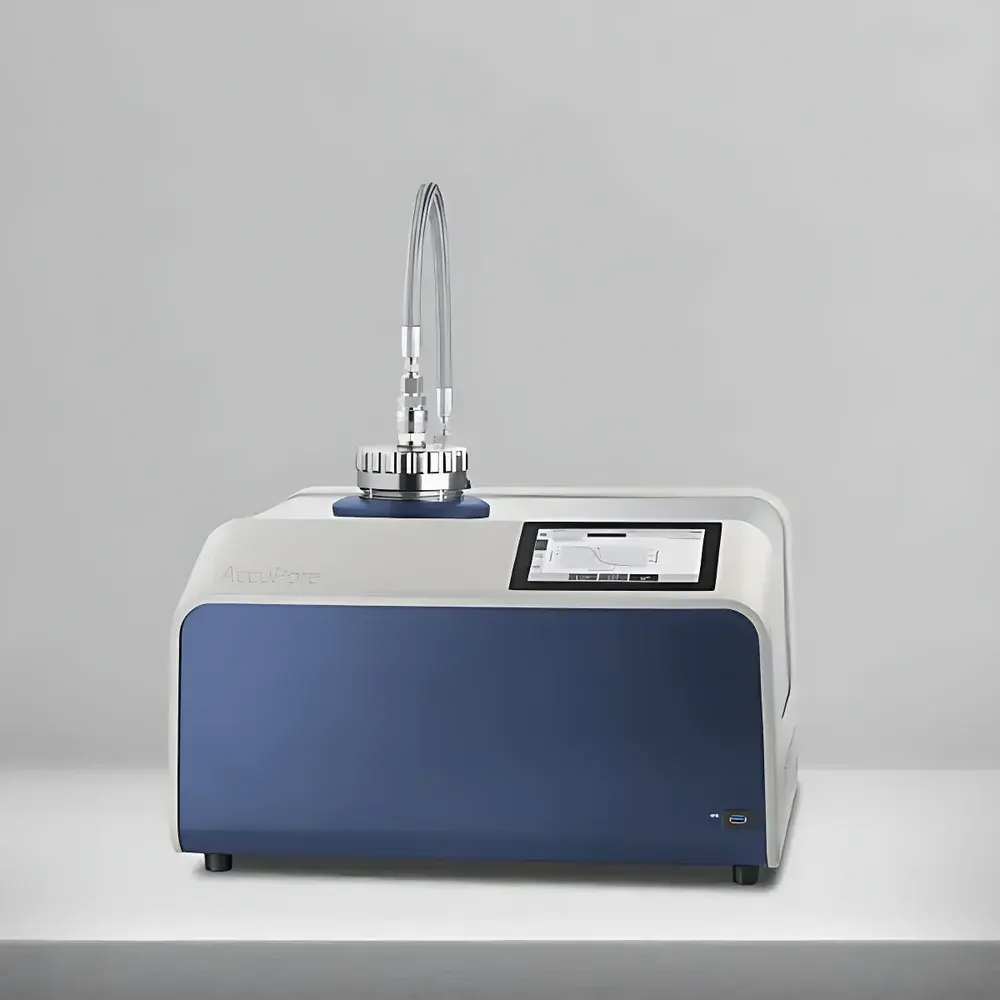
Micromeritics AccuPore Capillary Flow Porometer
| Brand | Micromeritics |
|---|---|
| Origin | USA |
| Model | AccuPore |
| Measurement Principle | Capillary Flow Porometry (CFP) |
| Standard Compliance | ASTM F316 |
| Pore Size Range | 0.013–500 µm (fluid-dependent) |
| Maximum Pressure | 500 psi (35 bar) |
| Gas Flow Rate Range | Up to 200 L/min |
| Sample Diameters Supported | 13 mm, 25 mm, 47 mm |
| Data Resolution | >1000 data points per run |
| Sampling Rate | 20 Hz |
| Operating Gases | Air or Nitrogen |
| Measurement Modes | Bubble Point, Wet/Dry, Wet/Calculated-Dry, Wet/Dry Flow Curve Analysis |
| Sample Prep Time | <30 s |
Overview
The Micromeritics AccuPore Capillary Flow Porometer is a precision-engineered instrument for the quantitative characterization of through-pore size distribution, porosity, and gas permeability in thin, porous materials. It operates on the principle of capillary flow porometry (CFP), also known as gas-liquid porometry (GLP), a pressure-driven displacement technique grounded in Washburn’s equation and Laplace’s law. In this method, a non-wetting liquid (e.g., water or isopropanol) is intruded into the pores under increasing gas pressure; the pressure at which gas first flows continuously through a pore corresponds inversely to its effective hydraulic diameter. Unlike imaging-based or mercury intrusion techniques, CFP requires no empirical model fitting, image segmentation, or hazardous mercury—making it both inherently traceable and compliant with modern laboratory safety and sustainability protocols.
Key Features
- Mercury-free, environmentally safe operation—eliminates regulatory handling constraints and disposal costs associated with mercury porosimetry.
- Sub-30-second sample preparation enabled by integrated liquid saturation fixtures and rapid pneumatic actuation.
- Triple-mode measurement capability: bubble point (for largest pore identification), wet/dry flow curve analysis (for mean flow pore size), and wet/calculated-dry analysis (for dry curve reconstruction without physical drying).
- High-resolution data acquisition: >1000 discrete pressure-flow data points per test cycle, sampled at 20 Hz for robust statistical representation of pore structure.
- Modular sample holder system accommodating 13 mm, 25 mm, and 47 mm diameter specimens within a single chamber—minimizing cross-contamination and calibration drift between runs.
- Gas conservation design reduces compressed air or nitrogen consumption by up to 95% versus legacy systems, supporting cost-effective high-throughput QC environments.
- Full compliance with ASTM F316–22 “Standard Test Methods for Pore Size Characteristics of Membrane Filters by Bubble Point and Mean Flow Pore Test”, ensuring data acceptability in regulated industries including medical device manufacturing and pharmaceutical filtration validation.
Sample Compatibility & Compliance
The AccuPore is validated for use across a broad spectrum of planar, porous substrates—including polymeric and ceramic membranes, battery separators (e.g., PE/PP microporous films), fuel cell gas diffusion layers (GDLs), nonwovens, sintered metals, and track-etched polycarbonate filters. Its low-force clamping mechanism and configurable support inserts prevent deformation of fragile or low-modulus samples during saturation and pressurization. All measurement outputs—including bubble point pressure, mean flow pore size (MFPS), minimum pore size (MPS), and differential/cumulative pore size distributions—are reported in SI units (µm) with full metrological traceability. The system supports audit-ready documentation aligned with GLP and GMP frameworks, including user access control, electronic signatures, and 21 CFR Part 11–compliant data integrity features when paired with Micromeritics’ optional Porometer Software Suite.
Software & Data Management
The AccuPore integrates with Micromeritics’ proprietary Porometer Control and Analysis Software, a Windows-based platform delivering real-time visualization of wet and dry flow curves, automatic derivation of critical pore metrics, and export of ASCII- and CSV-formatted datasets for integration into LIMS or statistical process control (SPC) platforms. The software enforces standardized test sequences per ASTM F316, logs all operator actions and instrument parameters with timestamps, and maintains immutable audit trails for regulatory submissions. Batch reporting tools allow comparative analysis across multiple lots or material grades, while customizable report templates facilitate direct alignment with internal SOPs or external client requirements.
Applications
- Battery R&D and QA: Quantifying pore interconnectivity and tortuosity in lithium-ion separator films to correlate with ionic conductivity and dendrite suppression performance.
- Filtration membrane qualification: Verifying pore size uniformity and defect density in ultrafiltration (UF), microfiltration (MF), and venting membranes prior to sterilizing-grade validation.
- Fuel cell component testing: Assessing gas transport resistance and hydrophobic/hydrophilic balance in microporous layers and catalyst-coated membranes (CCMs).
- Medical device manufacturing: Validating pore architecture of surgical meshes, wound dressings, and implantable barrier membranes per ISO 10993 biocompatibility guidelines.
- Materials science research: Correlating thermal sintering profiles or electrospinning parameters with resulting pore morphology in ceramic and polymer scaffolds.
FAQ
What pore size range can the AccuPore measure?
The instrument measures through-pores from 0.013 µm to 500 µm, depending on the surface tension and contact angle of the selected wetting liquid (e.g., water, ethanol, or FC-40).
Is mercury required for operation?
No—AccuPore uses only non-toxic, low-volatility wetting liquids and compressed air or nitrogen. It fully complies with RoHS, REACH, and OSHA mercury elimination directives.
Can I test asymmetric or graded-pore membranes?
Yes—the capillary flow method inherently characterizes the largest through-pore pathway, making it especially suitable for evaluating skin-layer integrity and defect detection in composite membranes.
How does the AccuPore ensure measurement reproducibility across operators?
Through automated saturation protocols, fixed-pressure ramp rates, and software-enforced pass/fail criteria based on ASTM F316 repeatability thresholds (±5% RSD for MFPS across replicate runs).
Does the system support IQ/OQ/PQ documentation for regulated labs?
Yes—Micromeritics provides comprehensive validation packages, including installation qualification (IQ), operational qualification (OQ), and performance qualification (PQ) protocols aligned with ISO/IEC 17025 and FDA guidance for analytical instrument qualification.



