
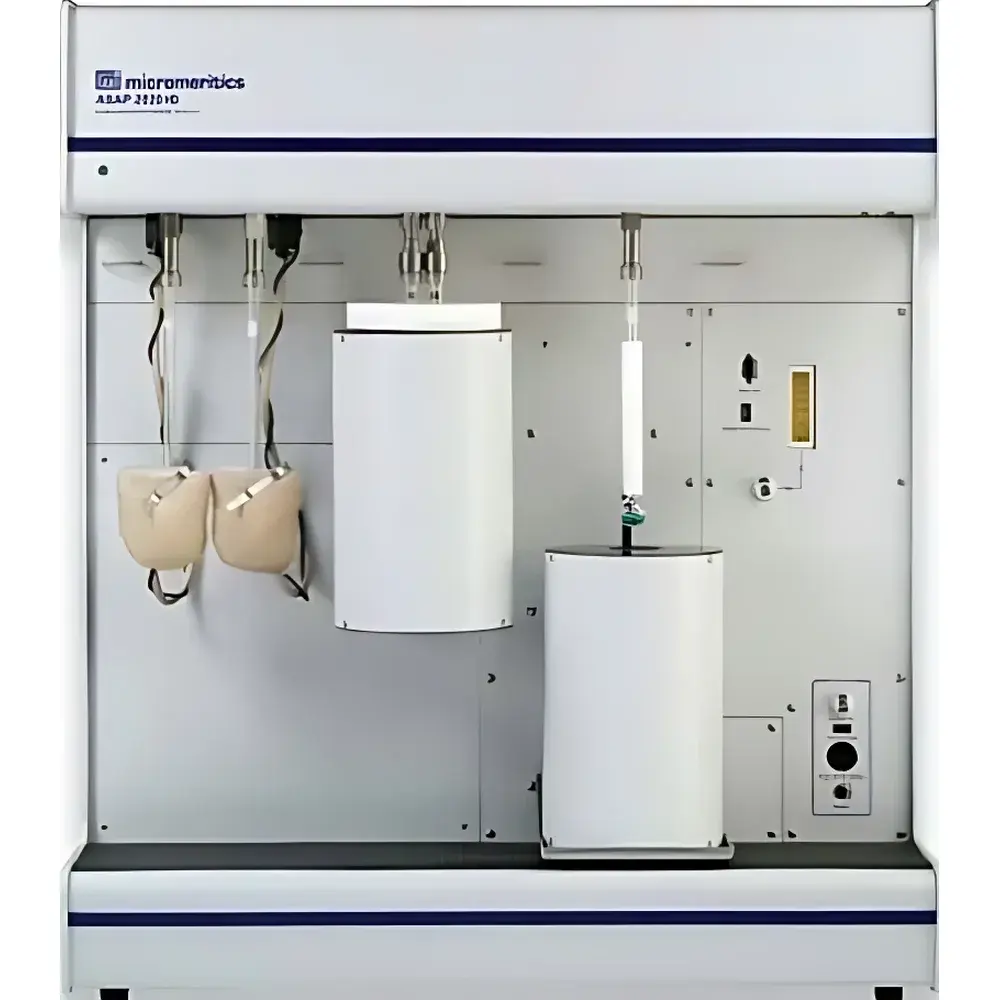
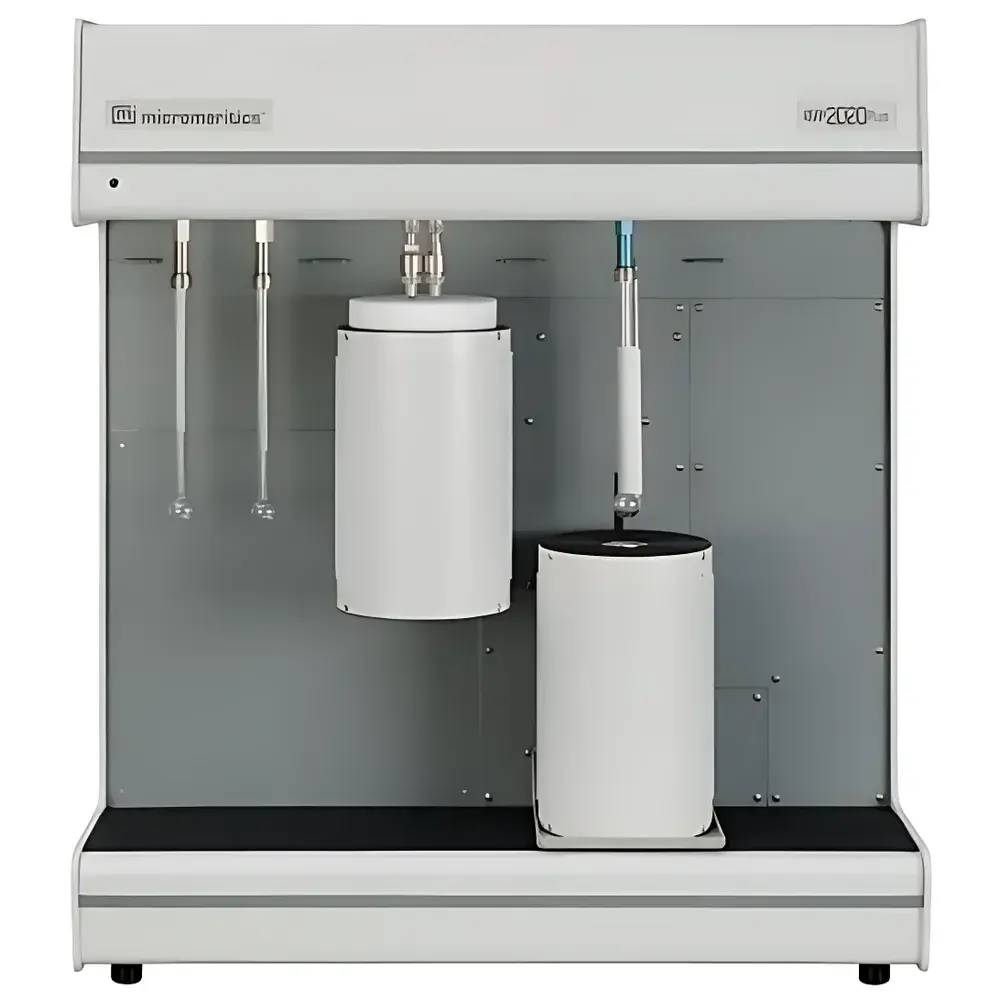
Micromeritics ASAP 2020 Plus Automated Static Chemisorption Analyzer
| Brand | Micromeritics |
|---|---|
| Origin | USA |
| Model | ASAP 2020 Plus Series |
| Gas Inlet Ports | 12 |
| Heating Temperature Range | Ambient to 1100 °C |
| Pressure Range | 0–1000 mmHg |
| Analytical Functions | TPD, TPR |
| Optional Configurations | Steam Adsorption, Micropore Analysis (0.1 mmHg sensor + high-vacuum pump), Corrosion-Resistant Stainless Steel Manifold, Cryogenic Cooling Access |
Overview
The Micromeritics ASAP 2020 Plus Automated Static Chemisorption Analyzer is a research-grade, dual-station surface characterization platform engineered for precision measurement of chemisorption behavior, catalytic surface reactivity, and active site quantification under controlled thermal and gaseous environments. Based on static volumetric gas adsorption principles, the system operates by dosing calibrated pulses of reactive gases (e.g., H₂, CO, O₂, NH₃) onto pre-degassed solid catalysts or adsorbents, followed by quantitative uptake measurement via high-resolution pressure transduction in a closed, ultra-high-purity manifold. Its design adheres to fundamental thermodynamic and kinetic frameworks for surface science—enabling derivation of adsorption enthalpies, activation energies, and dispersion metrics through temperature-programmed desorption (TPD) and temperature-programmed reduction (TPR) protocols. The instrument supports both static and dynamic equilibrium acquisition modes, with full compliance to ASTM D3663 (Standard Test Method for Surface Area of Catalysts) and ISO 9277 (Calculation of Specific Surface Area), serving as a foundational tool in heterogeneous catalysis R&D, materials development, and quality control laboratories.
Key Features
- Dual independent degas stations with programmable temperature control from ambient to 450 °C (1 °C resolution), enabling simultaneous sample preparation while analysis runs on the main station.
- 12 independently controlled gas inlet ports—eliminating manual valve switching and cross-contamination risk during multi-gas sequential experiments (e.g., O₂ pretreatment → CO chemisorption → H₂ TPD).
- High-temperature furnace capable of ramping from ambient to 1100 °C at user-defined gradients: 20 °C/min up to 800 °C, 10 °C/min up to 1000 °C, and 5 °C/min up to 1100 °C—with rapid cooling via forced-air quenching for improved cycle throughput.
- Ultra-high vacuum compatibility: optional 0.1 mmHg pressure transducer (resolution down to 1×10⁻⁷ torr) and turbomolecular pumping system for micropore analysis (0.35–3 nm) and low-surface-area measurements using Kr adsorption at 77 K.
- Corrosion-resistant configuration available with electropolished stainless steel manifold and chemically inert wetted surfaces—validated for operation with acidic vapors (e.g., NH₃, SO₂, Cl₂-containing streams) and steam adsorption studies.
- Integrated dedicated exhaust port for coupling with external detectors such as mass spectrometers (MS), thermal conductivity detectors (TCD), or Fourier-transform infrared (FTIR) cells for evolved gas analysis during TPD/TPR.
Sample Compatibility & Compliance
The ASAP 2020 Plus accommodates standard 6–8 mm OD quartz or ceramic sample tubes and accepts powders, pellets, monoliths, and supported catalysts across diverse material classes—including transition metal oxides, zeolites, MOFs, carbon-based sorbents, and sulfided or halogenated catalysts. All fluidic pathways meet U.S. Pharmacopeia (USP) cleanliness standards for residual solvent testing instrumentation. Data acquisition and audit trails comply with FDA 21 CFR Part 11 requirements when operated with validated MicroActive software configurations and networked electronic signatures. Instrument calibration protocols align with NIST-traceable pressure and temperature references, supporting GLP/GMP-regulated environments where documentation integrity and method reproducibility are mandatory.
Software & Data Management
MicroActive software—developed exclusively by Micromeritics—is a Python-embedded, interactive data evaluation platform designed for surface science professionals. It enables real-time visualization of isotherms in linear and logarithmic scales, dynamic point exclusion via draggable calculation sliders, and concurrent overlay of up to 25 datasets—including mercury intrusion porosimetry (MIP) and BET surface area results from complementary techniques. The software includes built-in models for Langmuir, Freundlich, Temkin, and Dubinin–Radushkevich analyses; TPD peak deconvolution using Gaussian/Lorentzian fitting; and dispersion calculations based on stoichiometric uptake assumptions. Custom report templates can be authored and previewed in situ, exporting structured outputs (PDF, CSV, XML) with embedded metadata, instrument logs, and calibration certificates. Scripting extensions allow automation of repetitive workflows—such as batch processing of TPR ramp sequences or automated outlier detection in multi-point chemisorption titrations.
Applications
- Quantification of metal dispersion and active surface area in Pt/Al₂O₃, Ni/SiO₂, and Co/Mo/Al₂O₃ hydrotreating catalysts.
- Acid site strength distribution mapping in zeolitic and amorphous aluminosilicates via NH₃-TPD.
- Oxygen storage capacity (OSC) assessment in ceria-zirconia automotive three-way catalysts using CO-TPR.
- Hydrogen spillover kinetics and surface mobility studies on carbon-supported noble metals.
- Stability evaluation of single-atom catalysts under cyclic redox conditions (e.g., alternating H₂/O₂ pulses).
- Steam-assisted pore structure evolution monitoring in mesoporous silica during hydrothermal aging.
FAQ
What gases are compatible with the ASAP 2020 Plus for chemisorption studies?
H₂, CO, O₂, NO, NH₃, SO₂, and hydrocarbon gases (e.g., C₃H₆) are routinely used; corrosive or condensable species require the stainless steel manifold option.
Can the system perform both physisorption and chemisorption on the same sample?
Yes—sequential analysis is supported: physical adsorption (N₂, Ar, Kr) at cryogenic temperatures followed by in-situ high-temperature chemisorption after evacuation and thermal treatment.
Is remote operation and data monitoring supported?
MicroActive supports secure LAN/WAN connectivity with role-based access control, enabling off-site method deployment, live data streaming, and centralized instrument fleet management.
How is temperature calibration verified across the full 1100 °C range?
Calibration follows ASTM E220 procedures using NIST-certified reference materials (e.g., In, Sn, Zn, Al, Ag melting points); furnace uniformity mapping is performed annually per ISO/IEC 17025 guidelines.
Does the system support automated regeneration cycles for reusable catalyst samples?
Yes—customizable purge-and-reheat sequences can be scripted within MicroActive to execute multi-cycle stability tests with integrated mass balance tracking.



