
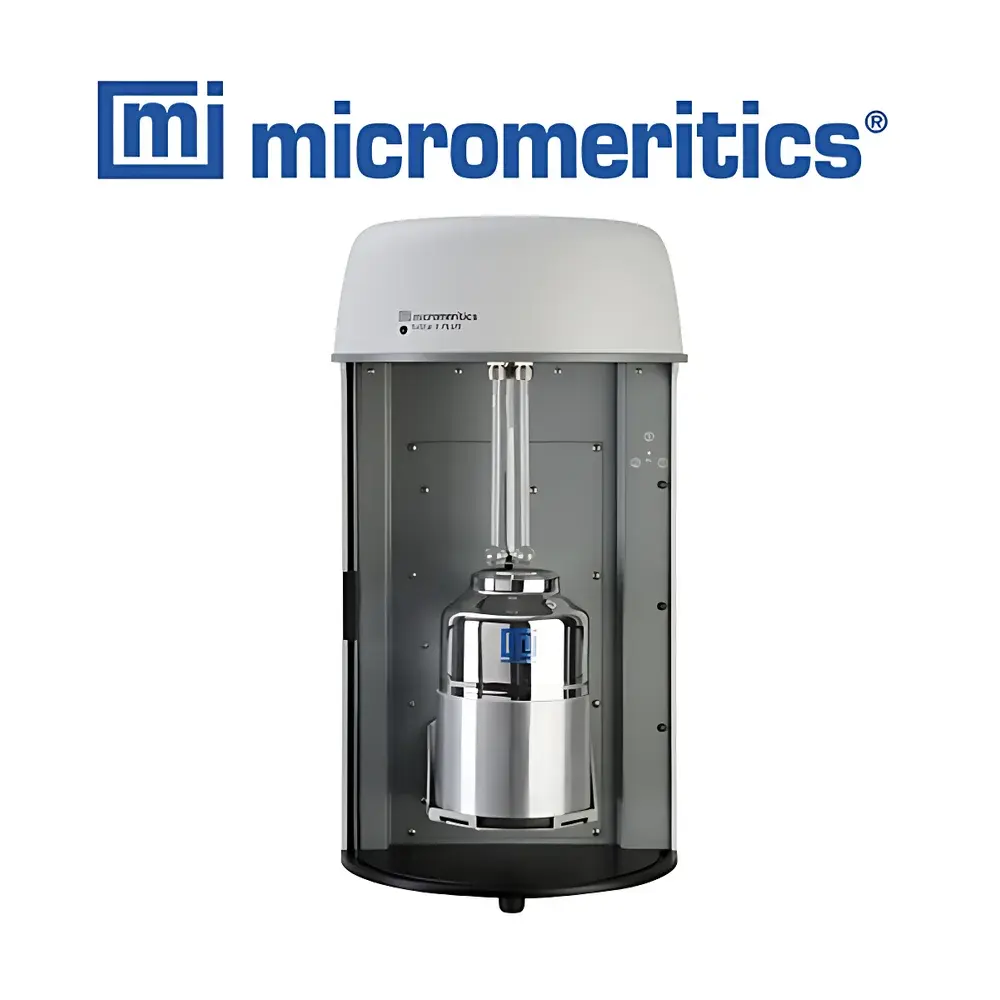
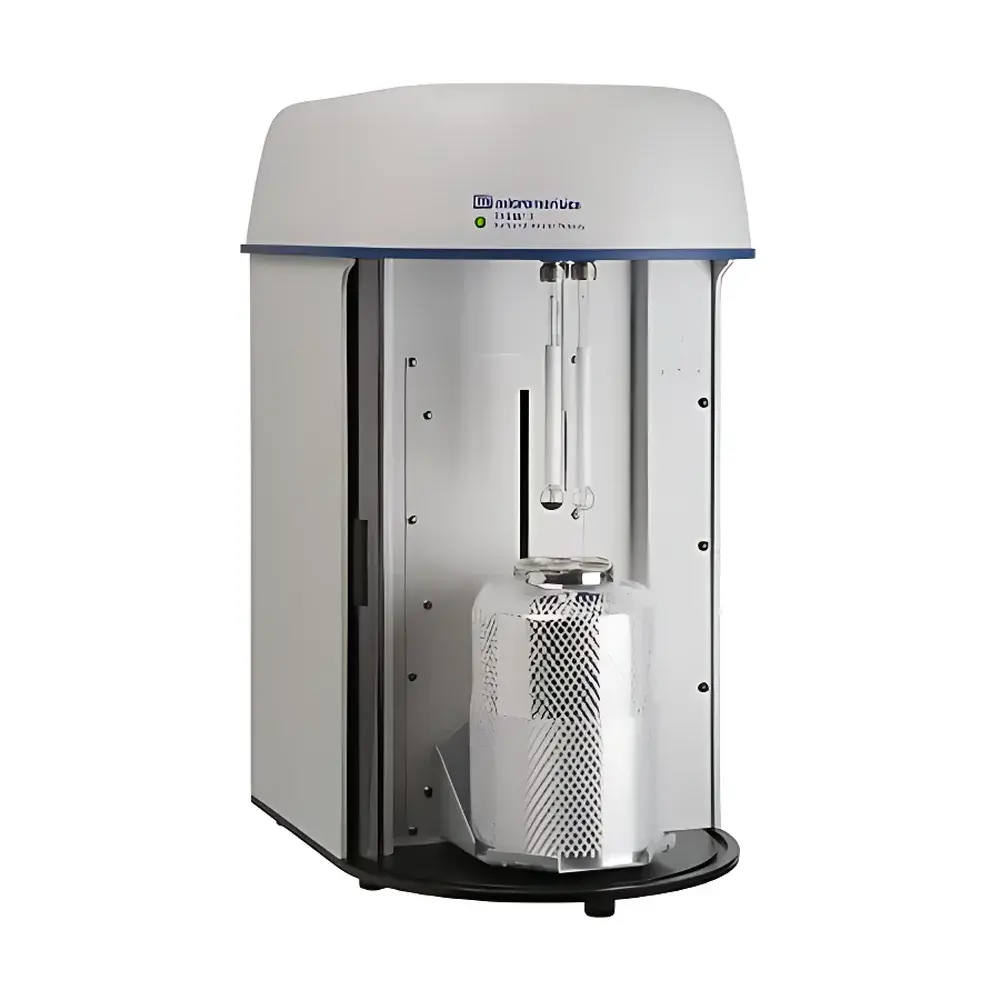
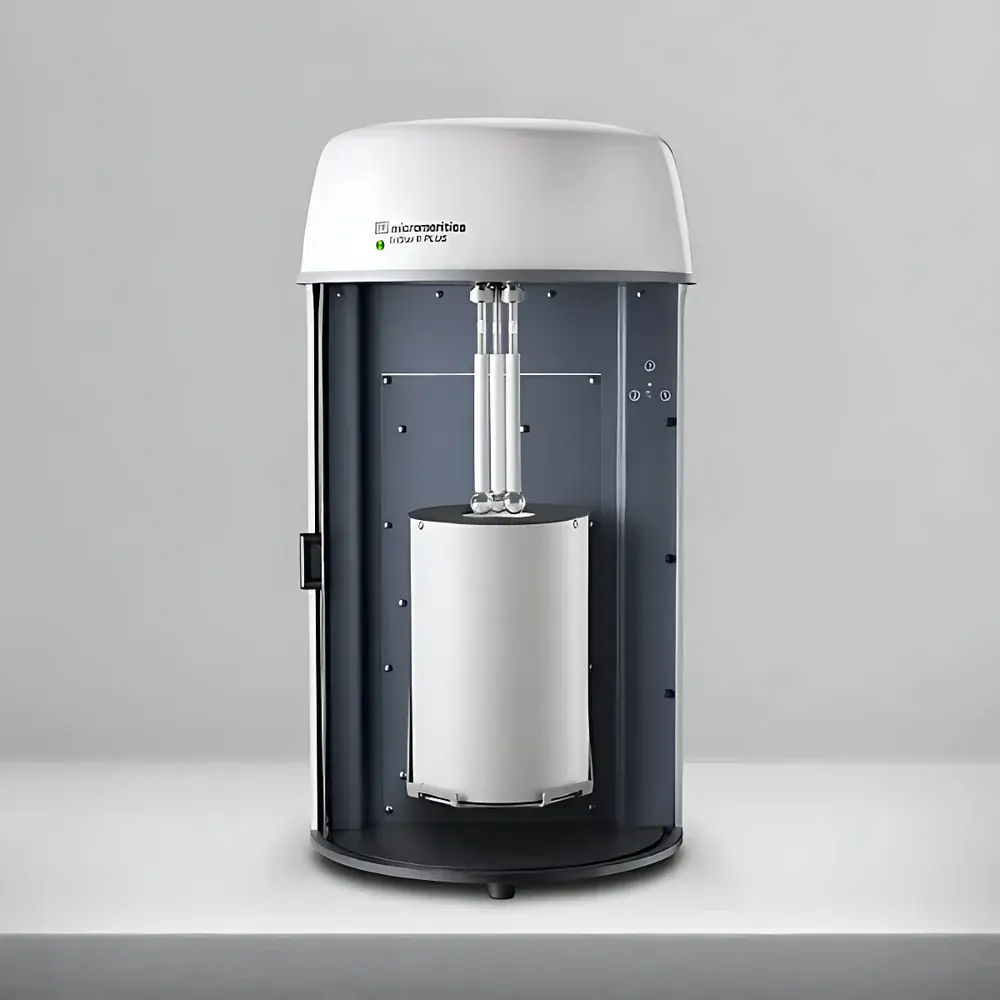
Micromeritics TriStar II Plus Surface Area and Porosity Analyzer
| Brand | Micromeritics |
|---|---|
| Origin | USA |
| Model | TriStar II Plus |
| Analysis Stations | 3 (independent) |
| Measurable Surface Area | ≥0.01 m²/g (N₂), ≥0.001 m²/g (Kr) |
| Pore Volume Detection Limit | ≥4 × 10⁻⁶ cm³/g |
| Dewar Capacity | 2.75 L (optional 4 L) |
| Continuous Operation Time | up to 40 h |
| Gas Compatibility | N₂, Ar, CO₂, C₄H₁₀, CH₄, and other non-corrosive gases |
| P₀ Measurement | continuous, manual, or in-situ |
| Data Points per Isotherm | up to 1000 |
| Software | Windows-based with SPC reporting, DFT modeling, t-plot, αₛ-plot, isosteric heat calculation, and thickness model integration |
Overview
The Micromeritics TriStar II Plus Surface Area and Porosity Analyzer is a fully automated, three-station gas adsorption system engineered for high-throughput, high-fidelity characterization of specific surface area, pore size distribution, and total pore volume. Based on the principle of physical gas adsorption—primarily nitrogen at 77 K, but extendable to argon at 87 K, carbon dioxide at 273 K, or krypton for ultra-low-surface-area materials—the instrument implements the Brunauer–Emmett–Teller (BET) theory for surface area quantification and applies density functional theory (DFT), Barrett–Joyner–Halenda (BJH), and other validated models for pore size analysis. Its tri-station architecture enables parallel, independent analyses without cross-talk, supporting both routine quality control and advanced materials research under ISO 9277, ASTM D3663, and IUPAC-recommended protocols.
Key Features
- Three thermally isolated analysis stations operating simultaneously—each with dedicated pressure transducers, temperature sensors, and dosing valves—to ensure reproducibility and eliminate inter-station drift.
- Extended dewar capacity (2.75 L standard; 4 L optional) supports uninterrupted isotherm acquisition for up to 40 hours, enabling full N₂ adsorption–desorption isotherms (up to 1000 data points) without manual cryogen refills.
- Integrated P₀ port with real-time saturation pressure monitoring—measurable continuously during analysis, entered manually, or determined in situ via blank runs—ensuring thermodynamic consistency across all isotherm branches.
- Flexible gas selection: compatible with N₂, Ar, CO₂, Kr, CH₄, C₄H₁₀, and other non-corrosive analytes; Kr option extends surface area detection limit to 0.001 m²/g for highly dense or low-porosity ceramics, metals, and catalysts.
- Programmable dose control: users select between incremental or fixed-step gas dosing to optimize resolution versus analysis time—critical for capturing subtle inflections in microporous materials or sharp capillary condensation steps in mesopores.
- Free space calibration options: automatic He pycnometry, user-input value, or calculated from reference material—accommodating irregular geometries, swelling samples, or rapid screening workflows.
Sample Compatibility & Compliance
The TriStar II Plus accommodates solid powders, granules, monoliths, and thin films within standardized 6–12 mm OD sample tubes. Sample degassing is supported via integrated heated flow gas (up to 400 °C) or vacuum heating (with optional turbomolecular pump), meeting ASTM D4641 and USP requirements for residual moisture and physisorbed contaminant removal. All hardware and software modules comply with GLP/GMP documentation standards, including full audit trail logging, electronic signature support, and 21 CFR Part 11–ready configuration. Instrument validation packages—including IQ/OQ/PQ documentation—are available for regulated environments such as pharmaceutical excipient development and battery electrode qualification.
Software & Data Management
The TriStar II Plus operates via Micromeritics’ proprietary NovaWin software—a Windows-native application designed for multi-instrument network deployment. It provides centralized control of up to four TriStar systems from a single workstation. Data handling includes automated SPC chart generation, customizable report templates (PDF/Excel), and comparative overlay of historical datasets (e.g., Gemini VII, TriStar I, or legacy TriStar II archives). Advanced modeling modules support t-plot and αₛ-plot analysis for micropore/mesopore deconvolution, DFT kernel selection (N₂/Ar on carbon, silica, or alumina), and isosteric heat calculation via the Clausius–Clapeyron method. Raw isotherm data are stored in vendor-neutral ASCII format, ensuring long-term accessibility and third-party interoperability.
Applications
This analyzer serves diverse sectors requiring quantitative microstructural insight: catalyst developers assessing active site dispersion and pore confinement effects; battery researchers correlating electrode porosity with Li⁺ diffusion kinetics; pharmaceutical scientists evaluating tablet excipient surface energetics and dissolution behavior; and nanomaterial producers validating synthesis reproducibility across batches of MOFs, aerogels, or hierarchical zeolites. Its ability to resolve narrow micropore distributions (<0.7 nm) and quantify ink-bottle pore networks makes it indispensable for membrane filtration media and gas separation sorbent qualification.
FAQ
Can the TriStar II Plus perform both adsorption and desorption isotherms in a single run?
Yes—full hysteresis loops are acquired automatically using programmable equilibration times and pressure stepping, with independent control over adsorption and desorption branches.
Is remote diagnostics supported out-of-the-box?
Yes—Ethernet connectivity enables secure remote access for firmware updates, real-time performance monitoring, and collaborative troubleshooting with Micromeritics Field Application Scientists.
Does the system meet regulatory requirements for pharmaceutical QC labs?
When configured with audit trail, user access controls, and electronic signature modules, it satisfies FDA 21 CFR Part 11, EU Annex 11, and WHO TRS 992 data integrity expectations.
What degassing options are available for moisture-sensitive samples?
Vacuum-only, heated vacuum (up to 400 °C), or flowing inert gas purge—each with programmable ramp rates, dwell times, and endpoint criteria based on pressure decay rate.
Can I import custom DFT kernels or export raw isotherm data for external modeling?
Yes—ASCII-exported isotherms retain full pressure/volume metadata; third-party DFT kernels may be loaded via NovaWin’s open modeling interface, subject to validation per ISO 15901-2 guidelines.



