
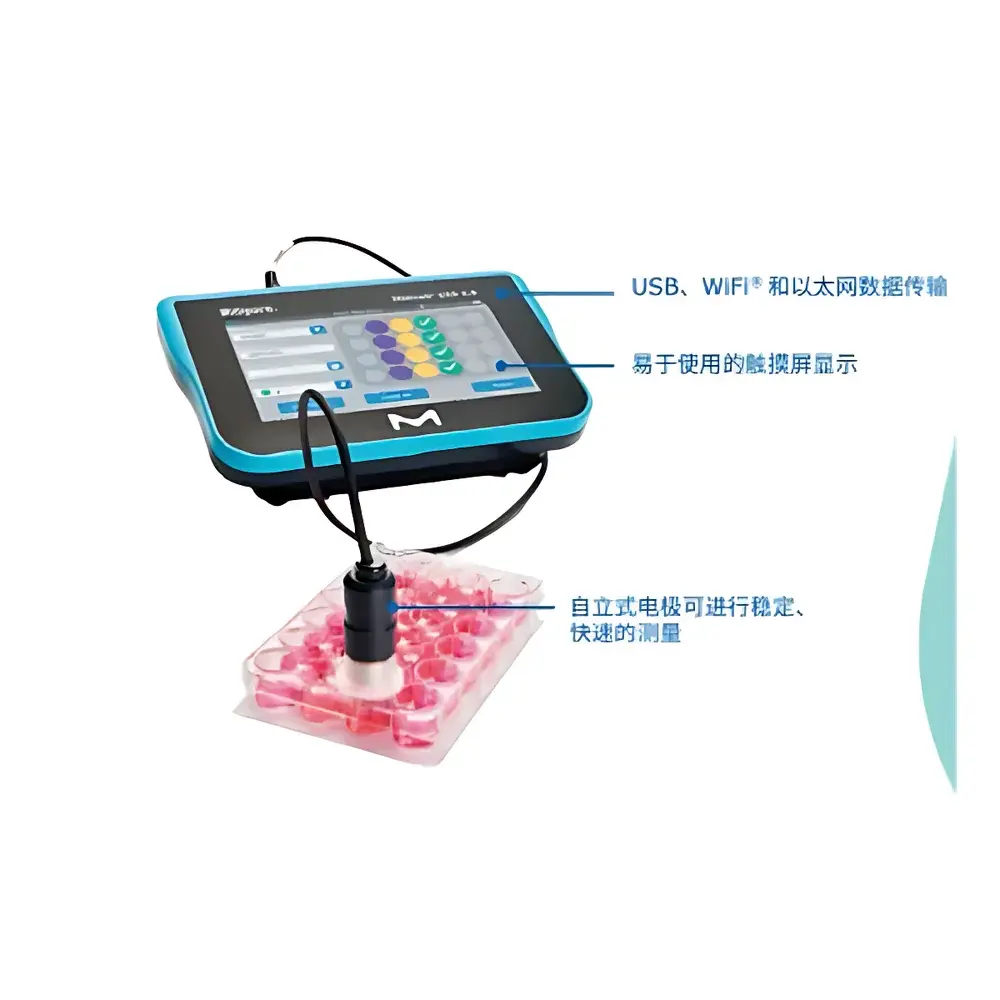
Millicell® ERS 3.0 Digital Electrical Resistance Spectrometer
| Brand | Chengmeng Technology |
|---|---|
| Origin | USA |
| Manufacturer Type | Authorized Distributor |
| Origin Category | Imported |
| Model | Millicell® ERS 3.0 |
| Price | Upon Request |
Overview
The Millicell® ERS 3.0 Digital Electrical Resistance Spectrometer is an engineered-instrument for non-invasive, real-time measurement of transepithelial/transendothelial electrical resistance (TEER) across cell monolayers cultured on permeable supports. Operating on the principle of alternating current (AC) impedance spectroscopy at low frequencies (typically 12.5–25 Hz), the system applies a controlled sinusoidal voltage and measures the resulting current to calculate resistance with high reproducibility and minimal electrode polarization error. Designed specifically for barrier function assessment in vitro, it delivers quantitative TEER values—expressed in Ω·cm² after geometric correction—that correlate directly with tight junction integrity, paracellular permeability, and monolayer confluence. Its integration into standardized cell culture workflows supports applications ranging from drug permeability screening to toxicology studies under GLP- and GMP-aligned laboratory practices.
Key Features
- Touchscreen-driven user interface with intuitive navigation for plate mapping, group assignment, and real-time data visualization
- Dual-mode measurement capability: raw resistance (Ω) and background-subtracted, temperature-compensated TEER (Ω·cm²)
- Integrated temperature monitoring (±0.1 °C resolution) with automatic thermal drift correction
- Wi-Fi® and USB connectivity enabling secure instrument control, remote calibration, and encrypted data export
- Hardware-based password lock for access control and audit trail compliance (aligned with FDA 21 CFR Part 11 requirements)
- Modular electrode design supporting 6-, 12-, and 24-well permeable inserts with auto-detect geometry recognition
- On-device progress tracking, elapsed time logging, and multi-well sequential scanning with visual plate map overlay
Sample Compatibility & Compliance
The Millicell® ERS 3.0 is validated for use with standard Transwell®-compatible polycarbonate, polyester, and collagen-coated membranes. It accommodates epithelial (e.g., Caco-2, MDCK, CHO-K1) and endothelial (e.g., HUVEC, bEnd.3) monolayers grown on porous supports with surface areas from 0.3–4.7 cm². All firmware and calibration protocols comply with ISO/IEC 17025:2017 general requirements for competence of testing and calibration laboratories. Measurement traceability is maintained through NIST-traceable reference resistors embedded in the instrument’s analog front-end. The system supports documentation workflows required for regulatory submissions under ICH M3(R2), USP , and ASTM F2971–15 standards for barrier integrity evaluation.
Software & Data Management
Data acquisition and post-processing are managed via a cloud-hosted web application accessible from any modern browser. The platform provides role-based user accounts, automated metadata tagging (including plate name, seeding date, cell line, and experimental group), and version-controlled data archiving. Raw resistance logs include timestamp, well ID, ambient temperature, and electrode contact status. Export options include CSV, PDF reports, and structured JSON for LIMS integration. Audit trails record all user actions—including edits, deletions, and calibration events—with immutable timestamps. Optional subscription tiers enable advanced analytics: trend analysis across passages, statistical outlier detection, and TEER stability scoring per well or plate cohort.
Applications
- Quantitative validation of epithelial/endothelial barrier formation during differentiation and maturation assays
- High-throughput screening of compound-induced barrier disruption (e.g., cytokines, chemotherapeutics, nanomaterials)
- Quality control of primary cell-derived organoids and air-liquid interface (ALI) cultures
- Correlation of TEER dynamics with immunofluorescence imaging (e.g., ZO-1, occludin localization) and permeability tracer assays (e.g., FITC-dextran flux)
- Supporting OECD TG 497 and EMA CHMP reflection paper guidelines for in vitro absorption prediction models
- Longitudinal monitoring of barrier recovery following chemical or mechanical insult
FAQ
What is the minimum measurable resistance and typical resolution?
The instrument resolves resistance values from 1 Ω to 10 kΩ with ±1% full-scale accuracy; resolution is 0.1 Ω in low-range mode and 1 Ω in high-range mode.
Does the system require daily recalibration?
No—factory calibration remains stable for ≥12 months under routine use; optional annual verification using supplied reference resistors is recommended for regulated environments.
Can TEER values be exported directly to Excel or LabArchives?
Yes—CSV exports include normalized Ω·cm² values, raw readings, temperature, and metadata fields compatible with ELN/LIMS ingestion pipelines.
Is the Wi-Fi module compliant with institutional IT security policies?
Yes—the device supports WPA2-Enterprise authentication, TLS 1.2+ encrypted API endpoints, and MAC address whitelisting for network onboarding.
How does the system handle edge wells or uneven electrode contact?
Real-time contact impedance monitoring flags poor electrode alignment; the UI displays visual feedback and disables invalid readings prior to calculation.







