
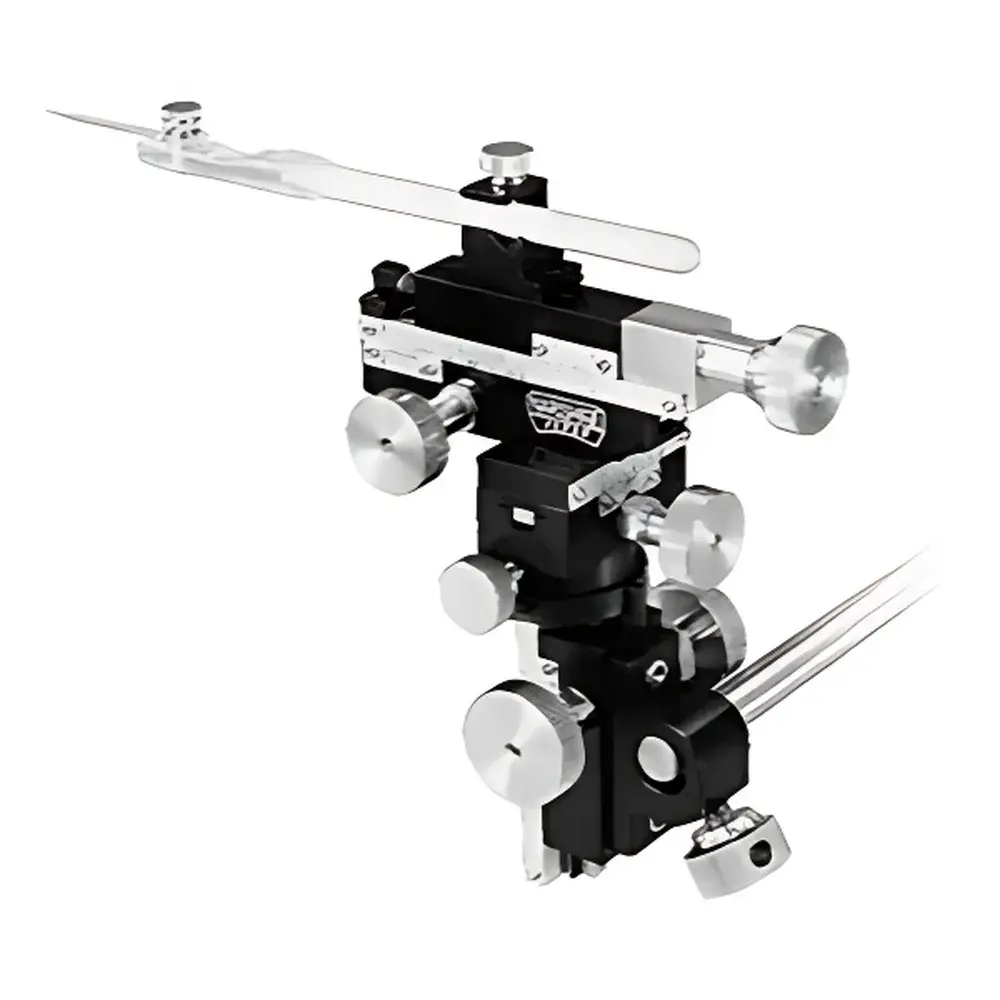
MMN-33 Micro Manipulator by NARISHIGE
| Brand | NARISHIGE |
|---|---|
| Origin | Japan |
| Model | MMN-33 |
| Axis Configuration | Single-axis coarse/fine adjustment (X-Z dual-hand control) |
| Coarse Travel Range | X 40 mm, Y 20 mm, Z 35 mm |
| Fine Travel Range | X 7 mm |
| Minimum Step Size | 10 µm |
| Maximum Rotation Speed | 250 µm/rev |
| Electrode Holder Compatibility | H-1 electrode holder included |
| Dimensions (W×D×H) | 105 × 70 × 155 mm |
| Weight | 880 g |
Overview
The MMN-33 Micro Manipulator is a precision mechanical positioning system engineered by NARISHIGE (Japan) for high-stability, low-drift manipulation of microelectrodes in electrochemical and electrophysiological applications. Designed with a single-axis coaxial alignment architecture—where the micromanipulator’s fine-adjustment axis shares the same orientation as the mounted microelectrode—it ensures minimal lateral deviation during approach, critical for reproducible tip-sample contact in voltammetric, amperometric, or patch-clamp configurations. Its rigid aluminum alloy frame and optimized gear-train mechanics deliver sub-micron repeatability under static load, while the dual-hand control layout (X and Z axes independently actuated via side-mounted ergonomic levers) supports ambidextrous operation without repositioning the user’s posture. Unlike motorized alternatives, the MMN-33 relies on purely mechanical translation—eliminating electromagnetic interference, thermal drift from drive electronics, and dependency on external power sources—making it suitable for shielded Faraday cages, low-noise amplifier setups, and multi-probe electrochemical cells.
Key Features
- Coaxial electrode alignment geometry ensures direct linear approach along the electrode axis, reducing shear-induced tip damage during cell penetration or surface scanning.
- Dual independent manual controls: left-side lever for Z-axis (vertical) coarse/fine motion; right-side lever for X-axis (horizontal) coarse/fine motion—both feature adjustable friction damping to prevent gravitational sag during extended positioning.
- Integrated fine-adjustment mechanism with 10 µm minimum incremental resolution and 250 µm per full rotation, calibrated for tactile feedback consistency across operators.
- Modular rotating joint design enables rapid electrode exchange without realignment—compatible with standard NARISHIGE H-1 electrode holders and interchangeable clamp rods.
- Compact footprint (105 × 70 × 155 mm) and 880 g mass ensure stable mounting on vibration-isolated optical tables, microscope stages, or custom electrochemical rigs without requiring auxiliary anchoring.
Sample Compatibility & Compliance
The MMN-33 is routinely deployed in regulated electrochemical laboratories performing ASTM D1149 (ozone cracking resistance), ISO 17468 (electrochemical impedance spectroscopy for coatings), and USP particulate matter testing with microelectrode-based detection. Its all-metal construction (no plastics in load-bearing paths) and absence of electronic components allow unrestricted use in Class 100 cleanrooms and explosion-proof environments where spark-free operation is mandatory. While the device itself carries no CE or FDA certification (as a passive mechanical tool), its design conforms to ISO 14971 risk management principles for ancillary lab equipment and supports GLP-compliant documentation when integrated into validated test methods—particularly where traceable manual positioning records are required alongside potentiostat data logs.
Software & Data Management
As a fully manual, non-digital positioning system, the MMN-33 does not interface with software or generate electronic data streams. This architecture intentionally avoids firmware dependencies, cybersecurity vulnerabilities, or calibration drift associated with embedded encoders. Position tracking is achieved through mechanical vernier scales (supplied with optional scale overlays) and documented via operator logbooks or synchronized video capture (e.g., using a co-mounted USB microscope). When used in FDA 21 CFR Part 11–compliant workflows, handwritten position annotations—cross-referenced with timestamped electrochemical data files—constitute auditable evidence of procedural fidelity. NARISHIGE provides metrology-grade calibration certificates upon request for lever travel linearity (±0.5% full scale) and rotational backlash (<2 µm).
Applications
- Controlled microelectrode insertion into biological tissues (e.g., hippocampal slices, retinal explants) for extracellular recording or localized drug delivery.
- Precise positioning of carbon-fiber or Pt-Ir microelectrodes in flow-cell configurations for real-time amperometric detection of neurotransmitters (dopamine, serotonin) in microdialysate.
- Alignment of reference and counter electrodes in miniaturized three-electrode cells for corrosion monitoring of coated alloys per ASTM G59.
- Manual scanning probe electrochemistry (SPECM) where stepwise raster movement replaces automated stages to eliminate piezo creep artifacts.
- Teaching labs requiring robust, repairable instrumentation for undergraduate electrochemistry courses—no software training or IT support overhead.
FAQ
Is the MMN-33 compatible with inverted microscopes?
Yes—the compact height (155 mm) and low center of gravity permit secure mounting on standard Nikon or Olympus inverted microscope stage adapters without obstructing objective clearance.
Can the friction damping be locked during long-term experiments?
The damping knobs provide continuous torque adjustment but do not include a hard mechanical lock; for static hold, users apply slight over-torque to engage gear train static friction—verified via 24-hour positional stability tests showing <1 µm drift.
Does NARISHIGE supply replacement parts for wear-prone components?
Yes—gear sets, lever bushings, and H-1 holder collets are available as service kits (P/N: MMN-33-SPK) with lifetime technical support from authorized distributors.
What is the maximum recommended electrode weight?
The manipulator supports electrodes up to 15 g total mass (including holder and clamp rod); heavier loads may reduce fine-step resolution due to increased inertial lag in manual actuation.
Is there an option for Y-axis fine adjustment?
No—the MMN-33 is strictly X-Z configured; for full 3-axis manual control, NARISHIGE recommends the MN-4 or MMO-2 series, which retain identical ergonomics and compatibility.




