
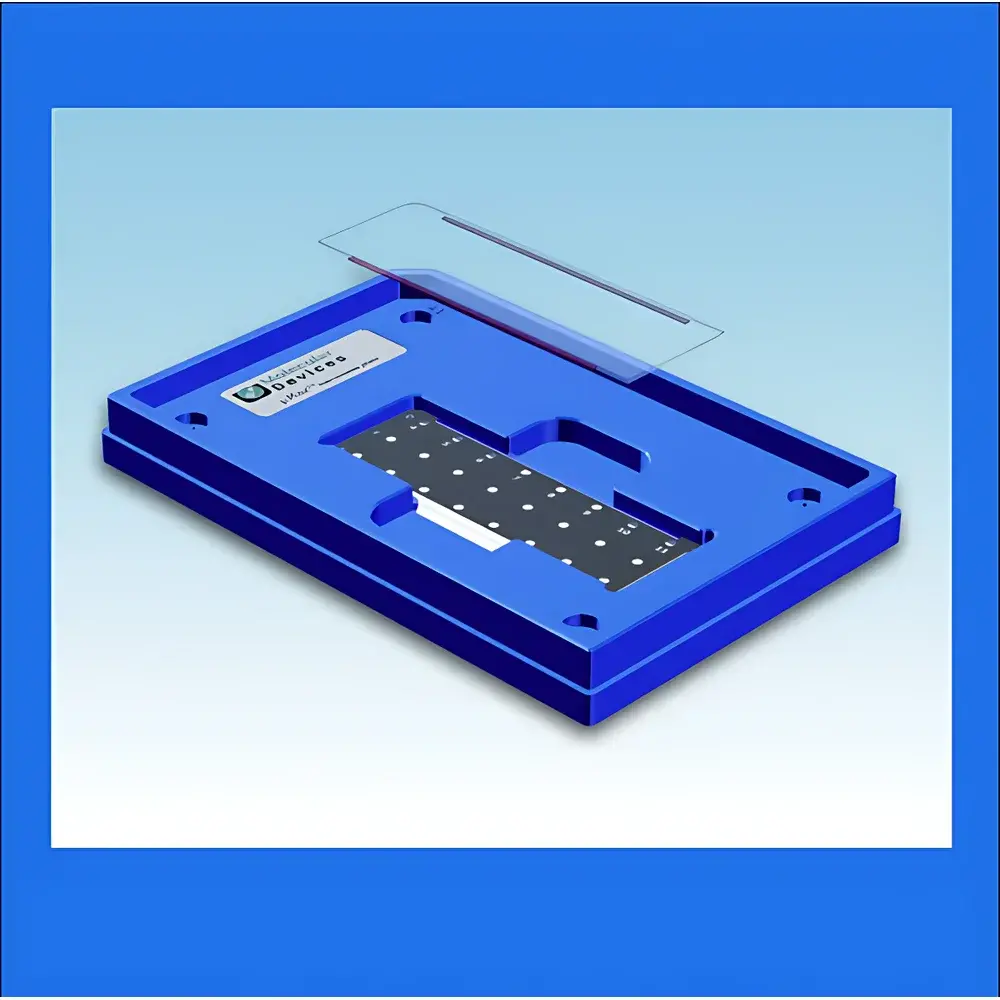
Molecular Devices SpectraMax Drop Micro-Volume Quantification System
| Brand | Molecular Devices |
|---|---|
| Origin | USA |
| Manufacturer Type | Original Equipment Manufacturer (OEM) |
| Product Category | Imported Instrument |
| Model | SpectraMax Drop |
| Pricing | Available Upon Request |
Overview
The Molecular Devices SpectraMax Drop Micro-Volume Quantification System is a dedicated UV-Vis spectrophotometer engineered for rapid, precise, and high-throughput quantification of nucleic acids and proteins using micro-volume sample handling. Based on fixed-pathlength absorbance measurement—eliminating the need for dilution or cuvettes—the system leverages optical pathlengths of 0.5 mm (2 µL) and 1.0 mm (4 µL) to deliver accurate concentration calculations directly from raw A260/A280 and A260/A230 ratios. Its core optical architecture features a high-stability xenon flash lamp and a precision Czerny-Turner monochromator, enabling continuous spectral scanning from 190 nm to 1000 nm in 1 nm increments. Designed specifically for molecular biology and biopharmaceutical workflows, the SpectraMax Drop supports critical pre-analytical steps including cDNA library normalization, NGS library QC, protein expression screening, and purification yield assessment—where sample conservation, speed, and inter-run reproducibility are non-negotiable.
Key Features
- Micro-volume capability: Measures 2 µL or 4 µL samples without dilution or capillary loading
- High-throughput configurations: Simultaneous analysis of up to 64 samples per run using interchangeable 24-well or 64-well SpectraDrop plates
- Extended dynamic range: Linear absorbance detection from 0 to 120 OD, accommodating highly concentrated lysates or purified oligonucleotides without manual attenuation
- Full-spectrum acquisition: 190–1000 nm wavelength coverage with 1 nm resolution, supporting nucleic acid integrity assessment (e.g., A260/A230, A260/A280) and protein secondary structure screening via far-UV CD-compatible scans
- Reproducibility: Coefficient of variation (CV) < 5% across technical replicates under standardized ambient conditions, validated per ISO 8655-7 gravimetric pipette calibration protocols
- Integrated thermal management: Active temperature stabilization of optical bench to minimize baseline drift during extended spectral acquisitions
Sample Compatibility & Compliance
The SpectraMax Drop accommodates native, unpurified, and column-eluted samples—including dsDNA, ssDNA, RNA, BSA, IgG, and denatured proteins—without requiring buffer exchange or dilution. Its open-path optical design eliminates meniscus-related errors common in capillary-based systems and reduces surface adsorption losses for low-abundance analytes. All hardware and firmware comply with IEC 61010-1 safety standards for laboratory equipment. Data acquisition and reporting meet GLP/GMP-aligned documentation requirements, with optional audit trail configuration supporting FDA 21 CFR Part 11 compliance when integrated with SoftMax Pro Software v7.1 or later. The system supports ASTM E275–22 (Standard Practices for Describing and Measuring Performance of UV-Vis Spectrophotometers) for routine performance verification.
Software & Data Management
Controlled exclusively via SoftMax Pro Software, the SpectraMax Drop enables method-driven workflow automation—including auto-wavelength selection, kinetic profiling, multi-point standard curve fitting (linear, quadratic, 4-/5-parameter logistic), and real-time QC flagging. Raw spectral data are stored in vendor-neutral .SMP binary format with embedded metadata (timestamp, operator ID, plate barcode, instrument serial number). Export options include CSV, Excel (.xlsx), and XML for LIMS integration. Version-controlled method templates can be locked and digitally signed to enforce SOP adherence across multi-user lab environments. Batch processing supports parallel analysis of heterogeneous sample sets (e.g., DNA + protein + endotoxin assays) within a single protocol.
Applications
- Nucleic acid quantification and purity assessment (A260/A280, A260/A230) for PCR, sequencing, and transfection
- Protein concentration determination using A280, Bradford, BCA, or Lowry-compatible colorimetric assays
- Enzyme kinetics (e.g., phosphatase, kinase, dehydrogenase activity) in micro-volume format
- Cell viability and cytotoxicity assays (MTT, resazurin, ATP luminescence with optional module integration)
- Endotoxin detection via chromogenic LAL assay readout at 405 nm
- Reporter gene assays (luciferase, β-galactosidase) with endpoint or kinetic acquisition modes
- Growth monitoring of microbial cultures (OD600) with temperature-controlled kinetics
- UV-Vis characterization of nanomaterials, liposomes, and synthetic oligonucleotides
FAQ
What is the minimum detectable concentration for dsDNA using the 2 µL pathlength?
For double-stranded DNA, the practical lower limit is approximately 2 ng/µL (equivalent to ~33 ng/mL), assuming optimal A260 linearity and background correction.
Can the SpectraMax Drop be used with opaque or colored samples?
Yes—scattering correction algorithms and reference beam normalization enable reliable quantification of turbid lysates and phenol-contaminated extracts, though extreme opacity may require dilution validation.
Is the system compatible with third-party microplates or custom substrates?
No—quantitative accuracy relies on proprietary SpectraDrop plates with precisely engineered quartz windows and calibrated pathlengths; only Molecular Devices-certified plates (e.g., 0200-6262, 0200-6267) are supported.
How often does the instrument require recalibration?
Factory calibration is stable for 12 months under normal use; annual verification using NIST-traceable holmium oxide and neutral density filters is recommended per ISO/IEC 17025 quality management guidelines.
Does the system support kinetic measurements?
Yes—time-resolved absorbance acquisition is supported at user-defined intervals (1 second to 24 hours), with temperature control (ambient ±0.5°C) available via optional environmental chamber integration.
Related Products




