
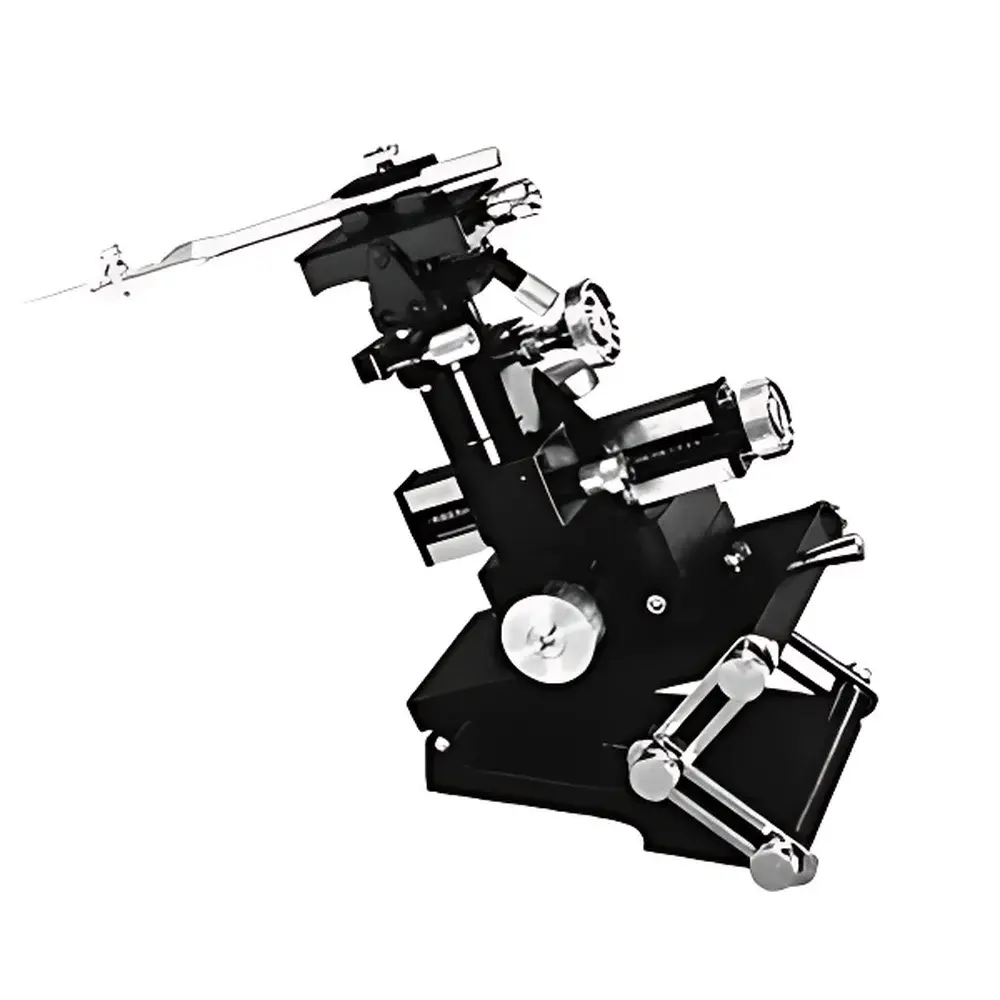
MP-2 Micromanipulator by Narishige
| Brand | Narishige |
|---|---|
| Origin | Japan |
| Model | MP-2 |
| Motion Range (Coarse) | X 60 mm, Z 50 mm |
| Motion Range (Fine) | X 4 mm, Z 4 mm, Y 40 mm |
| Fine Adjustment Resolution | 10 µm per click (X/Z/Y) |
| Coarse Knob Travel per Full Rotation | X/Z 250 µm, Y 500 µm |
| Pivot & Tilt Functionality | Integrated |
| Electrode Holder Included | H-1 |
| Dimensions (W×D×H) | 150 × 130 × 210 mm |
| Weight | 4.8 kg |
Overview
The MP-2 Micromanipulator is a precision-engineered three-axis mechanical manipulator developed by Narishige, a globally recognized Japanese manufacturer of laboratory instrumentation for electrophysiology, microinjection, and patch-clamp applications. As the enhanced successor to Narishige’s original “Petteruch-type” manipulator design, the MP-2 integrates refined mechanical architecture with improved stability and ergonomic operability—particularly through its dedicated fine-motion Y-axis sub-stage. It operates on purely mechanical (non-motorized) principles, utilizing high-tolerance rack-and-pinion and micrometer-driven mechanisms to deliver reproducible, backlash-free positioning across X, Y, and Z axes. Its core function is to enable precise, repeatable placement and angular orientation of microelectrodes, glass pipettes, or other sub-millimeter probes relative to biological specimens under optical microscopy. The device is widely deployed in neuroscience laboratories, developmental biology facilities, and academic electrophysiology cores where manual dexterity, mechanical rigidity, and long-term positional stability are critical.
Key Features
- Three-axis independent motion system (X, Y, Z) with dual-range control: coarse adjustment for rapid positioning and fine adjustment for sub-micron precision.
- Dedicated fine-motion Y-axis sub-stage—engineered to eliminate coupling errors and enhance lateral stability during delicate electrode approaches.
- Integrated pivot and tilt mechanism enabling controlled angular reorientation of mounted electrodes without requiring realignment of the base stage.
- Ergonomic foldable tilt bracket allowing variable-angle manipulation (e.g., oblique approach trajectories), supporting both vertical and angled recording/injection protocols.
- H-1 electrode holder included as standard—compatible with standard 1.2–1.5 mm OD glass micropipettes and tungsten or platinum-iridium microelectrodes.
- Mechanically locked coarse/fine actuation: full rotation of coarse knobs yields 250 µm (X/Z) or 500 µm (Y); fine knobs provide 10 µm resolution per click—calibrated for consistent user feedback and traceable positioning.
- Robust aluminum alloy chassis with vibration-damping base geometry; designed for integration onto air-tables or rigid optical tables without additional stabilization hardware.
Sample Compatibility & Compliance
The MP-2 is compatible with standard microelectrodes, patch pipettes, injection needles, and fiber-optic probes used in intracellular recording, sharp-electrode electrophysiology, and microinjection workflows. Its mechanical design conforms to standard microscope stage mounting interfaces (e.g., dovetail or threaded post adapters). While the MP-2 itself is not an electrically active device, its construction adheres to ISO 9001-certified manufacturing practices at Narishige’s Japanese production facility. Units supplied to EU-based laboratories comply with CE marking requirements for laboratory equipment (2014/30/EU EMC Directive and 2014/35/EU Low Voltage Directive). No electrical safety certification (e.g., UL, CSA) applies, as the unit contains no powered components. For GLP/GMP-regulated environments, position logs must be manually recorded; the device does not support electronic audit trails or FDA 21 CFR Part 11-compliant data capture natively.
Software & Data Management
The MP-2 is a fully manual, analog micromanipulator with no embedded electronics, firmware, or digital interface. Consequently, it requires no driver installation, software license, or operating system compatibility. All positional adjustments are made via tactile knobs and calibrated scales—ensuring operational continuity during extended experiments unaffected by software crashes, power interruptions, or cybersecurity vulnerabilities. Users may document coordinates using external lab notebooks or integrate position metadata into third-party acquisition platforms (e.g., Spike2, pCLAMP, or custom Python/Matlab scripts) via manual entry or synchronized timestamp logging. Optional accessories—including digital readout add-ons (e.g., Narishige’s MT-100 series encoder kits)—can be retrofitted to enable position digitization, though such upgrades fall outside the base MP-2 specification.
Applications
- Intracellular and extracellular electrophysiological recordings in brain slices, cultured neurons, and invertebrate preparations.
- Microinjection of DNA, RNA, dyes, or tracers into oocytes, embryos, or single cells.
- Patch-clamp configuration (cell-attached, whole-cell, perforated) requiring stable pipette positioning and axial compliance control.
- Single-cell electroporation and iontophoresis protocols demanding precise probe alignment and angular access.
- Combined use with confocal, two-photon, or DIC microscopy systems where mechanical drift and thermal expansion must be minimized.
- Training platforms in graduate electrophysiology courses due to intuitive mechanical feedback and transparent kinematic behavior.
FAQ
Is the MP-2 compatible with inverted microscopes?
Yes—the MP-2 mounts directly to standard microscope stages via optional dovetail adapters (e.g., Narishige’s ST-1 or ST-2 series) and supports upright and inverted configurations with appropriate pillar height selection.
Does the MP-2 require calibration or periodic maintenance?
No scheduled recalibration is required. Routine maintenance consists only of light cleaning of gear surfaces and occasional application of silicone-based lubricant to micrometer threads—per Narishige’s Technical Bulletin TB-MP2-Rev.4.
Can the MP-2 be used in Faraday cages or shielded electrophysiology rigs?
Yes—its all-metal construction (aluminum alloy frame, stainless steel screws, brass gears) ensures electromagnetic compatibility and grounding integrity within shielded recording environments.
What is the maximum load capacity for mounted electrodes?
The MP-2 supports payloads up to 150 g when properly balanced; exceeding this may compromise fine-motion resolution and long-term repeatability.
Is the H-1 electrode holder autoclavable?
No—the H-1 holder is constructed from anodized aluminum and Delrin®; it is compatible with 70% ethanol or isopropanol disinfection but not steam sterilization.






