
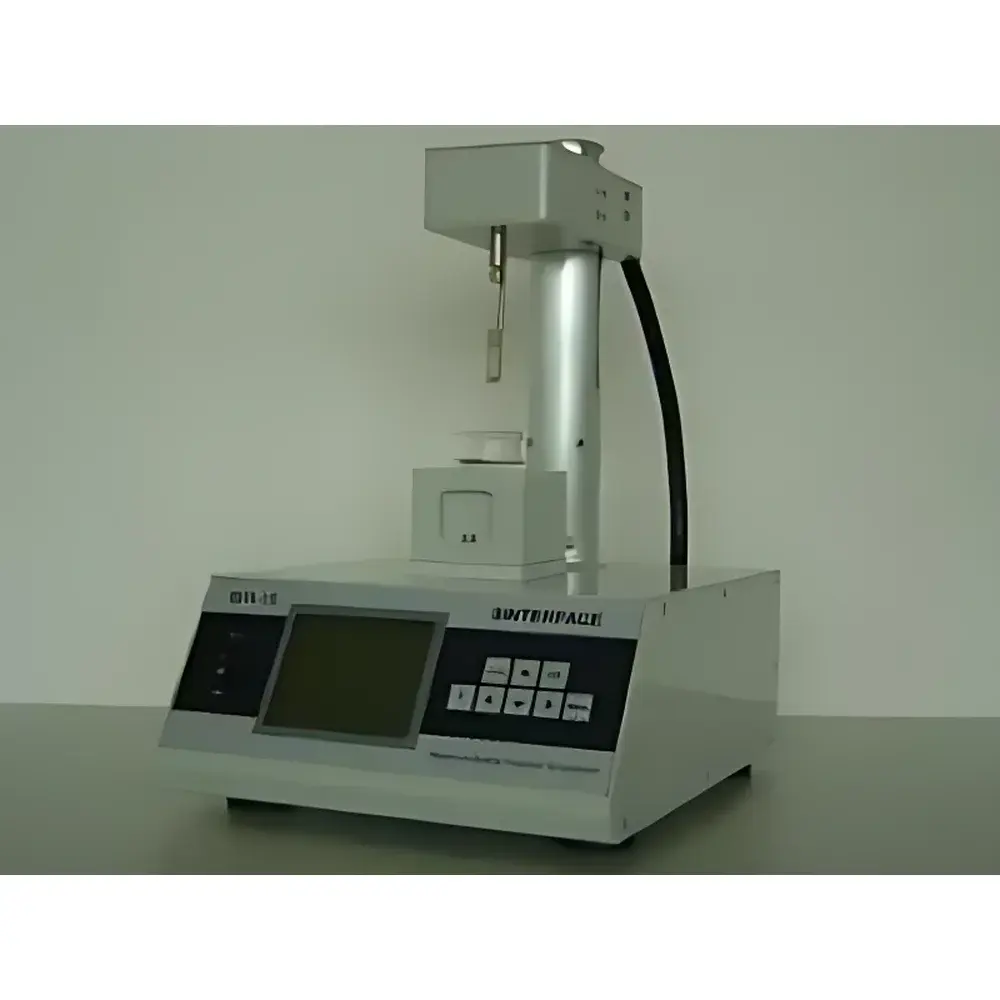
MPB BPA-1S Dynamic Bubble Pressure Tensiometer
| Brand | MPB |
|---|---|
| Origin | Germany |
| Model | BPA-1S |
| Surface/Interfacial Tension Range | 10–100 mN/m |
| Reproducibility | ±0.1 mN/m |
| Accuracy | ±0.1 mN/m |
| Dynamic Time Range | 0.1 ms to 100 s |
| Display | Monochrome graphic LCD (320 × 240 px) |
| Minimum Sample Volume | 1 mL |
| Temperature Control Range | 10–80°C |
| Onboard Memory | 2 MB (stores up to 180 full scans or ≥30,000 points in constant mode) |
| Power Supply | 100–240 VAC, 50–60 Hz |
| Measurement Unit | 12 VDC |
| Max. Power Consumption | 6 W |
| Dimensions (L×W×H) | 200 × 250 × 400 mm |
| Weight | 3 kg |
| Interface | RS232 and USB |
| Software | Windows-based BPA-1S software with free updates for 1 year |
| Capillary Options | Interchangeable capillaries with varying inner diameters and geometries |
Overview
The MPB BPA-1S Dynamic Bubble Pressure Tensiometer is a high-precision instrument engineered for the quantitative determination of dynamic surface and interfacial tension as a function of adsorption time—spanning six orders of magnitude from 0.1 milliseconds to 100 seconds. It operates on the well-established bubble pressure principle: gas is forced through a submerged capillary into a liquid phase, generating a spherical bubble whose maximum internal pressure correlates directly with surface tension via the Young–Laplace equation. Unlike static methods, the BPA-1S captures the time-resolved evolution of interfacial activity by analyzing pressure transients during bubble growth, enabling rigorous kinetic modeling of surfactant adsorption, diffusion, and rearrangement at fluid interfaces. Its core innovation lies in the implementation of the Fainerman measurement routine—a specialized algorithm optimized for ultra-short time regimes (<1 ms)—which compensates for compressibility effects, gas flow dynamics, and capillary immersion depth in real time. This allows for accurate dead-time and live-time tension evaluation without reliance on external PC synchronization, making the system suitable for both benchtop kinetics studies and integration into automated QC workflows.
Key Features
- Ultra-fast dynamic resolution down to 0.1 ms, enabled by high-frequency pressure transduction and the Fainerman correction algorithm
- Onboard graphic display (320 × 240 px monochrome LCD) supporting real-time visualization of pressure vs. time curves and derived tension profiles
- Standalone operation capability: stores up to 180 complete measurement scans (or ≥30,000 data points in constant-mode acquisition) in 2 MB internal memory
- Automatic capillary immersion correction accounting for hydrostatic pressure, gravitational offset, and liquid viscosity effects
- Dual-mode operation: manual critical flow rate adjustment and automatic flow optimization for reproducible bubble formation
- Integrated temperature monitoring with external Pt100 sensor support (10–80°C range); optional Peltier-controlled sample holder available
- Minimal sample consumption (as low as 1 mL) facilitated by precision-engineered capillaries with reduced dead volume and optimized geometry
- RS232 and USB interfaces for bidirectional communication, data export, and remote control under Windows OS
Sample Compatibility & Compliance
The BPA-1S accommodates aqueous and non-aqueous systems—including low-viscosity solvents, polymer solutions, micellar dispersions, and biological fluids—provided they are compatible with standard fused-silica or stainless-steel capillaries. Its measurement protocol adheres to fundamental principles outlined in ISO 6889 (surface tension of surfactant solutions) and ASTM D1331 (bubble pressure method), while its data structure supports audit-ready traceability per GLP and GMP requirements. The onboard software enforces user-access levels, timestamps all acquisitions, and logs operator ID, environmental conditions, and calibration status—features aligned with FDA 21 CFR Part 11 expectations for electronic records when used in regulated environments (e.g., pharmaceutical formulation development or cosmetic stability testing). All hardware components comply with CE, RoHS, and IEC 61010-1 safety standards.
Software & Data Management
The included Windows-based BPA-1S software provides full instrument control, real-time plotting, post-acquisition analysis, and export functionality. It supports overlay of multiple tension–time curves for comparative assessment, interactive zooming (linear/logarithmic time axes), and derivative calculation (dγ/dt) to identify adsorption rate transitions. Data can be exported in plain-text format (.txt) or directly into Microsoft Excel (.xlsx) for statistical processing or kinetic fitting (e.g., Ward–Tordai or Frumkin–Dukhin models). Calibration routines include zero-pressure offset, capillary radius verification, and temperature-dependent density compensation. Firmware and software updates are provided free of charge for one year post-purchase via secure download portal. Audit trail generation, electronic signatures, and encrypted database storage are available as optional modules for regulated laboratories.
Applications
- Surfactant science: Quantification of adsorption kinetics, CMC determination, and competitive adsorption in mixed systems
- Pharmaceutical development: Evaluation of excipient interfacial behavior in parenteral formulations and pulmonary drug delivery systems
- Inkjet printing: Optimization of ink surface rheology to prevent satellite droplet formation and nozzle clogging
- Coating & adhesives: Assessment of wetting dynamics and substrate compatibility under process-relevant time scales
- Food technology: Stabilization mechanism analysis of protein- or polysaccharide-based foams and emulsions
- Biological interfaces: Study of lung surfactant analogs, membrane peptide insertion, and biosurfactant activity
- Detergency & ecology: Degradation kinetics of surfactants in environmental matrices and biodegradation screening
FAQ
What is the minimum measurable adsorption time?
The BPA-1S achieves reliable surface tension resolution at 0.1 ms using the Fainerman measurement routine and high-bandwidth pressure sensing.
Can the instrument operate without a connected PC?
Yes—the BPA-1S functions fully autonomously with onboard display, memory, and real-time curve analysis; PC connection is required only for data export or advanced modeling.
How is temperature controlled during measurement?
The system monitors sample temperature via an external Pt100 probe; precise thermostatic control requires an optional Peltier stage or external circulator.
What capillary types are supported?
Standard configurations include fused-silica capillaries with inner diameters of 0.15 mm, 0.2 mm, and 0.3 mm; custom geometries (e.g., tapered or double-orifice) are available upon request.
Is the software compliant with regulatory data integrity requirements?
Base software includes timestamped logging and user authentication; 21 CFR Part 11 compliance modules (electronic signatures, audit trails, role-based access) are available as validated add-ons.



