
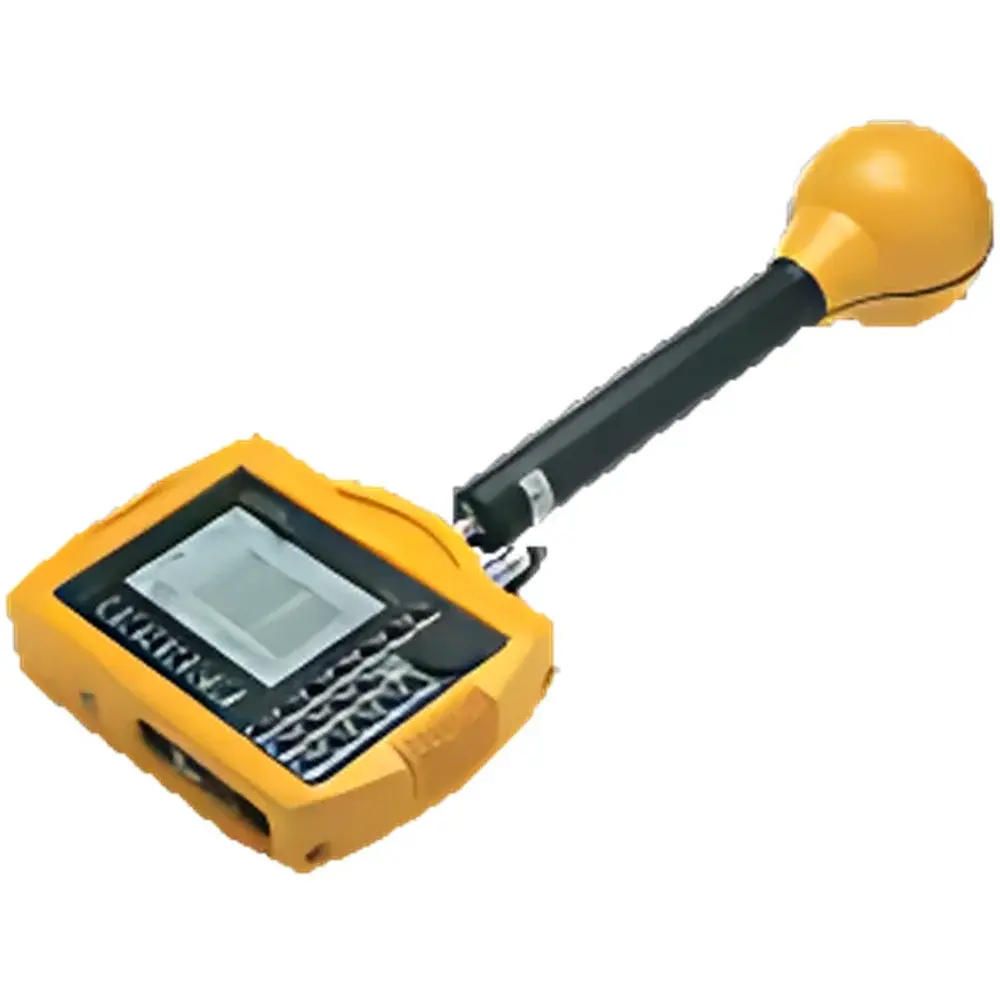
Narda SRM 3000 Broadband Electromagnetic Field Selective Analyzer
| Brand | Narda |
|---|---|
| Origin | Germany |
| Model | SRM 3000 |
| Frequency Range | 100 kHz – 3 GHz |
| Measurement Modes | Safety Assessment, Spectrum Analysis (with user-defined RBW integration), UMTS P-CPICH Option, Time-Domain Monitoring |
| RBW | 1 kHz – 5 MHz (configurable) |
| Dynamic Range | −121 dBm to +23 dBm |
| E-field Probe | Isotropic, 5 MHz – 3 GHz, Max. 200 V/m (Destruction Limit: 1000 V/m) |
| Operating Temperature | −10 °C to +50 °C |
| Humidity | Up to 95 % RH (IP54) |
| Battery Life | ~3.5 h |
| Dimensions | 255 × 195 × 60 mm |
| Weight | 1.9 kg (instrument), 450 g (probe) |
| Calibration Interval | 24 months |
Overview
The Narda SRM 3000 Broadband Electromagnetic Field Selective Analyzer is a precision-grade, portable field measurement system engineered for regulatory compliance verification, spectrum-aware exposure assessment, and multi-source electromagnetic interference (EMI) attribution in complex RF environments. Unlike conventional broadband field meters that integrate total power across wide frequency bands—obscuring source-specific contributions—the SRM 3000 implements real-time selective frequency analysis based on heterodyne superheterodyne receiver architecture with digitally synthesized local oscillators and configurable resolution bandwidths (RBW). It enables quantitative separation of co-located emitters (e.g., FM broadcast, DVB-T, GSM900/1800, UMTS2100, LTE, Wi-Fi) by performing frequency-selective field strength measurements referenced to internationally recognized exposure limits. Designed for use in rooftop antenna farms, urban macro-cell deployments, and public infrastructure sites, the instrument supports legally defensible, traceable, and auditable assessments required under national radiation protection frameworks.
Key Features
- Triaxial isotropic E-field probe with full spatial response compensation—measures vector-summed field magnitude independent of incident wave direction.
- High immunity to ambient field distortion: maintains metrological integrity up to 200 V/m; withstands transient overloads up to 1000 V/m without damage or calibration shift.
- Configurable RBW from 1 kHz to 5 MHz—enables both narrowband spectral characterization and broadband integrated field evaluation per ICNIRP, IEEE C95.1, FCC OET Bulletin 65, and national standards.
- Real-time time-domain monitoring with selectable averaging intervals (1 s – 30 min), RMS and peak detection modes, and true real-time capability at 6.4 kHz and 6 MHz RBW.
- UMTS P-CPICH demodulation option (field-upgradable): performs channel-specific power estimation and extrapolates worst-case total UMTS channel power using standardized crest factor assumptions.
- Open standard configuration environment: users may import, edit, and store custom limit curves—including country-specific regulations—via PC software or onboard interface.
- Ruggedized portable design: IP54-rated enclosure, −10 °C to +50 °C operational range, 95% relative humidity tolerance, and ergonomic form factor optimized for mast-top and confined-space deployment.
Sample Compatibility & Compliance
The SRM 3000 is validated for use with Narda’s certified isotropic E-field probes (e.g., EF0391, EF0691) and compatible third-party antennas via automatic antenna factor recognition and manual calibration coefficient entry. All probe calibrations are traceable to PTB (Physikalisch-Technische Bundesanstalt) and NIST-accredited laboratories. The system complies with IEC 62232:2017 (determination of RF field strength near base stations), EN 50492:2008 (measurement procedures for EMF exposure assessment), and supports GLP-aligned data integrity through timestamped, non-editable measurement records. Its internal memory (16 MB) stores up to 512 full-resolution spectra with metadata (GPS optional via external module), enabling retrospective audit trails compliant with ISO/IEC 17025 and EU Directive 2013/35/EU occupational exposure requirements.
Software & Data Management
Data acquisition, post-processing, and reporting are managed via Narda’s proprietary EMF-View software (Windows-based), which provides full control over instrument configuration, remote operation via USB/RS232, and automated generation of compliance reports aligned with ICNIRP, BGV B11, Safety Code 6, and other jurisdictional templates. The software supports batch spectral comparison, multi-site exposure summation, and frequency-band-specific weighted summation per summation rules defined in EN 50413:2022. All measurement files include embedded calibration certificates, probe serial numbers, environmental metadata, and digital signatures to satisfy FDA 21 CFR Part 11 and EU Annex 11 requirements for electronic records and signatures in regulated environments.
Applications
- Regulatory enforcement: Objective attribution of超标 emissions to specific operators in shared antenna sites—resolving disputes between mobile network providers, broadcasters, and public authorities.
- Site safety audits: Pre-commissioning and periodic assessment of EMF exposure levels around base stations, broadcast towers, radar installations, and smart city infrastructure.
- Occupational health & safety: Monitoring worker exposure in telecom maintenance, broadcast engineering, and defense-related RF environments.
- Environmental impact studies: Long-term trend analysis of ambient RF background, including seasonal variation and infrastructure rollout correlation.
- Research & development: Characterization of novel wireless systems (e.g., 5G NR FR1, IoT LPWAN) against evolving exposure guidelines prior to public deployment.
FAQ
Does the SRM 3000 support simultaneous multi-frequency exposure summation per ICNIRP guidelines?
Yes. The Safety Assessment Mode applies frequency-dependent weighting factors and computes cumulative exposure ratios across all detected signals in real time, adhering strictly to ICNIRP 2020 summation methodology.
Can the instrument measure UMTS signals without the optional P-CPICH module?
It can detect and quantify UMTS carrier power in spectrum mode, but only the P-CPICH option enables standardized channel power extrapolation and code-channel-level compliance evaluation per 3GPP TS 25.104.
Is probe calibration traceable to national metrology institutes?
All factory-calibrated probes include certificates traceable to PTB (Germany) and UKAS-accredited labs; recalibration is recommended every 24 months or after mechanical shock.
How does the SRM 3000 handle high-field environments where instrument self-interference could occur?
Its front-end architecture incorporates active RF limiting, harmonic rejection filtering, and temperature-compensated LO stability (< 0.5 ppm/year drift), ensuring measurement fidelity remains within ±1.5 dB even at 200 V/m incident field strength.
Can custom limit curves be imported directly into the device without PC software?
No—custom limit definitions must be created and uploaded via EMF-View software; however, once installed, they are fully accessible and selectable on-device during field measurements.







