
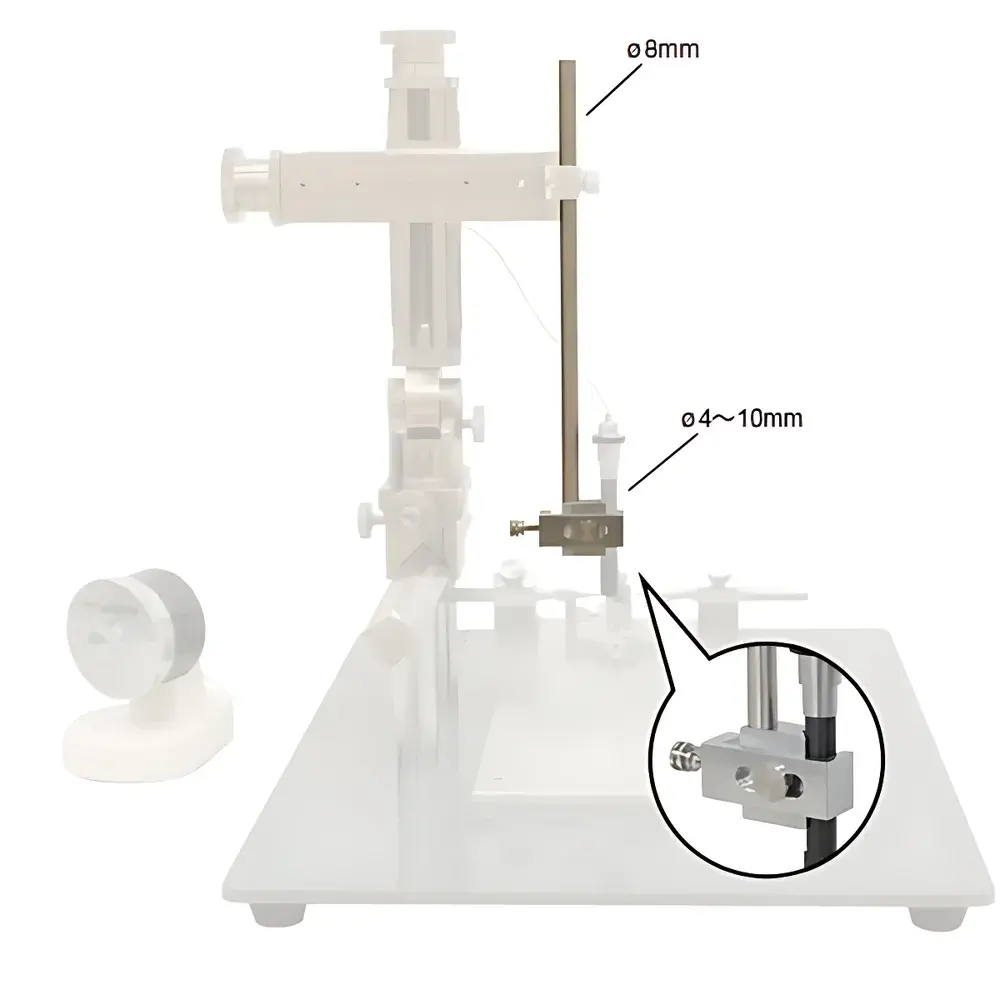
Narishige SMM-HD Multi-User Micromanipulator Mounting Stand
| Brand | Narishige |
|---|---|
| Origin | Japan |
| Model | SMM-HD |
| Dimensions (W×D×H) | 48 × 15 × 225 mm |
| Weight | 143 g |
| Compatibility | Accepts 4–10 mm OD pipettes and holders (e.g., HI-7/HI-9, MO-10, MO-82) |
| Mounting Flexibility | Separable holding segment with left-right directional reorientation capability |
Overview
The Narishige SMM-HD Multi-User Micromanipulator Mounting Stand is an engineered mechanical interface designed for concurrent, independent positioning of multiple microinjection or micromanipulation devices within shared stereotaxic or electrophysiology workspaces. It operates on a passive mechanical coupling principle—leveraging precision-machined aluminum alloy components, threaded adjustment interfaces, and modular clamping geometry—to provide rigid, repeatable fixation of instruments with outer diameters ranging from 4 mm to 10 mm. Unlike motorized or digitally controlled platforms, the SMM-HD delivers deterministic positional stability through manual kinematic constraint, making it particularly suitable for applications requiring minimal electromagnetic interference, long-term thermal equilibrium, and traceable mechanical reproducibility—key requirements in intracellular recording, patch-clamp setup alignment, and chronic implantation workflows.
Key Features
- Multi-position mounting architecture: Accommodates up to four independently adjustable instrument holders (e.g., HI-7, HI-9, MO-10, MO-82) on a single vertical rail, enabling parallel operation without cross-axis interference.
- Modular orientation control: The holding segment detaches from the main column via a knurled locking collar, allowing full 180° horizontal reorientation (left/right flip) to optimize workspace ergonomics and optical access during multi-angle imaging or dual-pipette approaches.
- Graduated height scalability: Each holder mounts to a vertically slotted rail with M3 threaded holes spaced at 5 mm intervals, supporting fine-tuned elevation adjustments without compromising structural rigidity or alignment fidelity.
- Material integrity and dimensional stability: Constructed from anodized 6061-T6 aluminum, the stand exhibits coefficient of thermal expansion (CTE) consistency ≤23.6 µm/m·K and maintains positional repeatability within ±5 µm under static load conditions typical of glass micropipette assemblies (≤200 g per holder).
- Inter-system compatibility: Designed to integrate natively with Narishige’s SMM-series base plates and stereotaxic frames (e.g., SR-6M, SM-15), while retaining mechanical interoperability with third-party stages adhering to standard 1/4″-20 or M6 mounting thread conventions.
Sample Compatibility & Compliance
The SMM-HD supports standardized microtool geometries common across neurophysiology and single-cell manipulation laboratories. Its 4–10 mm OD clamping range covers industry-standard borosilicate glass capillaries (e.g., Sutter BF150-86-10, Harvard 30-30-1), stainless-steel injection needles (26–34 G), and polymer-coated electrodes used in in vivo tetrode arrays. While the device itself carries no active electronic components and thus falls outside regulatory scope for IEC 61000-4 EMC compliance, its mechanical design conforms to ISO 9001-aligned manufacturing protocols observed by Narishige Co., Ltd. All machined surfaces meet ISO 2768-mK general tolerancing standards. No CE marking or FDA 510(k) clearance applies, as the unit functions solely as a passive mechanical support structure—not a medical device or diagnostic instrument.
Software & Data Management
The SMM-HD requires no firmware, driver installation, or software integration. It operates entirely offline and introduces no digital data pathway—making it inherently compliant with environments governed by strict IT security policies (e.g., air-gapped electrophysiology rigs) or regulatory frameworks requiring audit-trail-free hardware (e.g., GLP-compliant preclinical toxicology labs). Positional configuration is documented manually via lab notebook entries referencing physical scale markings and indexed hole positions. For laboratories implementing digital experiment logs (e.g., LabArchives, ELN systems), users may assign unique identifiers to each mounted device and record corresponding SMM-HD rail positions as structured metadata fields.
Applications
- High-throughput in vivo electrophysiology: Enables simultaneous deployment of four independent micromanipulators for multi-site cortical or hippocampal recordings in rodent models, reducing inter-animal variability through synchronized electrode insertion timing.
- Parallel microinjection workflows: Supports concurrent delivery of distinct pharmacological agents or genetic constructs into separate brain regions or cell populations using calibrated pressure or picospritzer systems mounted on individual SMM-HD arms.
- Training and pedagogical use: Facilitates hands-on instruction in stereotaxic surgery and patch-clamp technique by allowing instructors to monitor and adjust up to four student setups in real time within a shared microscope field-of-view.
- Hybrid imaging-manipulation rigs: Integrates with upright or inverted fluorescence microscopes equipped with motorized XY stages, permitting coordinated movement of both optical focus plane and pipette tip trajectory without mechanical crosstalk.
FAQ
Is the SMM-HD compatible with non-Narishige micromanipulators?
Yes—any manipulator or holder featuring a cylindrical shaft with outer diameter between 4 mm and 10 mm and sufficient axial length for secure clamping (≥12 mm engagement) can be mounted, provided its mass does not exceed 250 g per position.
Does the SMM-HD include mounting hardware for stereotaxic frames?
No—the stand ships with only the main column, detachable holders, and a 1.5 mm hex key; frame-specific adapters (e.g., SMM-BP base plate interface) are sold separately.
Can the SMM-HD be used in vibration-isolated optical tables?
Yes—its low center of gravity (225 mm height, 143 g mass) and rigid aluminum construction minimize resonance coupling; recommended mounting via M4 screws directly into table-threaded inserts.
What is the maximum allowable torque when tightening the clamping screws?
Do not exceed 0.3 N·m—over-torquing may deform the clamping sleeve and reduce grip consistency across repeated cycles.
Is chemical resistance specified for the anodized surface?
The Type II anodized finish resists mild aqueous solutions (e.g., PBS, saline, ethanol <70%), but prolonged exposure to strong acids, bases, or organic solvents (e.g., chloroform, xylene) may degrade the oxide layer over time.



