
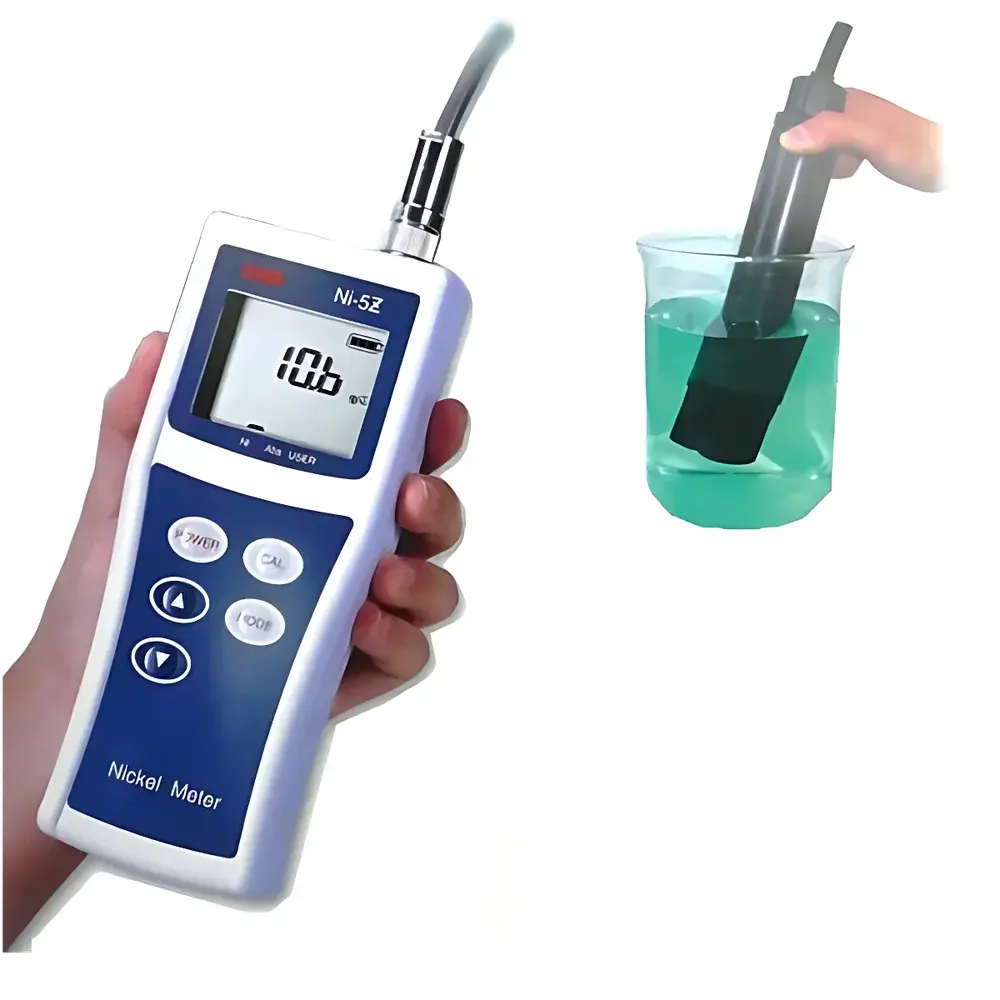
Ni-502L Portable Nickel Ion Concentration Meter by Rikari Chemical
| Brand | Rikari Chemical |
|---|---|
| Origin | Japan |
| Model | Ni-502L |
| Instrument Type | Portable Multi-Ion Analyzer |
| Measurement Range | 0.0–199.9 g/L Ni |
| Detection Limit | 0.01 g/L Ni |
| Response Time | ≤20 s |
| Accuracy | ±2% of Full Scale (FS) |
| Operating Temperature | 0–50 °C |
| Sensor Material | FEP and PVC (chemically resistant) |
| Measurement Modes | Nickel Concentration (g/L), Absorbance (Abs), User-Defined Calibration (e.g., NiSO₄ concentration, molarity) |
Overview
The Ni-502L Portable Nickel Ion Concentration Meter is an electrochemical sensor-based analyzer engineered for real-time, field-deployable quantification of total nickel ion concentration in electroplating bath solutions. Unlike optical or atomic absorption methods, the Ni-502L employs a selective potentiometric probe with a solid-state nickel-specific sensing membrane—optimized for stability in highly acidic, high-ionic-strength environments typical of sulfate, sulfamate, and chloride nickel plating baths. The instrument operates on a direct calibration principle: output voltage from the Ni-selective electrode is linearly proportional to the logarithm of free Ni²⁺ activity under controlled pH and ionic strength conditions; this signal is digitally amplified, temperature-compensated (via integrated Pt1000 sensor), and converted into concentration (g/L) using a two-point calibration routine. Its design prioritizes robustness in industrial QC labs and on-site bath management—where rapid decision-making on nickel replenishment, impurity accumulation, or bath aging is critical to deposit uniformity and adhesion performance.
Key Features
- True portable architecture: Integrated rechargeable Li-ion battery supports ≥8 hours of continuous operation; IP67-rated enclosure ensures dust/water resistance during shop-floor use.
- Chemically inert sensor housing: Fluorinated ethylene propylene (FEP) and polyvinyl chloride (PVC) construction resists degradation from sulfuric acid (up to 20% v/v), boric acid, ammonium ions, and common brighteners—eliminating cross-sensitivity and drift.
- Triple-mode measurement capability: Switch seamlessly between Nickel Concentration (g/L), Absorbance (Abs), and User-Defined Calibration modes—enabling direct reporting of NiSO₄·6H₂O mass concentration, molar Ni²⁺ concentration (mol/L), or custom-defined units without external conversion.
- Fast thermal equilibration: Built-in temperature sensor enables automatic compensation across 0–50 °C, minimizing error due to viscosity and activity coefficient shifts in warm plating baths.
- Low detection limit and high linearity: Achieves 0.01 g/L detection limit with ≤2% FS accuracy over full 0.0–199.9 g/L range; certified linearity (R² ≥ 0.9998) verified per ISO 8466-1 protocol.
Sample Compatibility & Compliance
The Ni-502L is validated for direct immersion measurement in aqueous nickel electrolytes including nickel sulfate (NiSO₄), nickel sulfamate (Ni(NH₂SO₃)₂), and nickel chloride (NiCl₂) systems—regardless of co-dissolved boric acid (H₃BO₃), ammonium ions (NH₄⁺), sodium chloride, or organic additives (e.g., saccharin, butynediol). It excludes interference from Fe²⁺/Fe³⁺, Cu²⁺, and Cr³⁺ at typical bath contamination levels (<50 mg/L). The device complies with IEC 61000-4 electromagnetic immunity standards and meets CE marking requirements for laboratory and industrial instrumentation. While not FDA-cleared, its measurement traceability aligns with ISO/IEC 17025 principles for in-house method validation; raw data logs support GLP audit trails when paired with optional RS-232/USB data export.
Software & Data Management
Data acquisition and configuration are managed via the embedded LCD interface with tactile keypad—no PC dependency required for routine operation. All measurements include timestamp, temperature, and calibration status metadata. Optional PC software (NiConfig v3.2, Windows/macOS) enables batch export to CSV, calibration certificate generation (with uncertainty budgeting per GUM), and trend analysis across multiple bath tanks. Audit-ready features include operator ID logging, calibration history with pass/fail flags, and write-protected storage—supporting alignment with ISO 9001 Clause 8.5.2 and internal QA documentation requirements.
Applications
- Routine monitoring of nickel concentration in rack and barrel plating lines to maintain optimal metal ion activity for consistent deposit thickness and brightness.
- Verification of nickel replenishment dosing accuracy following analytical chemistry titrations or ICP-OES reference checks.
- Stability assessment of aged plating baths—tracking nickel depletion rate versus organic breakdown product accumulation.
- Technical service support for plating chemical suppliers performing on-site bath audits and troubleshooting.
- Educational laboratories demonstrating ion-selective electrode theory, Nernst equation application, and industrial electrochemistry workflows.
FAQ
Does the Ni-502L require daily recalibration?
No—two-point calibration (zero and mid-range standard) is recommended before first use each shift or after prolonged storage; stability verification using a check standard is sufficient for subsequent measurements.
Can it measure nickel in non-acidic solutions such as rinse waters?
Not without matrix adjustment—the sensor is optimized for pH < 3.5. For neutral or alkaline samples, pre-acidification to pH ≤ 2.0 with HNO₃ and ionic strength adjustment are required per ASTM D1688 Annex A3.
Is sensor replacement user-serviceable?
Yes—the FEP/PVC probe assembly is a field-replaceable module with standardized BNC connector and tool-free housing latch; replacement takes <90 seconds and requires no recalibration if same lot number is used.
What is the expected sensor lifetime under continuous plating bath exposure?
Typical operational lifespan exceeds 18 months at 40 °C and pH 1.5–2.5; lifetime decreases proportionally with exposure to >50 °C or oxidizing agents (e.g., peroxysulfuric acid).
Does the instrument comply with FDA 21 CFR Part 11 for electronic records?
The standalone unit does not meet Part 11 requirements; however, when connected to validated LIMS via NiConfig software with digital signature and audit trail modules enabled, full compliance is achievable.







