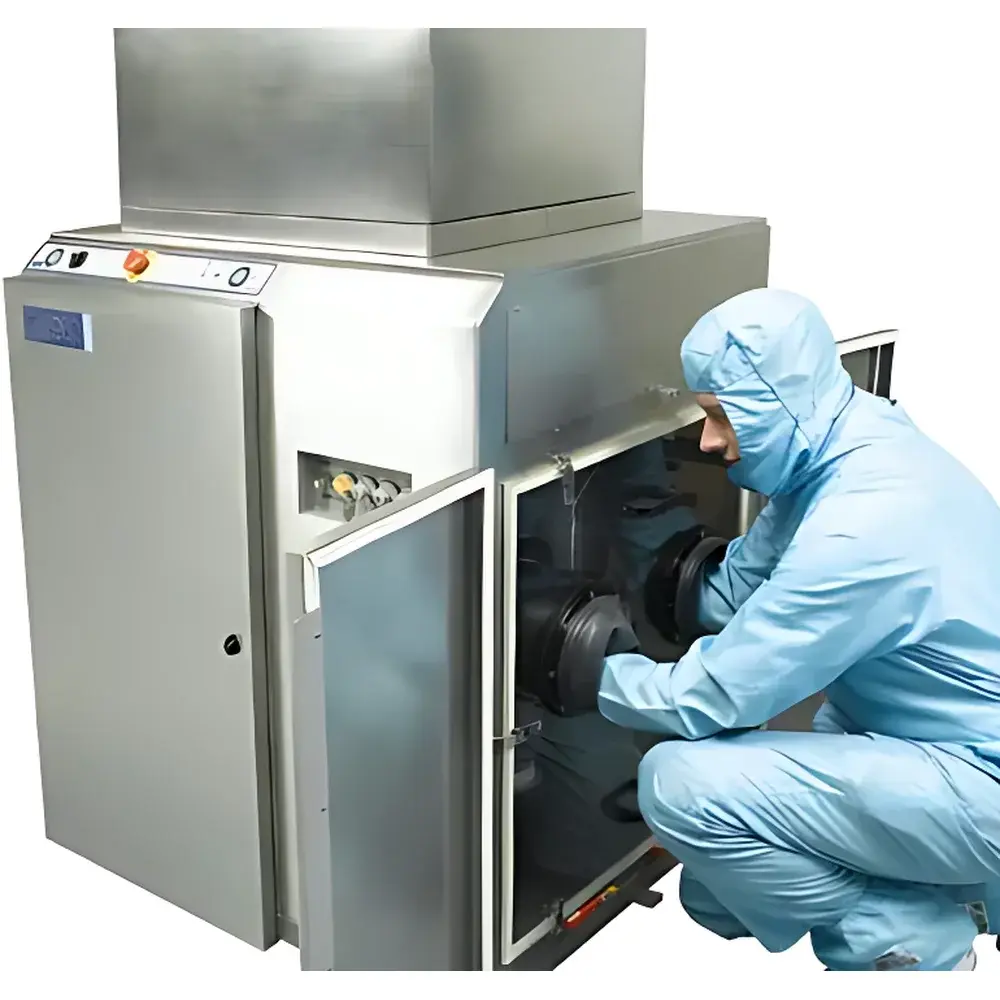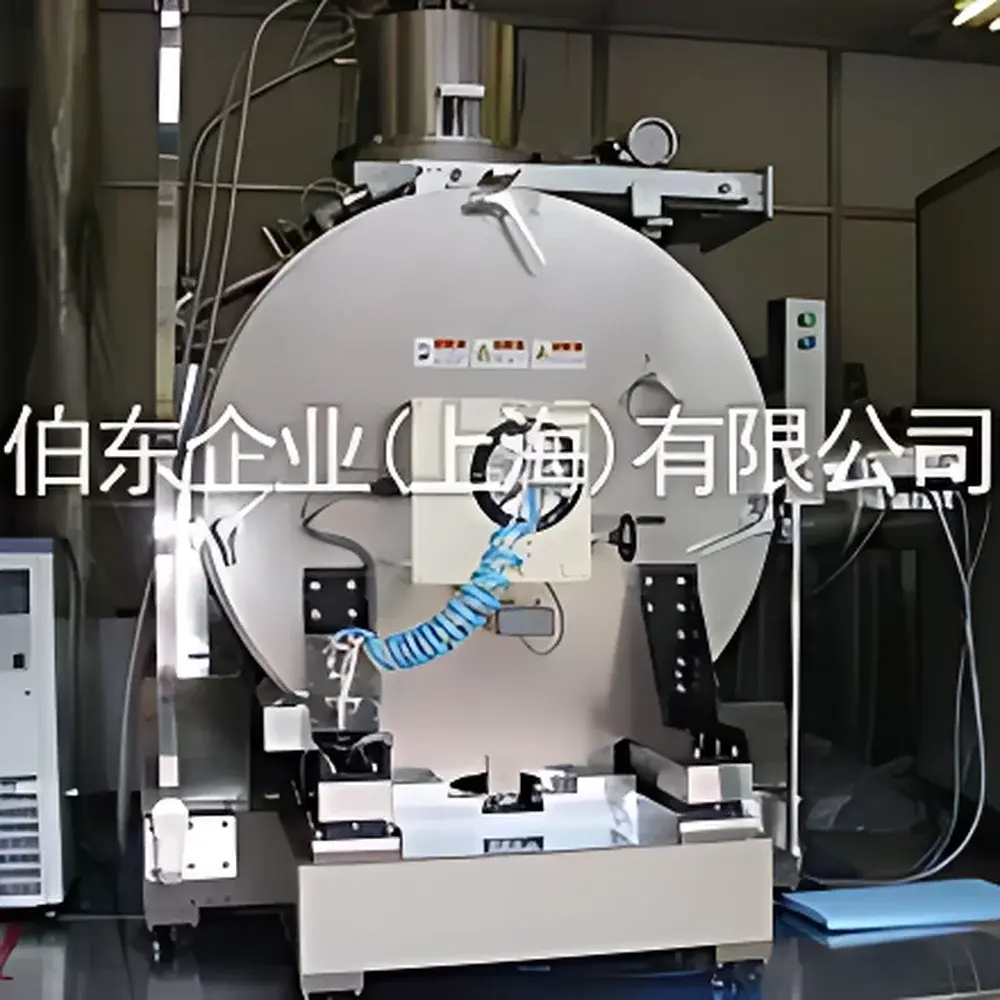
NS Plasma Ion Beam Etcher NS-12 (Kaufman-Type, 20 cm Ion Source)
| Brand | NS |
|---|---|
| Origin | Japan |
| Model | NS-12 |
| Etching Principle | Broad-Beam Ion Beam Etching (IBE) |
| Substrate Capacity | 12 × Ø4″ wafers or 3 × Ø18″ wafers |
| Cooling | Direct substrate cooling via chilled chuck |
| Ion Source | 20 cm Kaufman-type ion source (original equipment from Kimball Physics / formerly Kaufman & Robinson) |
| Beam Steering | Adjustable incidence angle (0°–75°) |
| Rotation Mechanism | Independent planetary rotation (substrate rotation + revolution) |
| Residue-Free Processing | Yes |
| Power Supply Compatibility | Dual-voltage input (100 V / 200 V AC, 50/60 Hz) |
Overview
The NS Plasma Ion Beam Etcher NS-12 is a high-precision, production-grade broad-beam ion beam etching (IBE) system engineered for physical sputter removal in vacuum environments. Unlike reactive plasma etching (RIE) or inductively coupled plasma (ICP) systems, the NS-12 employs a thermionic cathode-based Kaufman-type ion source to generate a collimated, neutralized argon ion beam (typically 500–2000 eV), enabling purely physical, directionally controlled material removal without chemical byproducts. This principle ensures stoichiometric etching of multi-layer stacks—including metals (Au, Pt, NiFe), dielectrics (SiO₂, Al₂O₃), magnetic films (CoFeB, TbFeCo), and compound semiconductors (GaAs, InP)—with sub-nanometer depth control and minimal subsurface damage. Designed for cleanroom integration in semiconductor pilot lines and advanced R&D facilities, the NS-12 supports both process development and medium-volume manufacturing under ISO Class 5 or better ambient conditions.
Key Features
- 20 cm diameter Kaufman ion source with dual-grid extraction optics, delivering stable beam current density up to 1.2 mA/cm² at ≤2 kV acceleration voltage
- Direct-contact cryogenic substrate cooling: electrostatic chuck with integrated coolant channels maintains wafer temperature between −40 °C and +80 °C during etch, critical for thermal-sensitive magnetic tunnel junctions (MTJs) and piezoelectric thin films
- Precision beam steering mechanism: motorized tilt stage enables continuous ion incidence angle adjustment from normal (0°) to oblique (75°), supporting anisotropic profile control, sidewall taper engineering, and ion milling of non-planar substrates
- Planetary motion system: independent substrate rotation (0–30 rpm) and revolution (0–10 rpm) ensure uniform fluence distribution across Ø4″–Ø18″ substrates, achieving <±2.5% etch rate uniformity (1σ) over full wafer area
- Modular power supply architecture: configurable dual-input AC power module (100 V / 200 V, 50/60 Hz) compliant with regional grid specifications; optional RF biasing kit available for enhanced surface activation
- Integrated base pressure capability: <5×10⁻⁷ Pa (measured via Bayard-Alpert gauge), maintained using turbomolecular pumping backed by dry scroll pump, minimizing hydrocarbon contamination and oxide regrowth
Sample Compatibility & Compliance
The NS-12 accommodates rigid and semi-rigid substrates ranging from Ø25 mm to Ø457 mm (18″), including silicon, quartz, sapphire, glass, and ceramic carriers. It is routinely deployed in fabrication workflows compliant with SEMI S2/S8 safety standards and ISO 9001:2015 quality management protocols. For regulated environments—such as those supporting MRAM, GMR sensor, or MEMS device manufacturing—the system supports optional audit-ready logging (timestamped parameter records, operator ID tagging) aligned with GLP and FDA 21 CFR Part 11 data integrity requirements. All vacuum chamber materials conform to ASTM F1128 (high-purity stainless steel 316L) and are electropolished to Ra <0.4 µm to minimize particle generation.
Software & Data Management
Control is executed via a real-time Windows-based HMI running NS proprietary EtchMaster v4.2 software. The interface provides synchronized monitoring of ion current, beam voltage, chamber pressure, substrate temperature, and rotational kinematics. Process recipes—including multi-step sequences with timed beam on/off, variable tilt angles, and dynamic power ramping—are stored with SHA-256 checksum validation. Raw sensor data streams (100 Hz sampling) are exported in HDF5 format for offline analysis in MATLAB or Python. Optional OPC UA server module enables seamless integration into factory-level MES platforms (e.g., Siemens Opcenter, Rockwell FactoryTalk) for traceable lot execution and SPC charting.
Applications
- Pre-deposition surface cleaning and native oxide removal prior to ALD or MBE growth
- Pattern transfer in hard-mask-less processes for spintronic devices (e.g., CoFeB/MgO/CoFeB MTJ stacks)
- Edge isolation and mesa definition in III–V optoelectronic chips (VCSELs, photodetectors)
- Surface smoothing and defect mitigation in optical coatings (anti-reflective, high-reflection multilayers)
- Microstructuring of diamond-like carbon (DLC) and SiC for tribological and biomedical microdevices
- Failure analysis cross-sectioning of packaged ICs using focused ion beam (FIB)-assisted lift-out preparation
FAQ
What vacuum level does the NS-12 achieve, and how is it measured?
The system achieves a base pressure of ≤5×10⁻⁷ Pa, verified by a calibrated Bayard-Alpert hot-cathode ionization gauge traceable to NIST standards.
Is the Kaufman ion source serviceable on-site, and what is its typical lifetime?
Yes—the 20 cm ion source features modular anode, cathode, and grid assemblies; mean time between maintenance (MTBM) exceeds 3,000 operating hours under standard Ar sputtering conditions.
Can the NS-12 perform reactive ion beam etching (RIBE)?
While optimized for pure IBE, optional gas injection nozzles (Ar/O₂/NF₃) can be integrated upstream of the target zone to enable limited RIBE modes, subject to chamber compatibility review.
Does the system support automated cassette-to-cassette loading?
The NS-12 platform is compatible with third-party load-lock modules and robotic handlers (SEMI E47.1 compliant); full automation integration requires custom mechanical and software interface engineering.
What documentation is provided for regulatory validation?
Factory acceptance test (FAT) reports, IQ/OQ protocols, material certifications (EN 10204 3.1), and vacuum leak test records (helium mass spectrometry, ≤1×10⁻⁹ mbar·L/s) are included with each shipment.
Related Products