
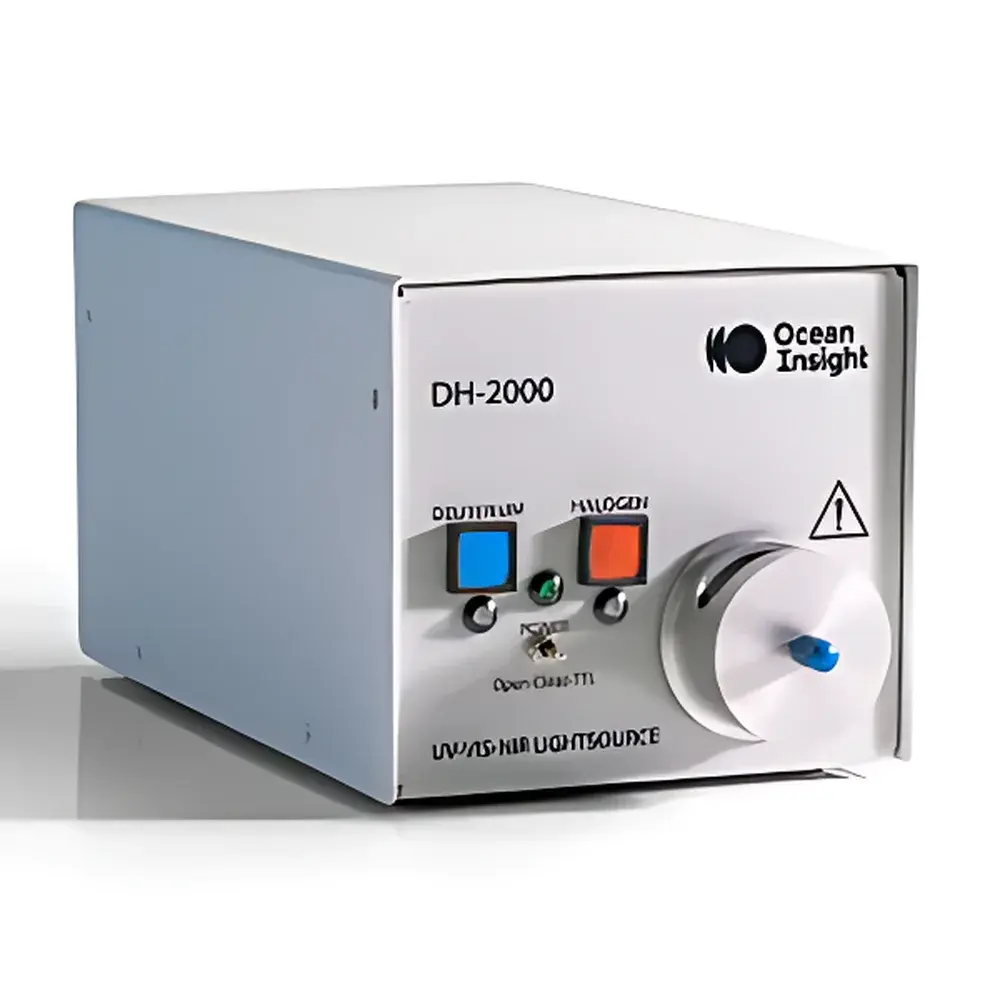
Ocean Optics DH-2000-CAL NIST-Traceable Deuterium-Halogen Calibration Light Source
| Brand | Ocean Optics |
|---|---|
| Origin | Imported |
| Manufacturer Type | Manufacturer |
| Model | DH-2000-CAL |
| Light Source Type | Xenon-based (Deuterium + Tungsten-Halogen) |
| Illumination Mode | External Illumination |
| Calibration Wavelength Range | 220–1050 nm |
| Calibration Uncertainty | ±5% |
| Calibration Validity | 50 hours of operation |
| Power Consumption | 25 W (D₂), 20 W (W-Halogen), max. 190 W total |
| Warm-up Time | 40 min (D₂), 20 min (W-Halogen) |
| Dimensions | 150 × 135 × 319 mm |
| Weight | 6 kg |
| Input Voltage | 85–264 V AC, 50/60 Hz |
| Voltage Stability | <5 × 10⁻⁶ peak-to-peak (0.1–10.0 Hz) |
| Humidity | 5–95% RH (non-condensing at 40 °C) |
| Operating Temperature | 5–35 °C |
| Certifications | CE, VDI/VDE 0160, EN 61010 |
Overview
The Ocean Optics DH-2000-CAL is a NIST-traceable, dual-lamp calibration light source engineered for absolute spectral irradiance calibration across the ultraviolet to near-infrared (UV-NIR) spectrum. It integrates a deuterium lamp (220–400 nm) and a tungsten-halogen lamp (350–1050 nm) in a single, thermally stabilized housing to deliver continuous, spectrally overlapping output from 220 nm to 1050 nm. Unlike general-purpose illumination sources, the DH-2000-CAL is purpose-built for radiometric traceability—its output is calibrated against primary standards maintained by the National Institute of Standards and Technology (NIST), enabling users to assign absolute irradiance values (µW/cm²/nm) to spectrometer measurements. This makes it essential for laboratories requiring compliance with ISO/IEC 17025, ASTM E275, or FDA 21 CFR Part 11–aligned validation protocols where documented metrological traceability is mandatory. The system operates on a stable, low-drift power supply (<0.01% voltage drift per hour), minimizing temporal uncertainty during extended calibration sessions.
Key Features
- NIST-traceable spectral irradiance calibration certified over 220–1050 nm, with full uncertainty budget documentation provided in both printed and digital formats (CSV and SpectraSuite-compatible .cal files)
- Integrated thermal and electrical stabilization architecture ensures <5 × 10⁻⁶ peak-to-peak voltage stability (0.1–10.0 Hz), critical for high-reproducibility radiometric measurements
- Built-in CC-3-UV cosine-corrected detector interface enables direct fiber-coupled calibration—eliminating angular dependency errors common in non-diffuse irradiance transfer standards
- Dual-lamp design with independent warm-up profiles (40 min for D₂, 20 min for W-Halogen) allows optimized operational sequencing without spectral gaps
- Compliant with IEC 61000-4-30 (power quality) and EN 61010-1 (safety requirements for electrical equipment for measurement), supporting integration into GLP/GMP-controlled environments
- Calibration validity defined as 50 hours of cumulative lamp-on time—tracked via internal non-volatile usage logging; recalibration triggers are auditable and support 21 CFR Part 11 electronic record integrity
Sample Compatibility & Compliance
The DH-2000-CAL is designed exclusively for radiometric calibration—not illumination—and is compatible with all Ocean Optics spectrometers (e.g., QE Pro, Maya2000 Pro, USB2000+) and third-party CCD/CMOS array spectrometers accepting SMA905 fiber input. It interfaces seamlessly with the CC-3-UV cosine corrector for hemispherical irradiance measurement geometry, satisfying ISO 13406-2 and CIE S 025/E:2015 requirements for spatial uniformity and angular response. All calibration data are delivered with full NIST traceability statements, including reference standard ID, calibration date, measurement uncertainty (k = 2), and environmental conditions at time of certification. The unit meets CE marking requirements under the Low Voltage Directive (2014/35/EU) and Electromagnetic Compatibility Directive (2014/30/EU), and conforms to VDI/VDE 0160 for functional safety in laboratory instrumentation.
Software & Data Management
Calibration data are natively supported in Ocean Insight’s SpectraSuite software (v3.12+), enabling one-click application of absolute irradiance correction to raw spectral counts. The embedded .cal file contains wavelength-indexed irradiance values (µW/cm²/nm), dark offset compensation, and lamp-specific nonlinearity coefficients. SpectraSuite enforces audit-trail logging for all calibration applications—including user ID, timestamp, instrument serial number, and applied correction version—fulfilling ALCOA+ principles (Attributable, Legible, Contemporaneous, Original, Accurate) required under GxP frameworks. For enterprise deployments, calibration metadata can be exported in CSV or XML format for integration into LIMS or ELN systems. Optional firmware updates maintain backward compatibility with legacy calibration files while extending support for new spectrometer models and detector gain configurations.
Applications
- Primary irradiance calibration of UV-Vis-NIR spectroradiometers used in photobiological safety testing (IEC 62471)
- Validation of optical emission monitors (OEMs) in semiconductor process tools and cleanroom lighting audits
- Reference standard for inter-laboratory comparison studies under ISO/IEC 17043 proficiency testing schemes
- Traceable calibration of integrating sphere systems for LED and laser diode radiant flux characterization
- Supporting method validation for USP Analytical Instrument Qualification (AIQ) across Operational Qualification (OQ) and Performance Qualification (PQ) phases
FAQ
Is the DH-2000-CAL suitable for routine illumination during spectral measurements?
No. It is a metrological reference source intended solely for radiometric calibration. For illumination applications, use the DH-2000 broadband light source.
How is calibration validity enforced and tracked?
The lamp’s cumulative operating time is logged internally. After 50 hours, SpectraSuite displays a warning and disables automated calibration application until a DH-2000-RECAL service is performed.
Can the DH-2000-CAL be used with non-Ocean Optics spectrometers?
Yes—provided the spectrometer accepts SMA905 fiber input and supports user-defined irradiance calibration files in linear wavelength-interpolated format.
What documentation accompanies the DH-2000-CAL upon shipment?
A physical calibration certificate, digital calibration data (.cal and CSV), NIST traceability statement, and CE/EN 61010 compliance report are included.
Is extended-range calibration (up to 2400 nm) available?
Yes—via the DH-2000-CAL-EXT upgrade option and corresponding DH-2000-RECAL-EXT service, which extends traceability to 1050–2400 nm using a calibrated InGaAs detector reference.




