
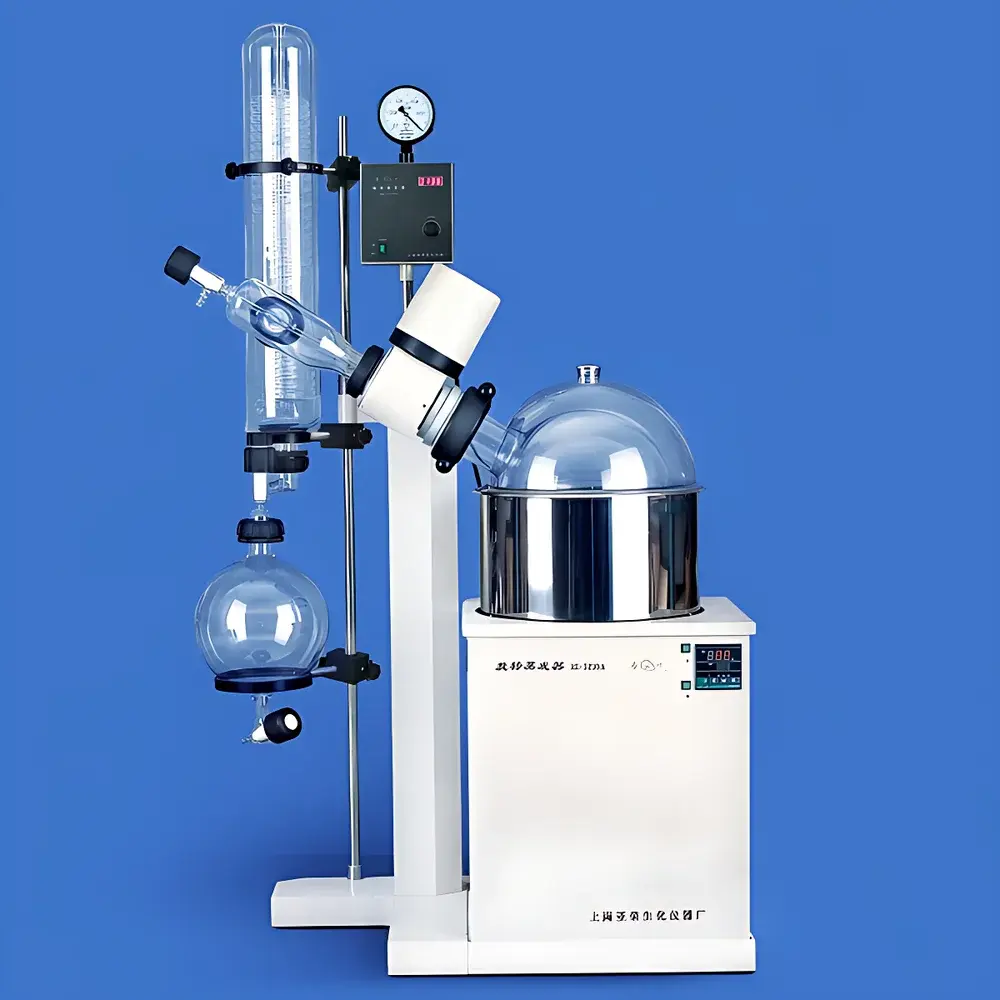
Shanghai Yarong RE-5210A Rotary Evaporator
| Brand | Jinye |
|---|---|
| Origin | Shanghai, China |
| Manufacturer Type | Direct Manufacturer |
| Product Category | Domestic |
| Model | RE-5210A |
| Capacity | 10 L |
| Ultimate Vacuum Range | −0.01 to −0.095 MPa (accuracy: ±0.2–0.5%) |
| Rotation Speed | 0–138 rpm |
| Temperature Control Range | Ambient to 99 °C (PID-controlled, digital display) |
| Temperature Control Accuracy | ±1 °C |
| Condenser Cooling Area | 1.1 m² |
| Condenser Type | Vertical, extra-long, high-efficiency double-reflux |
| Drive | Frequency-controlled motor |
| Features | Digital speed & temperature display, continuous feed/discharge, automatic water bath lift |
Overview
The Shanghai Yarong RE-5210A Rotary Evaporator is an industrial-grade benchtop purification system engineered for reproducible solvent removal, concentration, and recovery under reduced pressure. Based on the fundamental principle of rotary evaporation—where a rotating flask increases surface area while simultaneous vacuum lowers boiling points—the RE-5210A enables efficient phase separation of thermally sensitive compounds without thermal degradation. Designed for scalability from laboratory development to pilot-scale production, it integrates precision mechanical, thermal, and vacuum control systems into a robust architecture suitable for regulated environments in biopharmaceutical process development, fine chemical synthesis, and natural product isolation.
Key Features
- 10 L evaporation capacity with borosilicate glass components (flask, condenser, vapor duct, and receiving flask) compliant with ISO 3585 standards for chemical resistance and thermal stability
- Frequency-controlled AC motor drive delivering smooth, low-vibration rotation across 0–138 rpm with real-time digital speed readout and ±1 rpm repeatability
- PID-controlled water bath heating system with digital temperature display; maintains setpoint within ±1 °C across ambient to 99 °C range, minimizing thermal overshoot during ramping
- Vertical double-reflux condenser with 1.1 m² effective cooling surface area, optimized for high latent heat transfer and minimal bumping or foaming during volatile solvent recovery (e.g., ethanol, acetone, ethyl acetate)
- Integrated automatic water bath lifting mechanism (electromechanical actuator) enabling precise height adjustment for optimal immersion depth and safe flask detachment
- Continuous feed and discharge capability via standardized ground-glass joints (ISO 29761), supporting uninterrupted operation during multi-batch processing
- Vacuum regulation compatible with external diaphragm or oil-free vacuum pumps; calibrated vacuum gauge displays absolute pressure from −0.01 to −0.095 MPa with accuracy traceable to NIST-traceable references (±0.2–0.5% full scale)
Sample Compatibility & Compliance
The RE-5210A accommodates a broad spectrum of solute-solvent systems, including aqueous, polar aprotic (e.g., DMF, DMSO), and low-boiling organic media. Its all-glass path ensures inertness toward acids, bases, and oxidizers commonly used in API purification and botanical extraction. The unit meets general requirements for Good Manufacturing Practice (GMP)-aligned lab operations per ICH Q5C and supports audit-ready documentation when paired with validated vacuum and temperature loggers. While not certified to UL/CE as a standalone appliance, its electrical design complies with GB/T 14048.1 (Chinese national standard equivalent to IEC 60947-1) for industrial control equipment safety.
Software & Data Management
The RE-5210A operates as a stand-alone instrument with embedded microcontroller-based logic—no proprietary software required. All operational parameters (temperature setpoint, rotation speed, vacuum level) are monitored and displayed locally via dual digital LED interfaces. For integration into centralized lab data systems, optional analog output modules (0–10 V or 4–20 mA) can be installed to transmit real-time temperature and speed signals to SCADA or LIMS platforms. Audit trails for critical process parameters may be generated using third-party validated data loggers compliant with FDA 21 CFR Part 11 requirements when configured with electronic signature and user access controls.
Applications
- Concentration of heat-labile biologics (e.g., monoclonal antibody supernatants, plasmid DNA solutions) prior to downstream chromatography
- Solvent exchange in small-molecule API crystallization workflows (e.g., transition from THF to heptane)
- Removal of residual solvents from polymer synthesis intermediates per ICH Q3C guidelines
- Extraction and enrichment of terpenes, alkaloids, and polyphenols from plant matrices using ethanol or supercritical CO₂ extracts
- Recovery and recycling of high-purity solvents in fine chemical manufacturing to reduce EHS exposure and waste disposal costs
- Preparative-scale dehydration of hygroscopic materials where conventional ovens induce decomposition
FAQ
What vacuum pump is recommended for optimal performance with the RE-5210A?
A two-stage oil-free diaphragm pump capable of sustaining ≤5 mbar (0.005 MPa) base pressure is recommended for routine operation; for low-boiling solvents (e.g., dichloromethane), a cryogenic trap or cold finger accessory is advised to prevent pump oil contamination.
Can the RE-5210A be used under inert atmosphere (e.g., nitrogen or argon)?
Yes—via optional inert gas inlet valve kit (standard ISO-KF 16 or 25 port), enabling controlled blanketing during evaporation of oxygen-sensitive compounds.
Is the water bath lift function programmable or manually triggered?
The lift is electromechanically actuated and manually initiated via front-panel button; no programmable timing or position memory is built-in, though external PLC interfacing is possible via dry-contact terminals.
What maintenance intervals are recommended for long-term reliability?
Vacuum seal grease should be reapplied every 200 operating hours; PTFE stopcocks require inspection every 500 hours; condenser cleaning with dilute nitric acid is advised after each use with high-salt or viscous feedstocks.
Does the RE-5210A support GLP-compliant calibration records?
Yes—calibration certificates for temperature sensor (PT100 Class B) and vacuum transducer (capacitance manometer) can be issued upon request, traceable to national metrology institutes.



