
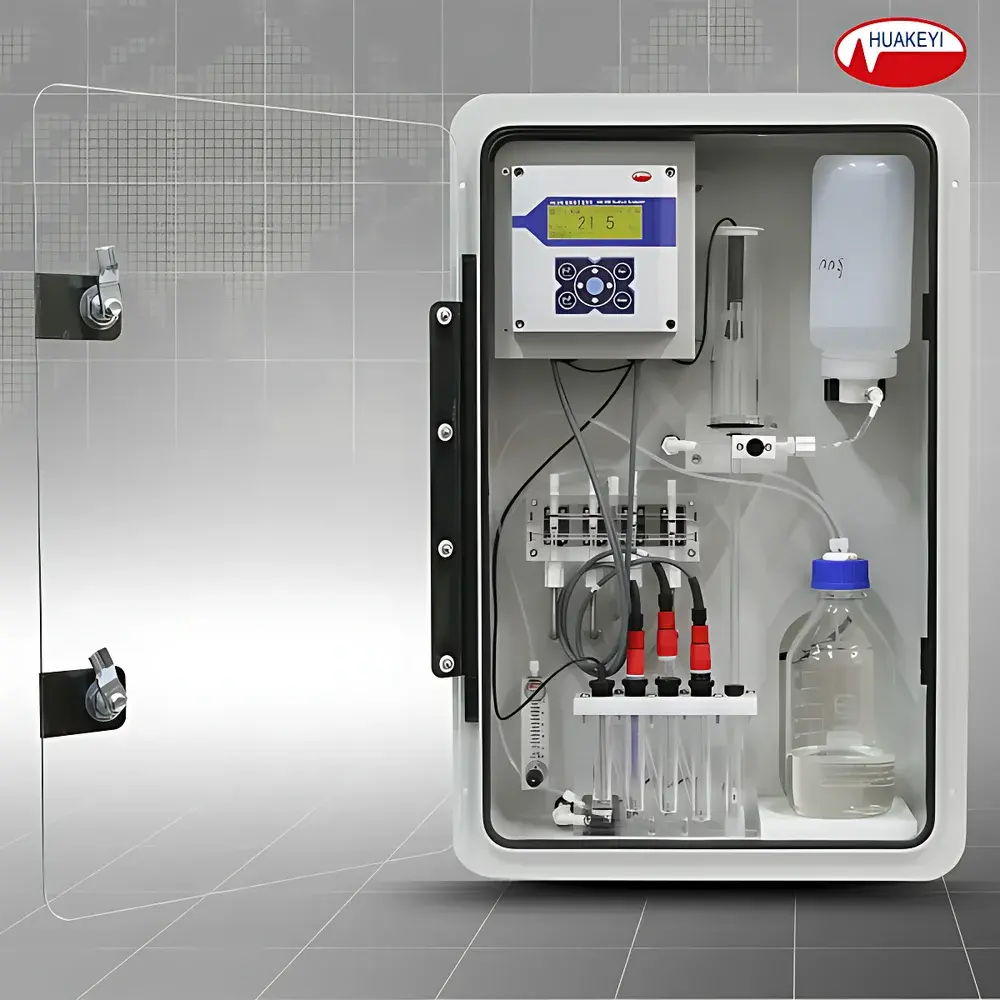
Huake Instrument HK-358AO Multi-Channel Online Sodium Ion Monitor
| Brand | Huake Instrument |
|---|---|
| Model | HK-358AO |
| Type | Online Sodium Ion Monitor |
| Measurement Range | (1.00–8.00) pNa, 0.23 μg/L–2.30 g/L, (0.00–14.00) pH |
| Detection Limit | 0.01 pNa, 0.01 μg/L, 0.01 pH |
| Response Time | ≤2 min at 25 °C |
| Temperature Range | (0.0–99.9) °C |
| Temperature Accuracy | ±0.5 °C |
| Resolution | 0.01 pNa / 0.01 μg/L / 0.01 pH |
| Channels | 1–4 configurable |
| Output | Four isolated (0–10) mA / (0–20) mA / (4–20) mA current outputs |
| Communication | RS-485 or Profibus-DP optional |
| Dimensions | 451 mm × 684 mm × 230 mm (W×H×D) |
| Weight | 20 kg |
Overview
The Huake Instrument HK-358AO Multi-Channel Online Sodium Ion Monitor is an industrial-grade electrochemical analyzer engineered for continuous, high-stability measurement of sodium ion activity in ultra-pure water systems. It operates on the principle of potentiometric ion-selective electrode (ISE) detection, utilizing a solid-state sodium-selective membrane electrode paired with a reference electrode to generate a Nernstian response proportional to the logarithm of sodium ion activity (pNa). Integrated dual-parameter capability enables simultaneous real-time monitoring of both pNa and pH—critical for maintaining alkaline conditioning in high-pressure boiler feedwater and steam cycle condensate. The instrument automatically regulates ammonia dosing based on post-alkalization pH feedback, ensuring optimal sample pH (±0.1 pH unit of setpoint) to maximize sodium electrode selectivity and minimize interference from hydrogen ions and other cations. Designed specifically for power generation, petrochemical, and semiconductor ultrapure water (UPW) applications, the HK-358AO meets functional requirements aligned with ASTM D4582–22 (Standard Practice for Measuring Sodium in High-Purity Water) and supports GLP-compliant data integrity through audit-trail-capable firmware architecture.
Key Features
- Configurable 1–4 independent measurement channels—reduces footprint, cabling complexity, and total cost of ownership versus multiple single-channel analyzers;
- Intelligent channel switching logic: user-selectable modes include time-based cycling (6–99 min intervals), stability-triggered transition (based on pNa/pH drift thresholds), or hybrid scheduling;
- Patented overflow mixing cell design ensures constant hydrostatic pressure across flow paths, eliminates pulsation-induced measurement noise, and enables seamless, valveless alternation between calibration and sample measurement loops;
- Integrated pH-controlled alkalization module maintains post-conditioning pH within ±0.1 unit of operator-defined setpoint—prevents under-alkalinization (leading to H⁺ interference) and over-alkalinization (causing NH₃ volatilization and reagent waste);
- Four fully isolated 4–20 mA analog outputs—each assigned to a specific channel and parameter (e.g., Channel 1 pNa, Channel 2 pH), supporting redundant PLC interfacing and distributed control system (DCS) integration;
- Temperature compensation via built-in Pt100 sensor (0.0–99.9 °C range, ±0.5 °C accuracy) with selectable manual or automatic compensation mode per channel;
- Rugged front-panel membrane keypad and backlit LCD display support local operation without external PC; all configuration, calibration, and diagnostic functions accessible onsite.
Sample Compatibility & Compliance
The HK-358AO is validated for use with low-conductivity water matrices typical of thermal power plant secondary cycles—including cation-exchange effluent (阳床出口), boiler feedwater, turbine condensate, steam drum water, and deaerator outlet. It tolerates inlet pressures up to 0.6 MPa and accommodates sample temperatures from 5 °C to 50 °C without external cooling. Electrode materials comply with IEC 61508 SIL2 functional safety principles for critical instrumentation loops. The system supports traceability per ISO/IEC 17025:2017 for calibration records and conforms to USP conductivity and ion testing guidance when deployed in pharmaceutical water systems. Data logging and event history meet FDA 21 CFR Part 11 requirements for electronic records when used with optional secure firmware and password-protected configuration access.
Software & Data Management
Internal non-volatile memory stores ≥12 months of timestamped measurement data (pNa, pH, temperature, alarm status) at user-defined intervals. All stored values are exportable via RS-485 Modbus RTU or Profibus-DP protocol to SCADA, historian, or LIMS platforms. Firmware includes configurable alarm thresholds (high/low pNa, pH deviation, electrode timeout, flow loss), latching/non-latching behavior, and relay output activation. Calibration history—including date, standard concentration, slope (%/decade), and asymmetry potential—is retained with full audit trail. Optional USB-to-serial adapter enables local firmware updates and raw data dump using Huake’s proprietary HK-ConfigSuite v3.2 utility (Windows 10/11 compatible).
Applications
- Real-time sodium monitoring at cation exchanger outlet to detect resin exhaustion before breakthrough;
- Boiler feedwater purity assurance in subcritical and supercritical fossil-fueled units per EPRI TR-102357 guidelines;
- Steam condensate return loop surveillance to identify corrosion-induced sodium ingress (e.g., copper alloy degradation);
- Ammonia dosing optimization in combined cycle HRSGs to maintain pNa < 2.0 (i.e., <230 μg/L) while minimizing excess NH₃ carryover;
- Pharmaceutical purified water (PW) and water for injection (WFI) system validation per EU GMP Annex 1 and WHO TRS 970;
- Monitoring sodium leaching from glass-lined reactors or stainless-steel piping in fine chemical manufacturing.
FAQ
What is the minimum detectable sodium concentration under typical operating conditions?
The instrument achieves a practical detection limit of 0.01 μg/L (equivalent to 0.01 pNa) when operated with freshly conditioned electrodes, stable sample temperature (±1 °C), and optimized alkalization (pH 10.2–10.8).
Can the HK-358AO perform automatic calibration without manual intervention?
No—it requires manual placement of standard solutions into the calibration port; however, automated sequence execution (zero, span, verification) is supported once standards are loaded.
Is the system compatible with hazardous area installations (e.g., Zone 1 or Class I Div 1)?
The base unit is rated IP65 for general indoor use; explosion-proof enclosures (ATEX/IECEx certified) are available as factory-installed options upon request.
How often must the sodium-selective electrode be regenerated?
Under continuous operation in <5 μg/L sodium service, regeneration (including membrane polishing and reconditioning in 10⁻⁴ mol/L NaCl) is recommended every 6–12 months depending on fouling rate and sample particulate load.
Does the instrument support remote diagnostics via Ethernet or cloud connectivity?
Native Ethernet or cloud interface is not included; however, third-party gateways (e.g., Moxa EDS-G205E) may be integrated via RS-485 to enable MQTT or OPC UA data forwarding.
Related Products







