
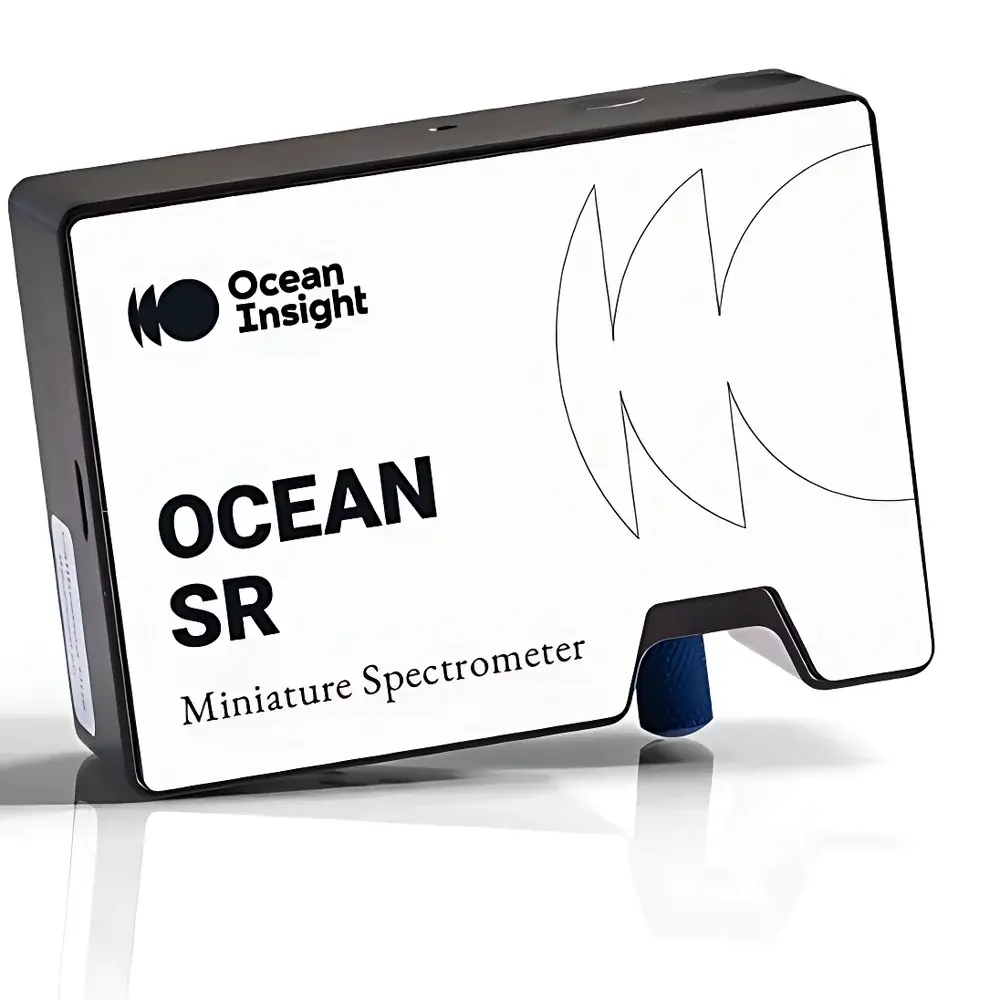
Ocean Optics Fiber Optic Spectrometer SR2
| Brand | Ocean Optics |
|---|---|
| Origin | USA |
| Manufacturer Type | Authorized Distributor |
| Product Origin | Imported |
| Model | Ocean Optics SR2 |
| Spectral Range | 185–1100 nm (configuration-dependent) |
| Detector Type | CCD |
| Optical Resolution (FWHM) | 0.56–1.71 nm |
| Signal-to-Noise Ratio (SNR) | 380:1 (single acquisition) |
| Dynamic Range | 3400:1 (single acquisition) |
| Integration Time | as low as 10 µs |
| Stray Light | Not specified |
| Slit Options | 5–200 µm |
Overview
The Ocean Optics Fiber Optic Spectrometer SR2 is a high-performance, compact CCD-based spectrometer engineered for demanding spectroscopic applications requiring both rapid spectral acquisition and high fidelity signal integrity. Operating on the principle of Czerny-Turner optical design with fiber-coupled input, the SR2 delivers calibrated spectral data across an extended UV-VIS-NIR range (185–1100 nm), enabled by selectable grating and detector configurations. Its core architecture integrates a thermally stabilized optical bench and precision-machined mechanical components to minimize wavelength drift and inter-unit variability—critical for multi-instrument deployments in QC labs or distributed monitoring networks. Unlike legacy miniature spectrometers constrained by the SNR–speed trade-off, the SR2 achieves simultaneous optimization of temporal resolution (down to 10 µs integration time) and photometric accuracy (380:1 SNR at full well), making it suitable for transient event capture—including pulsed laser characterization, plasma emission dynamics, and real-time absorbance kinetics.
Key Features
- Ultra-fast spectral acquisition: minimum integration time of 10 µs, enabling time-resolved measurements of rapidly evolving optical phenomena.
- High photometric stability: thermally managed optical platform ensures <±0.05 nm/°C wavelength shift and <0.1% intensity drift over 8-hour continuous operation.
- Configurable optical resolution: interchangeable entrance slits (5–200 µm) and grating options yield FWHM resolution from 0.56 nm to 1.71 nm—balancing spectral discrimination and throughput per application requirements.
- Robust mechanical architecture: aluminum alloy housing with integrated EMI shielding and passive thermal dissipation, rated for continuous operation in ambient temperatures from 15–35 °C.
- Cross-platform interoperability: native USB 3.0 interface with galvanically isolated power delivery; compatible with Windows, Linux, and macOS host environments without proprietary drivers.
Sample Compatibility & Compliance
The SR2 accepts standard SMA 905 fiber-optic inputs (core diameters 50–600 µm), supporting direct coupling to Ocean Insight light sources (e.g., DH-mini deuterium-halogen, HL-2000 tungsten-halogen), integrating spheres, flow cells, and remote probes. Its spectral calibration traceability follows NIST-traceable standards (via factory-certified Hg/Ar lamp reference), and raw spectral data output conforms to ASTM E131-22 (Standard Terminology Relating to Molecular Spectroscopy) and ISO/IEC 17025:2017 requirements for measurement uncertainty reporting. While not inherently 21 CFR Part 11 compliant, the instrument supports audit-ready workflows when deployed with validated third-party software environments meeting GLP/GMP documentation standards.
Software & Data Management
Each SR2 ships with OceanDirect—a rigorously tested, open-source SDK supporting C/C++, Python, MATLAB, LabVIEW, and .NET frameworks. The API provides low-level register access for synchronous triggering, hardware-level gain control, dark current subtraction, and nonlinearity correction. Spectral data is output in IEEE 754-compliant floating-point arrays (32-bit), timestamped to microsecond precision using onboard hardware clocks. OceanDirect includes built-in support for HDF5 and CSV export formats, enabling seamless integration into LIMS, ELN, or custom analytics pipelines. Optional OceanView GUI software (v2.5+) offers real-time spectral overlay, multichannel averaging, peak-finding algorithms per ASTM E1655-21, and automated baseline correction using asymmetric least squares (ALS) methods.
Applications
- Laser-induced breakdown spectroscopy (LIBS) and pulsed laser diagnostics, leveraging sub-100 µs spectral gating capability.
- In-line process monitoring of chemical reactions via UV-Vis absorbance kinetics (e.g., reaction progress analysis per USP ).
- Plasma emission profiling in semiconductor etch chambers or fusion research diagnostics.
- UV sterilization dose validation through real-time 254 nm irradiance tracking.
- Fluorescence lifetime screening in pharmaceutical excipient analysis using time-synchronized gated acquisition.
- Environmental water quality assessment via nitrate/nitrite spectral deconvolution in the 200–230 nm region.
FAQ
What spectral calibration standards are used for factory calibration?
Factory calibration employs NIST-traceable mercury-argon emission lamps, with wavelength accuracy certified to ±0.2 nm across the 185–1100 nm range and radiometric calibration referenced to a NIST-traceable tungsten halogen standard.
Can the SR2 operate in triggered acquisition mode with external TTL signals?
Yes—hardware trigger input (TTL-compatible, 3.3 V logic) enables precise synchronization with lasers, shutters, or process controllers, with jitter <200 ns.
Is thermal stabilization active or passive?
Thermal management is passive: the optical bench uses matched-coefficient-of-expansion materials and symmetric thermal mass distribution—no Peltier elements or active cooling circuits are employed.
How is inter-unit reproducibility quantified?
Typical unit-to-unit spectral response variation is ≤1.2% RMS across the visible range (400–700 nm) when operated under identical environmental conditions and configuration settings.
Does OceanDirect support real-time spectral streaming to networked databases?
Yes—the SDK includes TCP/IP socket wrappers and example implementations for MQTT and OPC UA protocols, facilitating integration into Industry 4.0 architectures.





