
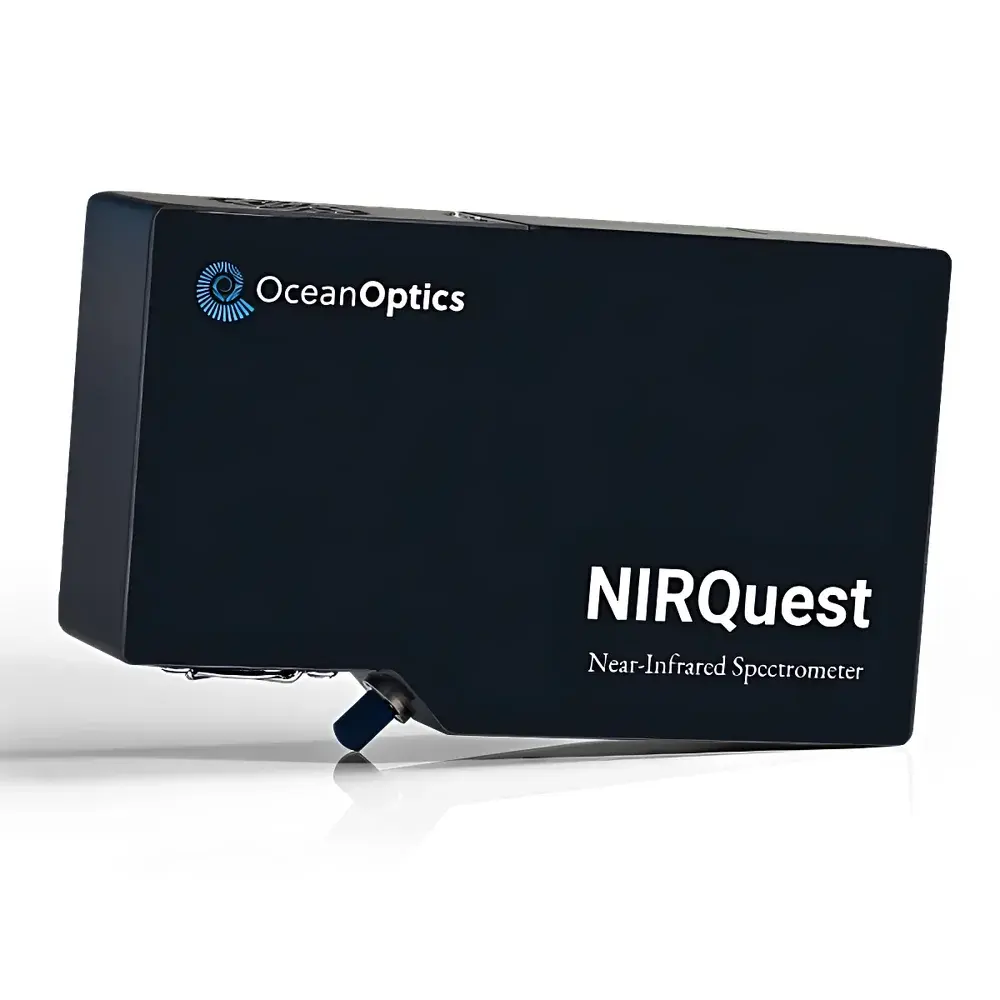
Ocean Optics NIRQuest+ Near Infrared Spectrometer
| Brand | Ocean Optics |
|---|---|
| Origin | Shanghai, China |
| Manufacturer Type | Original Equipment Manufacturer (OEM) |
| Instrument Type | Laboratory |
| Optical Principle | Fixed-grating array-detector non-scanning spectrometer |
| Wavelength Ranges | NIRQuest+1.7 (900–1700 nm), NIRQuest+2.2 (900–2200 nm), NIRQuest+2.5 (900–2500 nm) |
| Detector | InGaAs linear array (TE-cooled) |
| Resolution | 1.7–4.0 nm FWHM (configuration-dependent) |
| Integration Time | 1 ms to 65 s |
| Interface | USB 3.0 or Ethernet (optional) |
| Compliance | CE, RoHS, FDA 21 CFR Part 11 ready (with compliant software stack) |
Overview
The Ocean Optics NIRQuest+ is a high-sensitivity, fixed-grating near-infrared (NIR) spectrometer engineered for precision quantitative and qualitative analysis in laboratory and industrial environments. Based on a non-scanning optical architecture—featuring a thermoelectrically (TE) cooled InGaAs linear array detector and optimized Czerny–Turner optical bench—the NIRQuest+ delivers exceptional signal-to-noise ratio (SNR), low dark current, and stable spectral response across extended wavelength ranges. Unlike scanning monochromator-based systems, its array-detector design enables full-spectrum acquisition in a single integration event, eliminating mechanical wear and ensuring high reproducibility for time-critical applications such as inline process monitoring or rapid sample screening. The instrument operates across three calibrated spectral configurations: NIRQuest+1.7 (900–1700 nm), NIRQuest+2.2 (900–2200 nm), and NIRQuest+2.5 (900–2500 nm), supporting both reflectance and transmittance measurements in solid, liquid, and semi-solid matrices.
Key Features
- TE-cooled InGaAs detector with <150 e⁻ RMS dark noise (typical at 1 s integration), enabling low-light performance critical for diffuse reflectance and weakly absorbing samples
- Optimized optical throughput and minimized stray light via proprietary grating coating and baffling, achieving <0.05% stray light at 1000 nm
- Configurable slit widths (10–200 µm) and fiber coupling options (SMA 905, FC/PC) to balance resolution, sensitivity, and optical throughput per application
- USB 3.0 interface with real-time data streaming up to 100 spectra/sec; optional Gigabit Ethernet for industrial network integration and remote operation
- Rugged aluminum housing with thermal stabilization circuitry, rated for continuous operation from 15 °C to 35 °C ambient
- Firmware-upgradable architecture supporting custom calibration models, user-defined regions of interest (ROI), and hardware-triggered acquisition
Sample Compatibility & Compliance
The NIRQuest+ accommodates diverse sampling geometries—including integrating spheres, transmission cuvettes, contact probes, and fiber-optic reflection probes—enabling seamless adaptation to ASTM E1655-22 (standard practices for NIR quantitative analysis), ISO 12099:2017 (animal feeding stuffs), and USP (near-infrared spectroscopy). Its spectral stability (<0.05 nm/h drift at 25 °C) and photometric repeatability (<0.5% RSD over 8-hour session) meet GLP and GMP documentation requirements when paired with compliant data acquisition software. All factory calibrations are traceable to NIST-traceable standards, and the system supports audit trail logging, electronic signatures, and secure user access control under FDA 21 CFR Part 11 compliance frameworks.
Software & Data Management
Ocean Insight’s OceanView spectroscopy platform provides native support for NIRQuest+, offering real-time spectral visualization, multivariate calibration (PLS, PCR), and chemometric model deployment. The software includes built-in tools for baseline correction, Savitzky–Golay smoothing, derivative processing, and spectral normalization. Raw data export is supported in CSV, ASCII, and HDF5 formats, while API access (via Python SDK, .NET, or LabVIEW drivers) enables integration into LIMS, MES, or SCADA systems. For regulated environments, optional OceanInsight IQ software adds 21 CFR Part 11-compliant electronic records, role-based permissions, and immutable audit trails synchronized with instrument firmware timestamps.
Applications
- Industrial process analytics: Real-time monitoring of moisture, fat, protein, and polymer composition in food, pharma, and petrochemical streams
- Plastics sorting and recycling: Identification of polyolefins (PP, PE), PET, PVC, and additives via spectral fingerprinting in 1200–2400 nm region
- Pharmaceutical raw material verification: Identity testing and assay quantification per USP using validated PLS models
- Agricultural product grading: Non-destructive assessment of grain protein, oil content, and seed viability
- Research-grade material characterization: Band assignment and hydrogen-bonding analysis in polymers, biomolecules, and catalysts
- Environmental monitoring: Quantification of organic pollutants (e.g., hydrocarbons, phenols) in aqueous and soil extracts
FAQ
What wavelength range options are available for the NIRQuest+?
The NIRQuest+ is offered in three standard configurations: 900–1700 nm (NIRQuest+1.7), 900–2200 nm (NIRQuest+2.2), and 900–2500 nm (NIRQuest+2.5), each with factory-aligned calibration and certified spectral accuracy.
Is the NIRQuest+ suitable for regulatory-compliant environments?
Yes—when deployed with OceanInsight IQ software and configured per documented SOPs, the system meets technical and procedural requirements for 21 CFR Part 11, ISO/IEC 17025, and EU Annex 11 compliance.
Can the NIRQuest+ be integrated into an automated production line?
Absolutely—the USB 3.0 and Ethernet interfaces support hardware triggering, programmable acquisition sequencing, and deterministic latency (<5 ms trigger-to-first-pixel), making it compatible with PLC-controlled conveyors and robotic sampling stations.
How does TE cooling improve measurement reliability?
Thermoelectric cooling reduces dark current by >90% compared to uncooled InGaAs detectors, minimizing thermal noise contribution and enabling stable low-light measurements essential for diffuse reflectance and long-integration applications.
What maintenance is required for long-term spectral stability?
No routine optical alignment or lamp replacement is needed—the solid-state design requires only periodic validation using NIST-traceable reference standards (e.g., WS-1 or diffuse reflectance tiles), typically every 6–12 months depending on usage intensity.





