
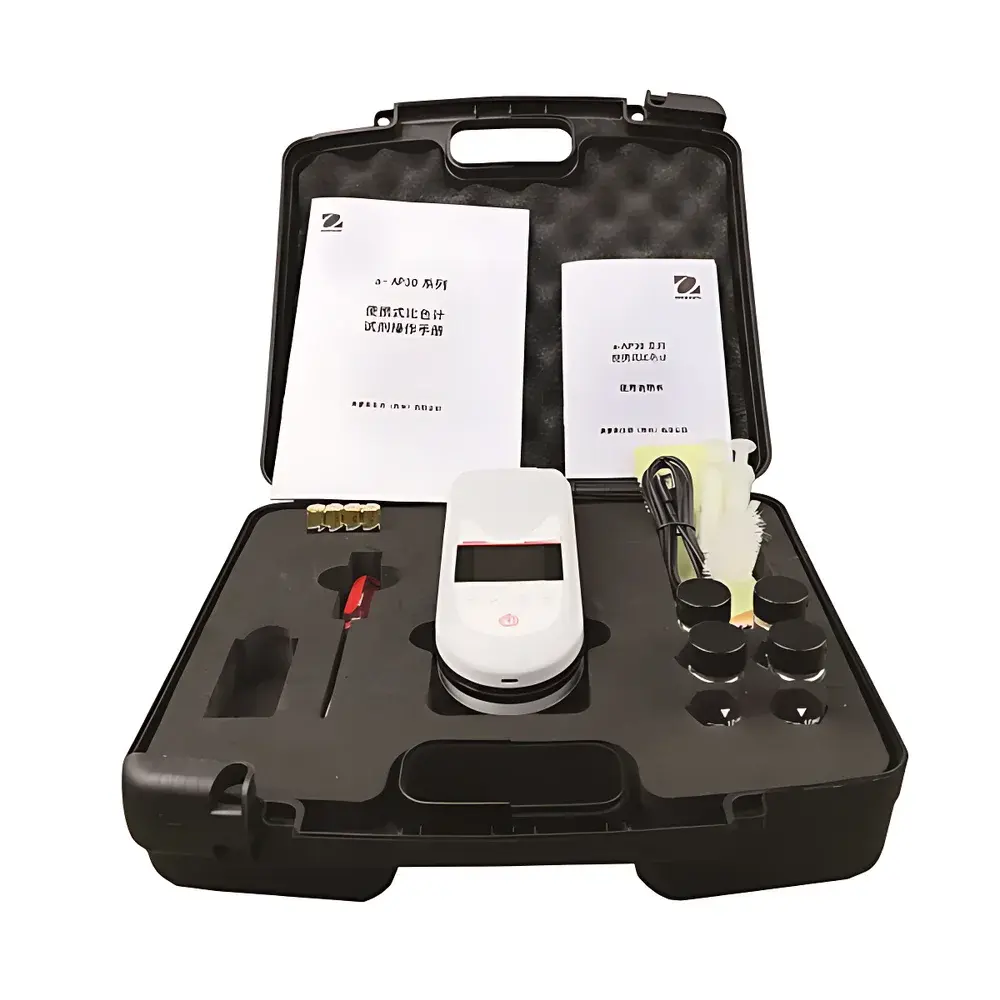
OHAUS Aquasearcher™ AP30PE Portable Photometric Water Quality Analyzer
| Brand | OHAUS |
|---|---|
| Origin | Shanghai, China |
| Manufacturer Type | Original Equipment Manufacturer (OEM) |
| Country of Origin | China |
| Model | AP30PE |
| Instrument Type | Portable / Handheld Photometer |
| Measured Parameter | Phosphate |
| Light Source | Multi-wavelength LED Array |
| Detection Principle | Absorption Photometry (Visible Spectrophotometry) |
| Display | High-brightness OLED |
| Power Supply | 4 × AAA batteries (alkaline or rechargeable) |
| Data Storage | 5,000 measurement records with timestamp |
| Interface | Built-in micro-USB port |
| Enclosure Rating | IP67-rated housing (dust-tight and submersible up to 1 m for 30 min) |
| Auto-power-off | Configurable delay (1–30 min) |
| Dimensions | 165 × 78 × 42 mm |
| Weight | 220 g (without batteries) |
Overview
The OHAUS Aquasearcher™ AP30PE is a field-deployable photometric water quality analyzer engineered for rapid, on-site quantification of orthophosphate in aqueous matrices. It operates on the principle of absorption photometry—measuring analyte-specific color development following standardized colorimetric reactions (e.g., ascorbic acid–molybdate method per ISO 6878:2004 and ASTM D515-19). Unlike broad-spectrum spectrophotometers, the AP30PE employs discrete, temperature-stabilized LED light sources at optimized wavelengths (e.g., 650 nm ± 5 nm for phosphate detection), eliminating the need for mechanical filters or monochromators while maintaining high optical specificity and long-term wavelength stability. Its compact form factor, low power consumption (<15 mW active mode), and robust IP67-rated enclosure enable reliable operation across diverse environmental sampling scenarios—from municipal intake points and industrial cooling loops to wastewater effluent channels and recreational water facilities.
Key Features
- Optimized optical path design featuring collimated LED illumination and precision-matched photodiode detection, delivering <±2% absorbance repeatability (CV <1.8%) across 0–2.0 AU range.
- Touch-responsive membrane keypad with haptic feedback—designed for gloved operation and resistant to moisture ingress and chemical splashes.
- Low reagent consumption: ≤0.5 mL per test; minimal sample volume requirement (10–25 mL), reducing field logistics and disposal burden.
- Integrated data management: 5,000 measurement records stored with date/time stamp, parameter ID, calibration status flag, and operator ID (user-configurable).
- Micro-USB interface compliant with USB 2.0 Full-Speed standard; supports direct connection to Windows/macOS/Linux hosts without proprietary drivers—data export via CSV or XML format.
- Auto-calibration verification: Built-in reference channel monitors LED intensity drift in real time, triggering alert if deviation exceeds ±3% over 8-hour period.
Sample Compatibility & Compliance
The AP30PE is validated for use with clarified, non-turbid water samples meeting ISO 7027:2016 turbidity limits (<5 NTU). It supports standard EPA-approved digestion protocols (e.g., persulfate oxidation for total phosphorus conversion) when paired with external heating modules. The instrument complies with IEC 61000-4-2 (ESD immunity: ±8 kV contact discharge) and IEC 60529 (IP67 ingress protection). All firmware and calibration routines adhere to GLP documentation requirements—including full audit trail capability (user login, calibration event, result modification log) when connected to OHAUS AquaLink™ desktop software (v3.2+), which supports 21 CFR Part 11-compliant electronic signatures and role-based access control.
Software & Data Management
OHAUS AquaLink™ desktop application provides secure post-acquisition analysis, report generation (PDF/Excel), and traceable calibration management. Raw absorbance values, calculated concentrations, and metadata (e.g., lot numbers of reagent kits, ambient temperature during measurement) are preserved in immutable binary logs. The software enables batch calibration curve import/export (linear, quadratic, or cubic fit), outlier detection via Grubbs’ test, and automatic flagging of results exceeding user-defined action limits. Audit trails are encrypted and time-stamped using NIST-traceable system clock synchronization.
Applications
- Cooling tower water monitoring: Real-time phosphate residual tracking to verify corrosion inhibitor dosing efficacy.
- Drinking water distribution networks: Field verification of orthophosphate levels post-disinfection (target: 0.5–1.0 mg/L PO₄³⁻ as P).
- Wastewater treatment plants: Influent/effluent phosphate screening per EU Urban Wastewater Treatment Directive (91/271/EEC) compliance thresholds.
- Swimming pool & spa management: Rapid verification of phosphate-driven algal bloom risk (threshold: >0.05 mg/L).
- Industrial boiler feedwater: Monitoring for phosphate carryover that may induce scale formation under high-pressure conditions.
- Environmental field surveys: Stream, lake, and estuary nutrient mapping in accordance with USGS NWIS protocols.
FAQ
What is the measurement range for phosphate on the AP30PE?
The instrument measures orthophosphate (as PO₄³⁻) from 0.02 to 10.00 mg/L, with resolution of 0.01 mg/L in low-range mode and 0.1 mg/L in high-range mode.
Does the AP30PE require factory recalibration?
No—field recalibration is performed using NIST-traceable phosphate standards (e.g., potassium dihydrogen phosphate solutions); factory calibration certificates are provided with each unit and remain valid for 12 months under normal operating conditions.
Can the AP30PE be used with third-party reagent kits?
Yes, provided the kit follows ASTM D515-19 or ISO 6878:2004 methodology and delivers stable chromophore formation within 2 minutes; OHAUS recommends validation against certified reference materials prior to deployment.
Is the device compatible with LIMS integration?
Yes—CSV exports support direct ingestion into common LIMS platforms (e.g., LabWare, Thermo Fisher SampleManager) via automated folder watch or API-based ingestion modules.
How is battery life affected by ambient temperature?
At 25°C, 4× alkaline AAA batteries provide ≥12,000 measurements; performance degrades linearly below 5°C and above 40°C, with cutoff at −10°C or +50°C per IEC 60068-2-1/2 testing.







