
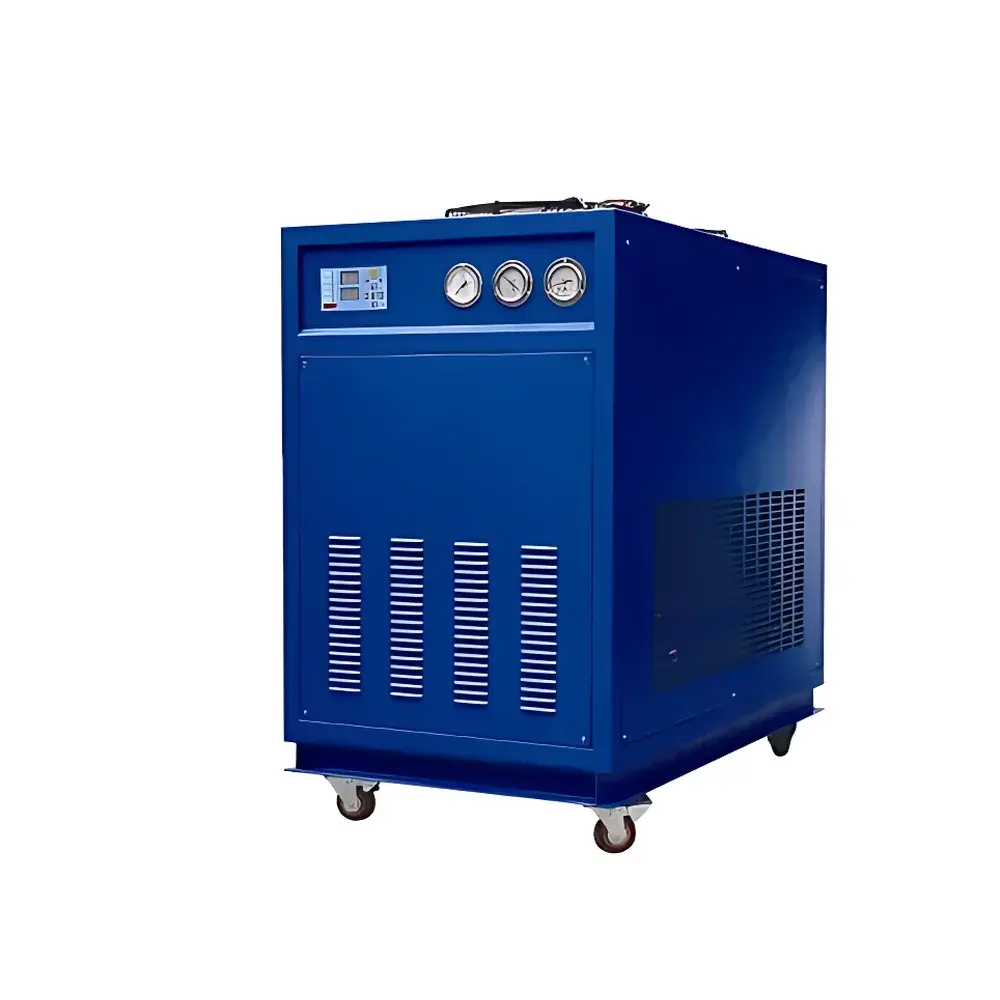
Tianfeng LS-3HP Circulating Chiller
| Brand | Tianfeng |
|---|---|
| Origin | Shanghai, China |
| Manufacturer Type | Direct Manufacturer |
| Equipment Type | Integrated Circulating Chiller |
| Cooling Method | Water-Cooled |
| Temperature Range | 0–10 °C |
| Cooling Capacity | 9.4 kW |
| Temperature Stability | ±0.1 °C |
| Circulation Pressure | 2.0 bar |
| Flow Rate | 2 L/min |
| Reservoir Volume | 60 L |
| Duty Cycle | Continuous Operation |
| Power Supply | 220 V, 50 Hz |
| Compressor Type | Scroll Compressor |
| Safety Protections | Compressor Overheat, Overcurrent, High/Low Pressure, and Overtemperature Protection |
| Enclosure Material | Stainless Steel Reservoir & Pump |
| Control System | Digital PID Controller (Optional RKC Controller Available) |
| Electrical Components | Siemens, Schneider, Omron |
| Expansion Valve & Solenoid Valve | Italian/German OEM |
| Noise Level | Low |
| Dimensions (L×W×H) | 550 × 880 × 1160 mm |
Overview
The Tianfeng LS-3HP Circulating Chiller is an integrated, water-cooled precision temperature control system engineered for continuous-duty laboratory and industrial applications requiring stable thermal management of heat-generating instrumentation. It operates on a closed-loop refrigeration cycle using a high-efficiency scroll compressor, R407C or R134a refrigerant (model-dependent), and a stainless-steel reservoir to deliver consistent chilled water at tightly regulated temperatures between 0 °C and 10 °C. The chiller employs proportional-integral-derivative (PID) temperature regulation with digital feedback, ensuring minimal thermal deviation (±0.1 °C) under dynamic load conditions. Its design conforms to ISO 9001:2000 quality management standards and integrates safety-critical protections—including high/low pressure cutoffs, compressor overheat monitoring, and overcurrent interruption—to support uninterrupted operation in mission-critical environments such as analytical laboratories and semiconductor fabrication support systems.
Key Features
- Integrated compact architecture with footprint of 550 × 880 mm and height of 1160 mm—optimized for placement beneath fume hoods, beside spectrometers, or within equipment racks.
- Stainless-steel water reservoir (60 L capacity) and corrosion-resistant circulation pump rated for 2.0 bar max pressure and 2 L/min nominal flow—compatible with deionized, glycol-blended, or inhibited coolant solutions.
- Digital PID temperature controller with real-time display of outlet water temperature; optional upgrade to RKC brand controller for enhanced repeatability and programmable setpoint ramping.
- Multi-layer safety architecture: dual-pressure switches, thermistor-based overtemperature detection, electronic current monitoring, and automatic shutdown with fault-code indication.
- Low-noise operation achieved via vibration-damped compressor mounting, acoustically insulated condenser enclosure, and optimized fan-speed control.
- Modular electrical interface compliant with IEC 61000-6-2 (immunity) and IEC 61000-6-4 (emission) standards; uses certified components from Siemens, Schneider Electric, and Omron.
Sample Compatibility & Compliance
The LS-3HP chiller is compatible with a broad range of heat-sensitive laboratory instruments, including graphite furnace atomic absorption spectrometers (GFAAS), inductively coupled plasma optical emission spectrometers (ICP-OES), inductively coupled plasma mass spectrometers (ICP-MS), X-ray fluorescence (XRF) analyzers, X-ray diffractometers (XRD), scanning electron microscopes (SEM), and transmission electron microscopes (TEM). Its stable cooling performance supports ASTM E1655 (standard practice for quantitative infrared analysis), ISO/IEC 17025:2017 (general requirements for competence of testing and calibration laboratories), and FDA 21 CFR Part 11–compliant data integrity protocols when integrated with validated software systems. All fluid-contact surfaces meet USP Class VI biocompatibility requirements for non-reactive wetted materials.
Software & Data Management
While the base LS-3HP operates via front-panel digital interface, it supports analog (0–10 V / 4–20 mA) and digital (RS485 Modbus RTU) output signals for integration into centralized building management systems (BMS) or laboratory information management systems (LIMS). Optional communication modules enable remote monitoring of real-time temperature, flow status, compressor runtime, and fault logs—facilitating GLP/GMP audit readiness. Event-triggered data logging (e.g., temperature excursion > ±0.2 °C for >30 s) can be configured to generate timestamped CSV reports compliant with 21 CFR Part 11 electronic record requirements when paired with validated third-party software.
Applications
- Materials Characterization: Maintains thermal stability of XRD goniometers and SEM cold stages during long-duration diffraction or imaging sessions.
- Elemental Analysis: Regulates graphite tube temperature in GFAAS and cools RF generators and torch interfaces in ICP-OES/ICP-MS systems to minimize spectral drift.
- Vacuum & Thin-Film Systems: Controls heat load on diffusion pumps, ion gauges, and sputtering targets in vacuum deposition chambers.
- Laser-Based Instrumentation: Provides stable coolant supply for solid-state and fiber lasers used in LIBS, Raman microscopy, and laser ablation ICP-MS.
- Pharmaceutical QC: Supports temperature-critical dissolution testing apparatus (USP ) and HPLC column ovens where ambient fluctuations compromise retention time reproducibility.
FAQ
What is the recommended inlet water temperature for optimal chiller efficiency?
For rated cooling capacity (9.4 kW), the chiller is calibrated to operate with incoming cooling water at ≤30 °C and a ΔT of 8–10 °C across the condenser. Return water temperature should not exceed 40 °C to prevent compressor overheating.
Can the LS-3HP be integrated into a facility’s central cooling loop?
Yes—the unit accepts external chilled water supply via its water-cooled condenser circuit and includes isolation valves and pressure relief for safe integration with building-level HVAC infrastructure.
Is the reservoir compatible with 20% ethylene glycol solutions for sub-zero applications?
The stainless-steel tank and pump are chemically resistant to glycol-water mixtures; however, the standard operating range remains 0–10 °C. Sub-zero operation requires optional low-temperature kit (evaporator heater, modified expansion valve, and antifreeze-rated refrigerant).
Does the chiller support validation documentation per IQ/OQ protocols?
Tianfeng provides factory-assembled FAT (Factory Acceptance Test) reports, material certifications (EN 10204 3.1), and electrical safety test records. Full IQ/OQ execution requires on-site commissioning by qualified personnel using calibrated NIST-traceable thermistors and flow meters.
What maintenance intervals are recommended for continuous laboratory use?
Compressor oil and refrigerant levels should be verified annually; condenser coils inspected quarterly; and reservoir cleaned biannually with citric acid solution to prevent biofilm accumulation. Filter replacement is advised every 6 months under typical lab conditions.



